

























































Montgomery County is moving forward with plans to turn North Bethesda Metro Station into a larger multimodal transportation hub, with a new northern entrance designed to eventually support a mixed-use life-sciences district stacked above the tracks. The Montgomery County Department of Transportation recently posted a notice of opportunity for the effort, formally called Project Connect: Accelerating Life Science at the North Bethesda Transit Oriented Development, giving construction, design and engineering firms an early look at the work ahead.
The notice, as reported by The MoCo Show, represents an early step in advancing the project and alerting firms to planned work. At its core is construction of a second Metro entrance at the station's northern end — a significant change for a station that currently has just one entrance, located at the southern end of the platform. According to Montgomery County Council meeting materials reviewed via Montgomery County Council documents, access is currently limited to that southern end, and the new entrance is intended to reduce walking times to the platform.
The county has requested a $275,000 supplemental appropriation for the Northern Entrance project, made up of $250,000 in state aid and a $25,000 local match drawn from Recordation Tax Premium funds, per the same council materials. That money would go toward a non-competitive grant to WMATA's chosen contractor, Hines Acquisition LLC, to fund initial community engagement and conceptual land planning. The project remains in preliminary design, with construction expected to begin in fiscal year 2028.
Cutting Walk Times and Easing Pressure on Rockville Pike
The new entrance is expected to shorten walking distances to destinations including Pike & Rose, nearby medical and dental offices, grocery stores and other businesses, per The MoCo Show's reporting. It's also expected to increase station capacity and improve evacuation times. The council materials add that a racial equity assessment found the project could cut walking distances by about three minutes for commuters arriving from the north, including seniors and people with disabilities.
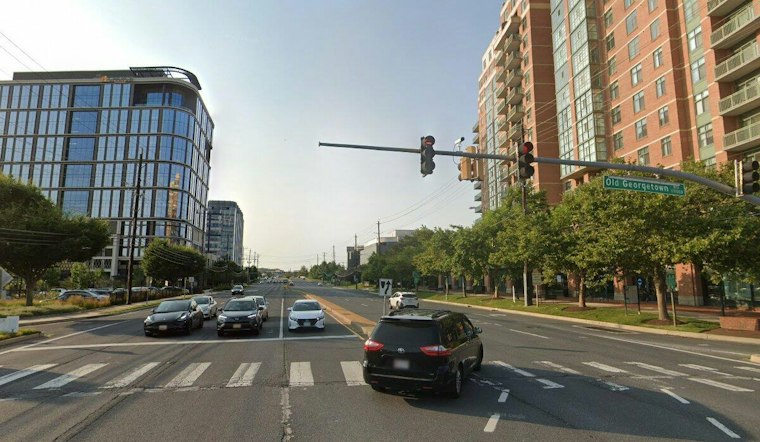
Rockville Pike itself has long been a barrier for pedestrians trying to reach the station, given its width and current design, according to The MoCo Show. The county envisions improvements to the intersection of Rockville Pike and Old Georgetown Road as part of the broader push, alongside wider sidewalks, buffered bike lanes and additional landscaping. Separate county project materials describe planned sidewalk widening and a street-tree buffer along Rockville Pike as part of related access improvements near the station, per Montgomery County's Department of Transportation.
Plans also call for two public plazas, pedestrian and bicyclist improvements, curbside pickup and drop-off areas, and infrastructure to prepare Rockville Pike for future Flash Bus Rapid Transit service. Council materials describe a new transit plaza meant to safely and directly connect the station to two future BRT lines. The new entrance itself would be built with slabs and columns engineered to support a potential mixed-use building above the station.
A Life-Sciences District Still Taking Shape
That potential building is where the numbers get complicated. The MoCo Show reports the mixed-use structure could measure 1.9 million square feet, envisioned as part of a life-sciences district anchored by the University of Maryland's Institute for Health Computing, which focuses on advanced computing and artificial intelligence. But other reporting on the broader site tells a different story about scale: Maryland Matters has described the plan as calling for as much as 3 million square feet of mixed-use space, while Bethesda Magazine put the figure at roughly 2 million to 3.7 million square feet across six buildings. The final scale of the development has not been settled in the available record.
Metro has already selected Hines as the developer for the nearly 14-acre station-area site, chosen from six development teams that responded to a Request for Qualifications, according to WMATA. The future development is envisioned to include the new north-side entrance, a signature building along Rockville Pike, the Institute for Health Computing, incubator space, and a mix of life-science, residential and retail uses. A memorandum of understanding between Metro and the county affirmed more than $36.6 million for on-site infrastructure and the new entrance, WMATA says, along with the university's commitment to establish the institute there.
Funding for the entrance and the institute is drawn from multiple levels of government. Maryland Matters reports the new entrance is expected to receive $25 million in federal aid approved under President Joe Biden, while the state is expected to contribute about $33 million to the project, including $24 million earmarked for the Institute for Health Computing. Metro General Manager and CEO Randy Clarke has cautioned that assembling the financing, permitting and design for a project of this size could take several years.
Betting on a Bigger Economic Payoff
County officials frame the project as more than a transit upgrade. According to The MoCo Show, MCDOT describes it as an effort to make North Bethesda a more pedestrian- and transit-oriented urban center, drawing comparisons to growth that has already reshaped areas around Metro stations in Bethesda and Silver Spring. Officials have said the larger project could bring economic development, housing and workforce opportunities to the area, and that it could catalyze redevelopment of more than 18 acres of vacant land surrounding the station.
Existing residential and commercial development within a half-mile of the proposed entrance already totals roughly 6 million square feet, per The MoCo Show's reporting, underscoring how much activity is already clustered around the site. Bethesda Magazine has reported that officials expect the development to strengthen Montgomery County's standing as a national center for life science and medical research while boosting economic development and transit ridership. Montgomery County Executive Marc Elrich has gone further, comparing the project's potential to Kendall Square in Cambridge, Massachusetts, a hub known for concentrated technology and research activity, according to Maryland Matters.
Council documents project the development could create 2,504 jobs and as many as 1,445 residential units, including at least 217 moderately priced dwelling units. For now, the immediate next step is modest by comparison: a $275,000 supplemental appropriation to get community engagement and conceptual land planning underway, with the bigger questions about final scale, cost and timeline still to be worked out as the project moves through preliminary design toward its expected FY28 construction start.




