

























































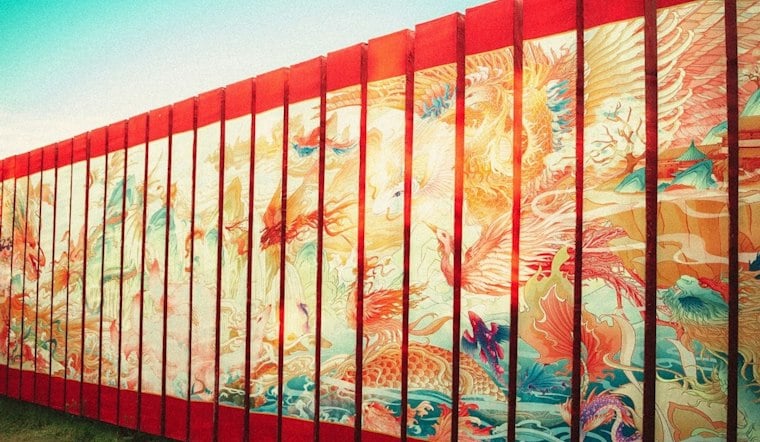
A new 200-foot mural now stretches along a flood control structure at Cave Creek Sweetwater Park in north Phoenix, but it is not just a splash of color for the neighborhood. As of KJZZ's October 31, 2026 report, city officials were scheduled to unveil the artwork, created by artist Nicole Poppell, painted with a material called EnKoat that has been shown to lower surface temperatures when applied to rooftops. It marks the first time the coating has been used on a mural, according to city officials.
The project began as a simple neighborhood request, according to KJZZ, which reported that the idea came up while Phoenix City Councilwoman Debra Stark was working with neighborhood leaders who wanted to bring a new mural to the park. Stark described the finished piece as a beautiful addition to the neighborhood, with a desert feel and splashy yellows and blues, and called it simply spectacular. But somewhere along the way, the mural also became a chance to ask a bigger question: could the same coatings used to cool building rooftops do something useful painted onto a wall in a park?
From Rooftop Fix to Public Art Experiment
That question is why the City of Phoenix plans to work with researchers to study whether the material will also reduce surface temperatures or air temperatures around the mural, the station's report notes. Stark said the city wanted to test whether the paint lowers temperatures, framing the mural as a legitimate piece of heat research dressed up as public art. The project offers the city a chance to explore another potential way to reduce heat.
“If there are ways that we can reduce heat in the summer, I think we really need to invest in that kind of research,” Stark said, per the same account. She added that while shade trees remain a go-to solution, Clearly, we plant trees, they provide shade, but there are other opportunities, pointing to coatings and materials as one of those other avenues worth exploring.
The Company Behind the Coating
EnKoat is a Phoenix-based company founded by two Arizona State University alumni, Matthew Aguayo and Aashay Arora, who started the business while they were doctoral students in ASU's School of Sustainable Engineering and the Built Environment, according to ASU News. The company has said its roof coatings cut energy use, extend roof life and protect against extreme weather, according to the company's own statements. EnKoat has also said its coating could serve as a moisture barrier that helps increase the lifespan of roofs, as the company told KJZZ's The Show in an earlier report.
The science behind the mural isn't coming from nowhere. EnKoat has been collaborating with ASU and the Salt River Project on a two-year study of its IntelliKoat coating, comparing temperatures and energy costs in sections of a 40,000-square-foot repository with and without the material, ASU News reported. That same two-year study is tracking the temperatures and energy costs associated with the coating, according to a separate ASU News account, part of a broader research push that comes as 2024 was recorded as the warmest year on record for Phoenix.
Reflective Paint Has a Track Record Elsewhere
Phoenix's mural isn't the first attempt to turn reflective coatings into a public cooling tool. In New Haven, Connecticut, a mural called Chromatic Drift was created with highly reflective paint specifically to reduce surface temperatures on a basketball court, according to the Hixon Center for Urban Ecology. That mural, unveiled on June 10, 2026, at Betsy Ross Arts and Design Academy, was shaped by more than 200 students, volunteers and community members, with roughly 40 students taking part in each of three design engagement sessions. The Hixon Center says cool murals like that one can reduce surface temperatures by as much as 10 degrees Fahrenheit and lower surrounding air temperatures by up to 3.5 degrees during extreme heat.
A separate Yale-affiliated project page describes cooling murals more broadly as artwork designed using reflective paints to decrease the surface temperature of whatever they cover, blending practical climate adaptation with community-driven artistic expression, according to Yale's cooling murals initiative. Phoenix has leaned on similar reflective-coating logic before, though not on murals. The city applied a reflective gray treatment to 36 miles of neighborhood roads and a parking lot and reported summer surface-temperature reductions of up to 12 degrees Fahrenheit, per ASU News.
Cooler Surfaces Don't Always Mean Cooler People
That track record comes with a caveat worth noting. Phoenix began a separate cool pavement program in 2020, applying a reflective coating to existing asphalt, and has since treated more than 107 miles of pavement at 27 locations across the city, according to Smart Cities Dive. An Arizona State University-led study of that program found that while the treated pavement had significantly lower surface temperatures than conventional asphalt, it also increased the thermal stress a person standing on the surface would experience at midday.
That finding underscores why the city's plan to study the mural matters beyond the artwork itself. Lower surface temperatures don't automatically translate into a cooler, more comfortable experience for the people actually standing nearby, which is part of what researchers hope to sort out as they look at whether EnKoat affects air temperatures around the Cave Creek Sweetwater Park mural, not just the wall it's painted on. For now, the mural stands finished and in place, with the research still ahead of it.





