

























































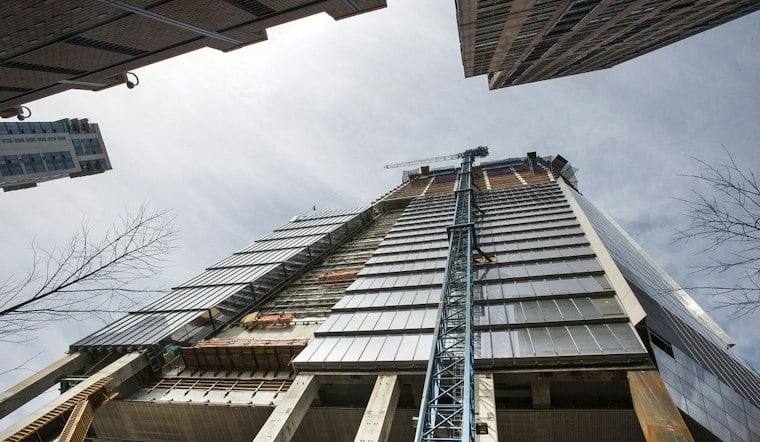
A 78-unit affordable housing project rising in Northeast Portland's King neighborhood is betting on heat pulled from 600 feet underground to keep residents from ever seeing a utility bill. The Nicole Sandoval Building, developed by Sabin Community Development Corporation, pairs a closed-loop geothermal system with rooftop solar to let the nonprofit absorb every tenant's energy costs rather than passing them along.
The system circulates water through underground pipes extending about 600 feet beneath the site, using the earth's relatively constant temperature to heat and cool the building, according to architect Sander Kohler, as reported by KOIN. The 79,442-square-foot development at 5015 NE 8th Ave replaces the former three-building, 22-apartment Avenue Plaza complex, a two-story property dismantled this year to make way for the new five-story structure, according to Scott Edwards Architecture. That swap nets the neighborhood 56 additional affordable homes.
The finished building will hold 35 two-bedroom, 39 one-bedroom, and four studio apartments, with 22 units reserved for households earning up to 50% of area median income under HUD assistance and the remaining 56 units set aside for households earning up to 60% AMI, per the same architecture firm's reporting. KOIN notes the development overall is slated to serve households earning 50% to 60% of area median income once it opens in 2028.
Why Utility Bills, Not Rent, Drive Evictions
Nathalie Hansen, with Sabin Community Development Corporation, told KOIN the Portland-based nonprofit plans to pay the building's utility bills outright, sparing residents from covering those costs themselves. She said that arrangement could help residents manage monthly expenses and reduce the risk of housing loss tied to unpaid bills, adding that residents will not have to choose between turning on heat and buying food.
That approach tracks with community engagement research conducted for the project, which found that utility bill debt — not unpaid rent — was the primary driver of tenant evictions and housing loss among lower-income households in Northeast Portland, according to Scott Edwards Architecture's findings from this past May. Developers designed the building's energy systems specifically so Sabin CDC could assume all tenant utility accounts rather than billing residents directly.
The geothermal setup also frees up something developers needed for that plan to work: roof space. Per KOIN's reporting, the system takes up less room than conventional heating and cooling equipment, which allowed for more solar panels. That additional solar capacity helps support putting utility accounts in the nonprofit's name in the first place.
A First-of-Its-Kind System for the Region
Developers say the geothermal system would be a first for the Portland area, and could serve as a model for future housing projects, KOIN reported. Kohler said the system is not commonly used locally but described it as a good testing ground. He pointed to the equipment's durability as part of the appeal — geothermal components could last 50 to 100 years, compared with an estimated 15 to 20 years for conventional systems, per KOIN.
The project pairs that ground-source heat pump with a 114 kW rooftop solar array, triple-paned windows, a domestic hot water heat pump, and a first-floor microgrid controller with battery storage, according to an Eventbrite listing detailing the building's sustainability specs. That ground-floor microgrid is built to keep community and operations space powered during emergency grid outages.
The geothermal installation also marks a municipal milestone: it's the Portland Clean Energy Community Benefits Fund's first-ever investment in a geothermal energy system, according to the City of Portland. PCEF is funded by a voter-approved municipal surcharge on large corporate retailers to invest in community climate resilience. KOIN reports the fund financed the geothermal portion of the project specifically, while Metro and the Portland Housing Bureau are helping fund the broader housing development.
Salvaging the Past Before Building What's Next
Before construction began this year, Sabin CDC partnered with the Portland Bureau of Planning and Sustainability's Commercial Deconstruction Pilot Program to dismantle Avenue Plaza's former buildings rather than demolish them outright, according to the city's planning bureau. Crews salvaged ceiling joists, doors, and appliances for local reuse, redistributing the materials to local nurseries, non-profit building centers, and existing Sabin properties.
The building takes its name from Nicole Sandoval, a local children's entertainer known as Nikki Brown Clown and a former Sabin CDC housing resident who went on to serve as the nonprofit's board chair during a key transitional period, advocating for community literacy initiatives, per Scott Edwards Architecture. Founded in 1992 in response to gentrification pressures in Northeast Portland, Sabin CDC owns and manages 117 affordable rental units along with 22 land trust and lease-purchase homes, according to Cause IQ, with a stated focus on preserving affordable housing for Black and Afro-Indigenous households facing displacement.
That mission reflects decades of demographic change in the surrounding area. Inner North and Northeast Portland shifted from roughly 60% Black with a $36,000 median income in 1990 to about 71% white with a $70,000 median income by 2019, according to data cited by Scott Edwards Architecture, as rising housing and living costs in the Alberta area pushed many long-term residents out. The $36 million project is funded through a mix of public grants and private financing from Heritage Bank, Beneficial State Bank, Enterprise Community Partners, Metro, Oregon Housing and Community Services, and PCEF, the architecture firm reports, with the Nicole Sandoval Building expected to open its doors in 2028.





