

























































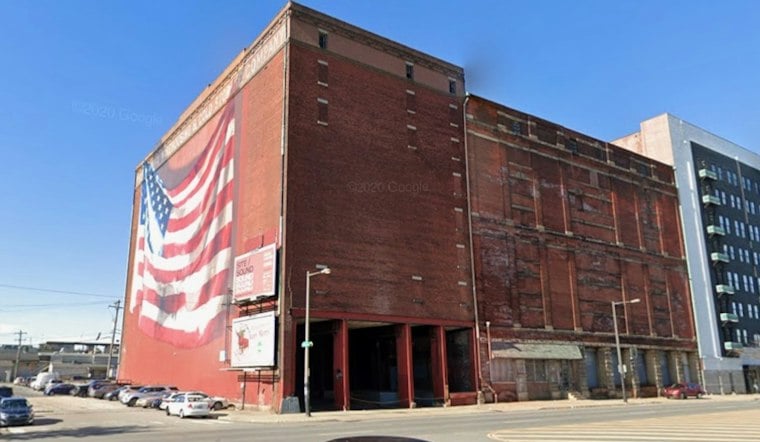
The hulking brick warehouse along Columbus Boulevard that millions of I-95 drivers know for its giant American flag mural is finally getting a second life. Developer Roman Ovrutsky paid $3.15 million for the historic building at 500 N. Christopher Columbus Boulevard and plans to turn it into 79 apartments, with 72 units inside the existing eight-story structure and seven more in a new ninth-floor addition.
The purchase and redevelopment plans were first reported by the Philadelphia Business Journal, with PHILADELPHIA.Today later covering the project. The building, formerly home to the Philadelphia Warehousing & Cold Storage Company, dates to the turn of the 20th century. Ovrutsky, founder of Omega Home Builders, said the industrial character of the space — its exposed beams and brick — is part of what makes it unique, and he expects the project could be completed by mid-2028, with views of the river, the bridge, and the city for future residents.
The Flag That Wouldn't Come Down
Central to the building's identity is the 6,000-square-foot “Our Flag Unfurled” mural, painted by artist Meg Saligman after the September 11 attacks. It has greeted I-95 drivers since 2001 and remains one of Mural Arts Philadelphia's most visible works, even though it was originally intended as a temporary post-9/11 display. The mural was painted in late 2001 using donated Sherwin-Williams paint, according to PhillyVoice, and it received a major restoration and rededication in 2016 ahead of the Democratic National Convention.
The building's path to redevelopment has not been simple. The Philadelphia Historical Commission designated the former cold storage complex to the Philadelphia Register of Historic Places in January 2021, a move that legally requires municipal approval for any exterior alterations or new construction, per City of Philadelphia records. Previous owner Aspen Equities had proposed a far larger 112-unit conversion in December 2023 that included a five-story rooftop addition requiring windows cut into the south wall and the mural dismantled or relocated to save the main building, as detailed by the Philadelphia Inquirer.
A Smaller Footprint, A Preserved Landmark
Ovrutsky's 79-unit plan with a single-story addition represents a notably scaled-down approach compared to that earlier proposal. The historical commission had approved a previous plan to relocate the mural to a neighboring building within the complex, though the current project keeps the flag in its familiar spot. Aspen Equities originally purchased the former cold-storage complex in 2019 and discovered the interior heavily encrusted with ice that concealed serious structural deficiencies in its steel girders, according to the same Inquirer account.
Built in 1901, the Philadelphia Warehousing & Cold Storage Company building was a cold-storage facility.
One Developer, Several Big Bets Across Philly
This is not Ovrutsky's only major play in the city's housing market. He also purchased a former Philadelphia Inquirer parking lot at 1527 Callowhill Street in late 2025 for $5.6 million, where he plans an eight-story, 188-unit residential complex, according to coverage from the Inquirer. And in January 2025, he acquired a stalled site at 2001 E. Lehigh Avenue for $2.5 million to advance a six-story, 146-unit mixed-use apartment project along the Kensington corridor, with underground parking and ground-floor commercial space.
The warehouse sits near I-95 and Columbus Boulevard in Northern Liberties, a stretch of the Delaware River waterfront that has seen rapid residential infill in recent years. Rivermark Northern Liberties was planned as a 470-unit project at the former Festival Pier site, along the Delaware River waterfront.
For a warehouse that spent years as a vacant, ice-damaged relic of the city's industrial past, the plan to preserve its most recognizable feature while finally putting its interior to use marks a notable turn for one of Northern Liberties' most visible landmarks.





