

























































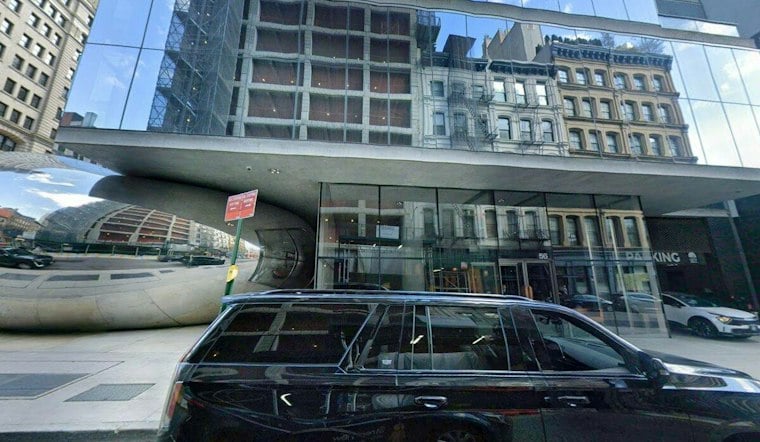
New York City households spend roughly 14 percent of their income on getting around, but for lower-income families that figure balloons to nearly a third of their total pre-tax earnings, according to NYC Department of Transportation Commissioner Mike Flynn. Flynn laid out those numbers during a talk at New York Law School's Lower Manhattan campus on Thursday, October 8, framing affordability as the defining challenge facing the city's streets, buses and curbs.
The 205th CityLaw Breakfast, hosted by the Center for New York City and State Law, featured Flynn speaking on a topic titled “The NYC DOT Future: Prioritizing Affordable Transportation.” New York Law School Dean Anthony W. Crowell and Professor Ross Sandler, the Samuel Seabury Professor of Law and founding director of the center, delivered opening remarks before Flynn took the podium. The breakfast was sponsored by Con Edison, Verizon, and Greenberg Traurig, LLP, per the event listing.
Flynn said the Mamdani administration views affordability as central to fixing public transit and transportation citywide, according to amNewYork. The discussion also touched on car dependence and transportation alternatives for lower-income New Yorkers.
Free Parking, Hard Choices
Much of Flynn's talk centered on New York City's roughly three million parking spaces, 97 percent of which remain free to use, he said. Despite that abundance of free parking, drivers in the city still spend an average of 107 hours a year hunting for a spot, the Times reports.
“The system as it currently works doesn’t work that great,” Flynn said, per amNewYork's account of his remarks. He argued that drivers should be able to find parking without circling for half an hour, that businesses should be able to receive deliveries without double-parking, and that Access-A-Ride users should be able to connect to service without added friction.
Mayor Zohran Mamdani is weighing an expansion of metered parking and the introduction of dynamic curb pricing, though the goal is framed as improving curb access rather than raising new city revenue, amNewYork reported. Flynn echoed that framing, saying better curb pricing should be considered wherever it would improve curb use for everyone. He also confirmed that the administration is reviewing paid street parking more broadly, according to SILive.com.
The stakes of that review are significant: the Center for an Urban Future has estimated that metering just one-fourth of the city's existing free parking spaces could generate at least $1.2 billion annually, per the same Times analysis. A separate 2024 Hunter College report went further, proposing paid street parking alongside a vehicle registration charge based on a car's value and a driving fee of 3 cents per mile, SILive notes.
Weighing Car Dependence Against Transit Costs
Flynn acknowledged that some lower-income residents depend on cars, and said expanding better transportation options for people without vehicles would advance the administration's broader equity goals, according to the SILive report. That tension sits alongside mounting evidence that mass transit itself has grown harder to afford. The Community Service Society found that 20 percent of all New Yorkers report struggling to afford mass transit, with 30 percent of low-income residents saying they often struggle to pay subway or bus fares, per the Community Service Society.
The organization's report ties that strain to a fare increase from $2.75 to $2.90 combined with the city's high cost of living. Fair Fares, which offers half-priced subway and bus fares to residents at or below 120 percent of the federal poverty level, has enrolled nearly 320,000 New Yorkers, but that represents only about a third of those eligible. A 2023 Unheard Third survey from the same organization found 56 percent of the eligible population was not engaged with the enrollment process at all. The State Assembly has called for $127 million in additional funding to expand eligibility to 200 percent of the poverty level, a move the Community Service Society estimates would actually cost $55 million.
Buses, Bike Lanes and a Bronx First
Flynn's appearance came amid a string of DOT infrastructure moves he has highlighted elsewhere. The agency has begun projects to expand its bus and bike lane networks, including new protected bike lanes along Ashland Place in Brooklyn, and recently restarted the Tremont Avenue Busway project in the Bronx. DOT has described that corridor as the borough's first busway, with Flynn telling PoliticsNY that more than 39,000 daily riders are expected to benefit.
DOT and the Mamdani administration have also launched Vision Zero Reimagined, a multi-agency roadmap aimed at further reducing deadly traffic crashes across the five boroughs. The plan calls for protected bike lanes, new traffic enforcement cameras and pedestrian refuge islands on wide roadways, alongside a commitment to deliver hardened daylighting or better treatments at a minimum of 1,000 intersections each year, according to a transcript posted by the NYC Mayor's Office. Flynn's broader portfolio spans safety, mobility, public transportation, infrastructure, micromobility, technology, freight, curb management and public space, he told PoliticsNY in a recent interview.
A full recording of Flynn's CityLaw Breakfast remarks is available through CityLand's event page, which hosted the livestream of the October 8 talk.





