

























































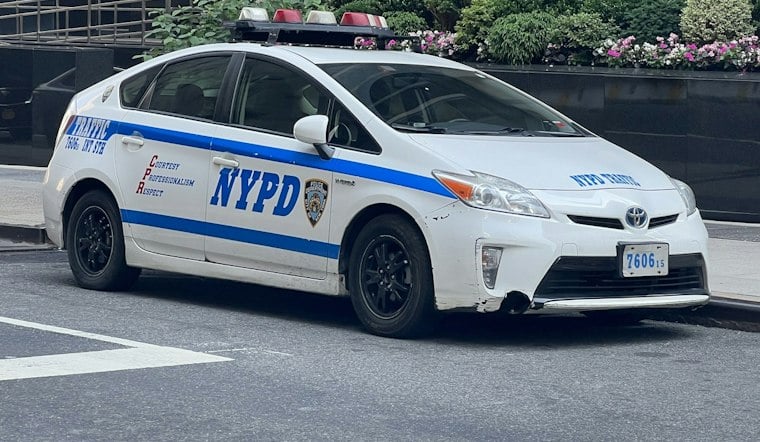
An NYPD lieutenant with a lengthy complaint history told a disciplinary judge he kicked a suspect because he feared the man was reaching for a weapon. But footage from multiple cameras showed the suspect attempting to surrender, according to testimony reported by the New York Daily News.
An NYPD lieutenant who was caught on video kicking a suspect in the head following a high-speed Manhattan car chase tried to justify his actions by saying he believed the man was reaching for a weapon. That explanation apparently didn't hold up particularly well against the video evidence.
Lt. Nikolaos Stefopoulos, a nearly two-decade veteran of the department with an extensive history of civilian complaints, was the subject of disciplinary proceedings over his February 2024 encounter with Brian Marchany, who was 25 at the time.
According to the New York Daily News, Stefopoulos testified that he believed Marchany posed a threat and that the kick was intended to gain compliance. But disciplinary judge Stone rejected his account, while NYPD Sgt. David Veloz testified that footage from multiple sources showed Marchany trying to surrender.
Those sources included video posted to X, police body-worn camera footage, and a stationary NYPD surveillance camera. Veloz also considered a punch Stefopoulos delivered to Marchany's chest to be excessive, the Daily News reported.
The case also involved a procedural appeal, adding another wrinkle to the department's handling of the incident.
A High-Speed Chase, a Crash, and a Kick to the Head
The incident unfolded on February 15, 2024, after Marchany, driving a Toyota Camry with his girlfriend in the passenger seat, encountered an unmarked police vehicle near East 59th Street.
Marchany fled, leading officers on a pursuit down Manhattan's East Side that reportedly reached speeds of more than 80 mph, before crashing into a parked vehicle near Church Street and Park Place in Lower Manhattan.
Stefopoulos was among the officers who approached the crashed car.
The lieutenant testified that Marchany reached toward his waistband as officers attempted to remove him from the vehicle, prompting Stefopoulos to punch him in the chest. He subsequently kicked Marchany as the suspect was on the ground, an action he characterized as an effort to gain compliance.
But the video evidence presented during the disciplinary proceedings told a different story, according to Veloz's testimony.
Marchany suffered a seizure and vomited while on the ground following the arrest. Police suggested he might have swallowed heroin, but Marchany's attorney disputed that account, saying there was no indication that he had ingested the drug.
Marchany later said he had little recollection of what happened and woke up in intensive care, according to earlier reporting on the incident.
He was arrested on charges including drug possession, resisting arrest, and reckless endangerment. His girlfriend was also charged with drug possession. Both cases were subsequently sealed, the Daily News reported.
The Lieutenant Has a History of Complaints
Stefopoulos was hardly a newcomer to the NYPD's disciplinary process.
A ProPublica database of NYPD civilian complaints, last updated in July 2020, identifies 11 complaints involving Stefopoulos, comprising 44 allegations, six of which were substantiated.
Those substantiated allegations included improper searches and frisks, threats of force, and an incident involving a 16-year-old boy in 2014 in which investigators substantiated allegations that Stefopoulos struck the teenager against an object, threatened force, and used discourteous language.
More recent records compiled by police accountability database 50-a.org show a substantially longer history, listing 31 civilian complaints and 109 allegations across his career, with 20 substantiated allegations. Those figures include allegations of varying seriousness and do not mean every complaint resulted in discipline.
The same database lists six lawsuits involving Stefopoulos that resulted in settlements totaling approximately $198,000, including a $125,000 settlement in a case brought by Michael Skolnick, who alleged that officers falsely arrested him in retaliation for filing a civilian complaint. Settlements do not, by themselves, establish that an officer committed misconduct.
Stefopoulos joined the NYPD in 2007 and has served in narcotics, patrol, and specialized enforcement units. He was assigned to the department's Citywide Community Response Team at the time of the February 2024 incident, according to earlier reporting.
The Department's Own Records Add Another Wrinkle
The Civilian Complaint Review Board also investigated the February 2024 encounter with Marchany.
Records reproduced by 50-a.org show that the board substantiated an allegation of physical force against Stefopoulos, while finding other allegations arising from the encounter within NYPD guidelines. The department's publicly reported disposition for the case was listed as administratively closed.
The NYPD's October 2025 disciplinary statistics similarly identify a substantiated physical-force allegation involving Stefopoulos that had been recommended for Command Discipline B, but was closed administratively.
The distinction matters because a substantiated civilian complaint, a disciplinary judge's finding, and the punishment ultimately imposed by the police commissioner are not necessarily the same thing.
Under the CCRB's disciplinary procedures, the police commissioner ultimately has authority over the penalties imposed following disciplinary trials, which can range from lost vacation days to termination.
For Marchany, the encounter left him hospitalized, while the criminal cases arising from the chase were eventually sealed. For Stefopoulos, the resulting disciplinary proceedings became another chapter in a career already marked by repeated complaints, substantiated misconduct allegations, and civil litigation.
And in this particular case, the officer's explanation of why he kicked a man on the ground ran up against something rather difficult to argue with: video from multiple cameras.





