

























































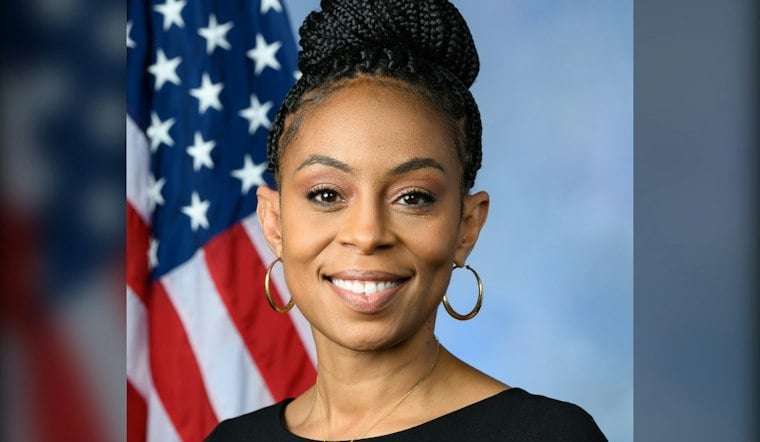
A federal science education program named after one of Cleveland's most towering political figures lost its Ohio alliance funding after DOGE and NSF canceled it on May 2, 2025, before the Justice Department declared the program unconstitutional, and Congresswoman Shontel Brown is now demanding the government explain itself. The Louis Stokes Alliances for Minority Participation program funded college and university partnerships meant to boost the number of Black, Hispanic and Native American students earning STEM degrees. In Ohio, that meant a $4.7 million alliance connecting public colleges and universities across the state, with $687,012.35 of it never paid out before the plug was pulled.
The Justice Department's Office of Legal Counsel, headed by T. Elliot Gaiser, issued the opinion on Aug. 12, 2026, finding the Louis Stokes Alliances for Minority Participation program unconstitutional along with two other National Science Foundation STEM education programs. As Science.org reported, the ruling found that the three long-running programs discriminated by race or sex and had to be ended, and it specifically ordered NSF to terminate the Stokes alliance. The opinion also barred NSF from spending the $104 million Congress had appropriated for the affected programs that year, concluding that lawmakers cannot compel the executive branch to engage in what the department deemed unconstitutional racial discrimination, even though Congress controls federal spending.
The program served students including Black and African American, Hispanic and Latino American, American Indian, Alaska Native, Native Hawaiian and Pacific Islander students, and the Justice Department argued that it was unconstitutional. Two other NSF STEM programs targeted in the same opinion could continue if reworked to drop race- or sex-based considerations, per Inside Higher Ed, which also reported that NSF itself had asked the Justice Department in May to evaluate the programs. Inside Higher Ed noted the three discontinued programs accounted for about $104 million of the $938 million Congress most recently allocated to NSF for STEM education overall.
Ohio's Alliance, Formalized in 2013, Connected Public Colleges Statewide
Ohio's chapter of the program was housed at Ohio State University and formalized in 2013, according to the research. One account from NBC4 described the Ohio LSAMP Alliance as connecting nine Ohio colleges and universities, while an NSF award record put the number at 10 public institutions, including four community colleges and six four-year schools; the discrepancy between the two counts was not resolved in available records. What is clear is what the money did: the station reported the funds supported participants' mentoring, access to tutoring, professional development opportunities, and assistance with research and internships.
The program began in 1990 as the Alliance for Minority Participation and was established by Congress in 1991. It was renamed in 1999 to honor former Congressman Louis Stokes, who had just retired after representing Cleveland's East Side for 30 years. Stokes was the first Black member of Congress elected from Ohio. He died in 2015 at age 90, about a month after being diagnosed with cancer. His name lives on across Cleveland at the Louis Stokes Cleveland VA Medical Center, the Louis Stokes Wing of the Cleveland Public Library's main branch, the Louis Stokes Health Sciences Center at Case Western Reserve University, and the Louis Stokes Station at Windermere in East Cleveland, the eastern terminus of the RTA Red Line.
Brown Presses Justice Department for Evidence Behind the Cuts
Brown has opposed ending the LSAMP program.
The cancellation follows an executive order President Donald Trump signed on Jan. 20, 2025, titled Ending Radical And Wasteful Government DEI Programs And Preferencing, directing agencies to terminate DEI offices, equity plans and related grants and contracts. NSF has reportedly terminated hundreds of grants as part of that broader crackdown, according to a cited report, and the agency also dismantled its Division of Equity for Excellence in STEM, which had funded many diversity-related efforts.
A Program With a Track Record, Now Sidelined
An evaluation from the Urban Institute found the program's reach grew dramatically over time: minority enrollment in STEM majors rose from 35,670 students in 1991 to more than 205,000 by 2003, and by 2005 the alliance network had expanded from six alliances to 34, involving more than 450 participating institutions. Among surveyed former participants, roughly 65 percent pursued graduate degrees compared with about 45 percent in national comparison samples, and about 45 percent completed a graduate degree versus roughly 20 percent nationally.
Not every reaction has come from Ohio. Rep. George Whitesides, a California Democrat and former NASA chief of staff, also criticized the Justice Department opinion in an emailed statement. Under the terms of the opinion, NSF can still use the unspent program money on other STEM education initiatives, according to Inside Higher Ed.





