

























































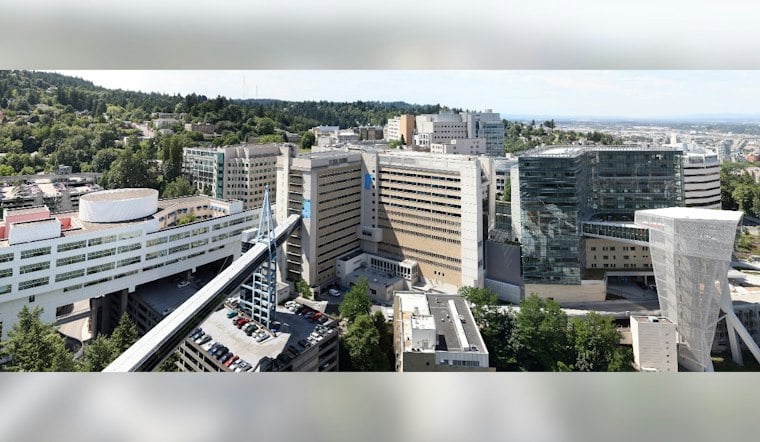
OHSU has received an $8 million grant from the National Institutes of Health to build a new Biosafety Level 3 laboratory on its Marquam Hill campus in Portland, part of an approximately $18 million project meant to replace an aging facility built for HIV research more than three decades ago.
The grant, awarded through the NIH's C06 Research Facilities Construction program, covers less than half the total cost, according to OHSU, which says it will provide the remaining $10 million in support. The new facility will replace OHSU's current BSL-3 laboratory, which the university says was built over 30 years ago specifically to study HIV and has since become limited in its capacity, with only two workspaces available to researchers.
FM News 101 KXL reports that construction on the replacement lab will begin soon and is expected to take about three years to complete, with the existing laboratory remaining operational until the new one opens. The project will be built on the seventh floor of OHSU's Richard Jones Hall, the university says, and will include four dedicated research suites along with two animal research suites; the current facility has two workspaces.
Why OHSU Says The Upgrade Can't Wait
Fikadu Tafesse, professor and chair of microbiology and immunology in the OHSU School of Medicine, led the successful grant application effort, per KXL. Tafesse framed the project in stark terms, saying the next pandemic is not a question of “if,” but “when,” and that a new BSL-3 lab is necessary to prepare the hospital and the state for that eventuality.
The university says the completed lab will enable leading-edge research on emerging infectious diseases and serve as an institutional resource for investigators across OHSU, as well as a regional asset for research partners who lack their own BSL-3 facilities. KXL similarly reports the lab will serve researchers across the Northwest as well as OHSU itself, broadening its reach well beyond Marquam Hill.
Part Of A Broader Push For Pandemic-Ready Labs
OHSU's expansion mirrors a wider federal effort to bolster biocontainment capacity nationwide. According to the National Institute of Allergy and Infectious Diseases, National and Regional Biocontainment Laboratories exist specifically to support research on emerging infectious disease agents and to be available to assist public health efforts during an infectious disease emergency. Comparable investments have surfaced elsewhere in recent years, including at Scripps Research, which was awarded an NIH grant to enhance and expand a BSL-3 facility addressing viruses of pandemic concern, according to a Scripps Research announcement.
For now, OHSU's BSL-3 capacity remains a small, aging facility on Marquam Hill — one that has outlasted its original mission studying HIV to become a bottleneck for the kind of research institutions now consider essential. With construction set to begin soon and run roughly three years, OHSU is betting that the next outbreak, whenever it arrives, won't find Oregon's research capacity caught flat-footed again.





