

























































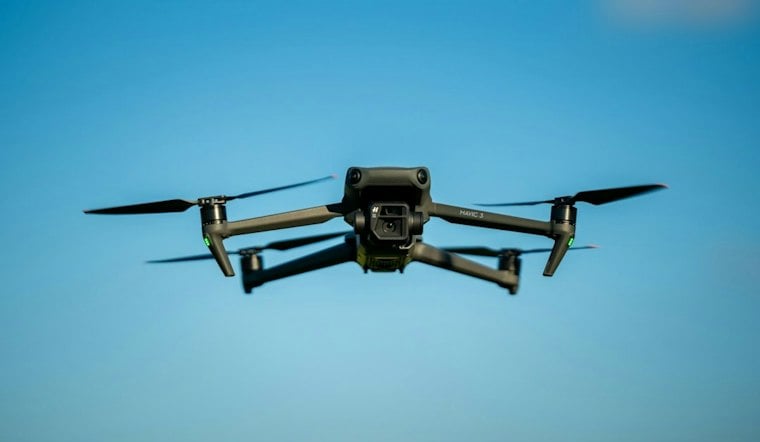
A woman who went missing in her vehicle while experiencing an unspecified medical condition was found by Palm Springs police in approximately 30 minutes, thanks to a network of license-plate readers, surveillance cameras and a drone called Halo 2. Officers located her, responded to her request for medical assistance, and reunited her with her family, according to police.
The Palm Springs Police Department said its Real Time Intelligent Center, described as a public safety and surveillance hub, used automated license-plate readers and a network of CCTV cameras to identify the woman’s vehicle, track its movements, and determine its last known location, according to MyNewsLA.com. Police then deployed the drone, Halo 2, which helped locate the vehicle and guided responding officers to the area.
Arriving officers made contact with the woman, who requested medical assistance, per the same account. Officers then helped her reunite with her family. Police did not disclose her identity.
How the Response Came Together So Quickly
Police said the coordinated efforts of patrol officers, crime analysts and the Real Time Intelligent Center produced what they called a successful outcome in roughly 30 minutes. According to police, the approach avoided the need for an extensive search and helped maximize available police resources — the kind of outcome the department has increasingly pointed to as it builds out its surveillance capabilities.
That buildout has been underway for years. Palm Springs police have had Flock and intersection cameras in place for several years and have recently added more technology, including three rooftop drones, the department told KESQ. Those drones can fly autonomously or by remote control, giving officers eyes on a scene before they arrive, and when a dispatch call comes in, pilots can watch in real time and help decide what kind of units need to respond, the station reported.
A Growing Arsenal of Drones and License Plate Cameras
The expansion traces back to a roughly $677,712 purchase approved by the Palm Springs City Council, which was projected to grow the department’s drone fleet from one aircraft to 14 and its license-plate camera count from 15 to 40, according to the Desert Sun. The purchases were funded by a $4.5 million state retail-theft-prevention grant the city received the previous fall, the paper reported, continuing a rollout of new technology the department has introduced over several years.
By last May, the department had launched what it described as the largest radar-enabled Drone as First Responder program in the country, covering 37 square miles without relying on human spotters, KESQ reported. Officials said at the time they expected the system to cut average emergency response times from three to five minutes down to under a minute. The radar network supporting that program includes ten nodes feeding three drone launch sites, with a single pilot able to operate aircraft from any of the three locations, according to Inside Unmanned Systems. DroneLife reported that two additional launch sites are planned, and that the department is seeking an FAA waiver for Beyond Visual Line of Sight operations that would let drones fly at night and in adverse weather. The department has said the Drone as First Responder effort is intended to help locate missing persons and provide aerial intelligence during emergencies.
Cameras Are Multiplying Across the Coachella Valley
As of August, the Palm Springs Police Department had 55 automated license-plate reader cameras and 169 additional CCTV cameras, the latter storing live footage for 30 days without capturing license-plate information, according to a report from USA Today. More than 700 license-plate reader cameras are now operating across the broader Coachella Valley, per that reporting. The same report noted that civil rights advocates and some residents have raised concerns that the expanding camera network could enable mass surveillance and potential data misuse.
Police have not released further details about the woman’s condition or the specific area where she was found. For now, the department is pointing to Wednesday’s outcome as evidence that its technology investments are paying off in the kinds of emergencies that used to require an extensive manual search.


