

























































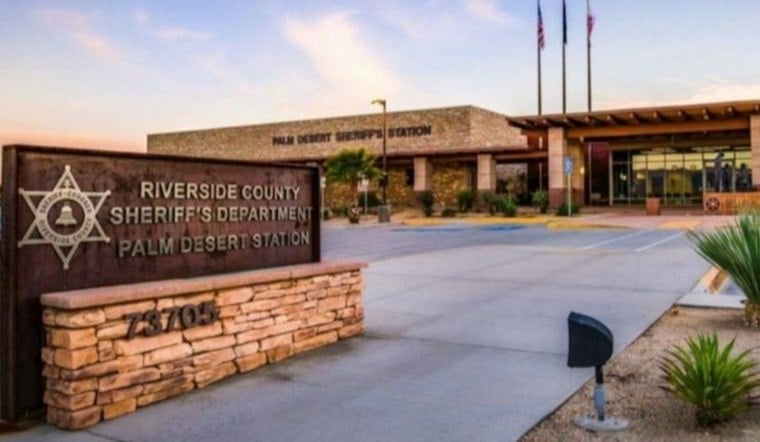
Palm Desert’s City Council is weighing a pair of regional public safety proposals that together carry a price tag of nearly $5.7 million, including a five-year drone contract with Axon Enterprise capped at $4.5 million and a shared real-time information center estimated at $1.2 million. If approved, the plans would let Riverside County Sheriff’s deputies launch drones from docking stations to view emergencies from above and would give them access to a new coordination hub inside the Palm Desert Sheriff’s Station.
The council was scheduled to consider authorizing the two initiatives, according to mynewsla.com, which reports that Palm Desert ran a bidding process for the drone program before ultimately selecting Axon. City staff recommended the five-year Axon agreement at an amount not to exceed $4.5 million, the outlet notes. As NBC Palm Springs reported, the drone initiative would establish a network of strategically located docking stations, giving deputies aerial views that could provide information before officers arrive on scene.
A Dispatch Hub Shared Three Ways
The second proposal, a real-time information center, would be built inside the Palm Desert Sheriff’s Station’s dispatch center to support the drone program and give deputies better situational awareness and incident coordination, per the same mynewsla.com account. The project was estimated to cost $1.2 million, with Palm Desert, Rancho Mirage and Indian Wells splitting the cost equally rather than Palm Desert shouldering the expense alone. The cost-sharing formula for the drone program itself was still being developed, the report notes.
Both initiatives are designed to give Riverside County Sheriff’s deputies additional tools and information when responding to calls across all three cities, and would be implemented in coordination with the department. The idea traces back to 2025, when the Cove Communities Services Commission began exploring ways to enhance law enforcement response capabilities across the three communities, according to the same mynewsla.com report.
Transparency Portal Planned for Drone Flights
Palm Desert also intends to create a public transparency portal that would share information on drone activity, including flight dates, flight locations and the nature of service calls, the report states. That kind of disclosure has become a flashpoint elsewhere in the state: an Associated Press article reports that Californians are pushing back against police drone expansion as departments adopt the technology rapidly.
Palm Desert would not be the first Coachella Valley effort to pool resources this way. Further west in the valley, the Coachella Valley Real-time Intelligence Center already pools technology from Palm Springs, Cathedral City, Desert Hot Springs, Indio and the Agua Caliente Band of Cahuilla Indians to coordinate regional emergency responses, according to dronelife.com.
What the Research Says So Far
Drone-as-first-responder programs typically position aircraft at fixed launch sites and deploy them remotely to live 911 calls, transmitting video to both responders and dispatch personnel, according to a research preprint posted on crimrxiv.com. That preprint, published October 9 and not yet peer-reviewed, reports that assigning calls to drone response in a Philadelphia trial cut receipt-to-closure service time by 14.5 minutes, or 16.6%, while operating drone sites in a Montgomery County trial reduced median first-arrival time by 1.33 minutes, or 10%, across eligible calls.
A separate study of a California municipal police agency found its drone program frequently arrived before any ground-level units and sometimes cleared calls without the need for ground-unit attendance at all, according to research published in link.springer.com. Not every jurisdiction eyeing the technology has settled the underlying questions, though. In Oakland, where officials have proposed six drones stationed at three rooftop locations for roughly $2.6 million over five years, a report from oaklandside.org cautioned that available evidence has not established how many incidents were resolved with drone help or whether their use reduced response times or uses of force.
Ventura County offers another regional comparison: its Sheriff’s Office launched a Drone as a First Responder program in partnership with the cities of Thousand Oaks and Camarillo, according to edhat.com. Whether Palm Desert’s proposed technology would deliver similar results locally remains to be seen, as the council has yet to take final action on either the drone contract or the shared information center.




