

























































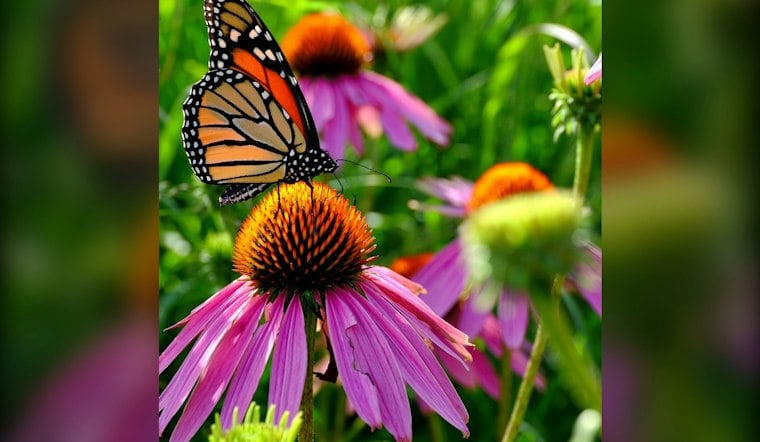
Every fall, as monarch butterflies begin their nearly 3,000-mile journey toward Mexico, a stretch of Pilsen becomes one of their rest stops. Claudia Galeno-Sánchez has spent years turning her family home into a monarch butterfly sanctuary and educational space, planting native milkweed and wildflowers in both her front and back yards so the migrating insects have somewhere safe to land and feed before continuing south. Monarchs also breed and lay eggs in Chicago during summer.
Galeno-Sánchez, 49, lives in the neighborhood with her husband and two children, and as reported by The Guardian, she migrated to the United States as a child herself. She has drawn a direct line between her own story and the butterflies she tends, saying that monarchs and migrants both migrate, but monarchs do not need passports. The Guardian also reports that she was unable to be with her father during his final moments because of her immigration status — a loss she has carried into the work of building sanctuaries for creatures that cross borders freely.
From One Front Yard to Eight Garden Projects
What began as habitat restoration at her own house has grown into eight native-plant projects scattered between her home and nearby schools, according to the same Guardian report. Neighbors, her children, and artist Héctor Duarte helped paint murals on her property as part of the effort, and she has since planted native plants throughout the surrounding neighborhood. She buys plants through donations and gives milkweed plants to a community garden located in an industrial area, extending the habitat well beyond her own block.
Galeno-Sánchez helped found Women for Green Spaces, which became a nonprofit organization in August 2024 after starting in 2021 as a project of the Women's Committee of Working Family Solidarity, according to the organization's own account on womenforgreenspaces.org. She serves as its executive director. The group built a small butterfly sanctuary in front of a Pilsen residence and later expanded with a larger sanctuary behind it, planting host plants for black swallowtail and monarch butterflies in a pesticide-free setting, per the same source. The organization hopes to partner with schools throughout Chicago and plans to teach children the importance of caring for the environment, and Galeno-Sánchez gives stipends to community members who help water and maintain the gardens, The Guardian reports.
Why Milkweed Matters So Much
Monarchs will only lay their eggs on milkweed, according to WTTW News, which makes patches like the ones in Pilsen critical links in the species' survival. A Field Museum community science project found that urban milkweed patches can pick up some of the slack left by disappearing rural habitat, the station reports. Established patches matter too: milkweed stands at least five years old contained eggs 95% of the time, compared with just 61% for first-season patches, and patches with common milkweed specifically saw eggs 86% of the time versus 60% for patches without it.
The scale of what backyard gardeners can contribute became clear in 2019, when Chicago-area participants in the Field Museum's monarch program monitored 130 milkweed patches over a single summer and documented 5,109 monarch eggs, according to the Field Museum. Many monarchs begin their southward journey right in Chicago, the museum notes, relying on native nectar plants like blazing star for the energy to make the trip. Not all milkweed helps, though — tropical milkweed can trick monarchs into lingering after other varieties go dormant, interfering with the timing of their migration south, per WTTW.
A Population Still Far From Recovery
Galeno-Sánchez has said monarchs need exposure to natural conditions — sunlight, temperature shifts, even predators — rather than being reared indoors, after learning that raising caterpillars inside and releasing them later can actually hinder their survival in the wild, The Guardian reports. She has framed the work as protecting not just monarchs but other pollinators, and ultimately humankind, telling the paper she wants to act for her children and future generations.
The urgency behind that message is backed by steep, long-documented losses. The monarch population has dropped by more than 80% since the 1990s in Central Mexico and by more than 95% since the 1980s in coastal California, according to IL Latino News, which also points to the loss of natural grasslands across Illinois as a factor making it harder for milkweed to take root. Habitat loss across agricultural, urban, and transportation landscapes, along with extreme weather, pesticide exposure, and disease, continue to pressure the species, per the Monarch Joint Venture.
There is a glimmer of good news in the latest count. The eastern monarch population overwintering in Mexico occupied 2.93 hectares during the 2025–2026 season, an increase of about 64% over the previous year's 1.79 hectares, the Monarch Joint Venture reports. But that figure still falls well short of what scientists say is needed — research cited by the group suggests at least six hectares of occupied overwintering habitat are required to support a stable eastern migratory population.
Federal Protection Remains Unsettled
Efforts to protect monarchs under the Endangered Species Act have moved slowly. The U.S. Fish and Wildlife Service proposed listing the monarch butterfly as a threatened species with protective regulations under section 4(d) of the Act, according to the agency's own rulemaking notice. The monarch had not yet been listed under the Act, the Monarch Joint Venture reports. More recently, the Monarch Joint Venture reports that the Fish and Wildlife Service moved the rulemaking to a long-term action designation in September 2025, leaving the species' federal status still unresolved.
Until that process plays out, the work falls largely to gardeners like Galeno-Sánchez and to people nationwide who plant native milkweed and cut back on pesticide use on their own lawns, small actions the Monarch Joint Venture and others say can help monarchs feed and flourish. For now, the migration continues to unfold through late October, with monarchs moving between the northern United States, Canada, and Mexico — and a Pilsen backyard remains one small, deliberate stop along the way.





