

























































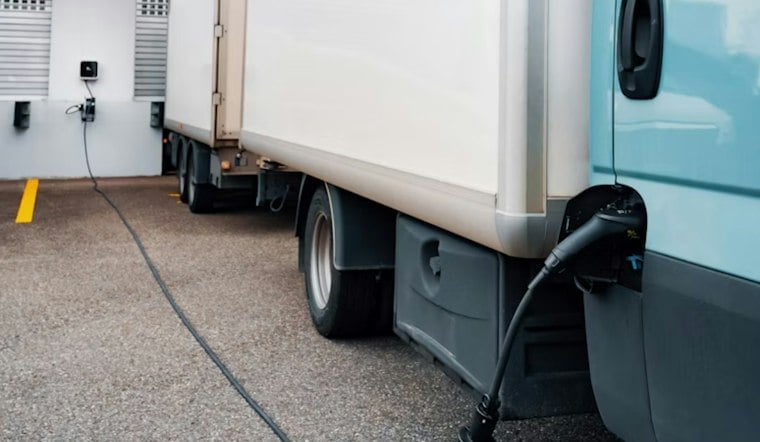
Six electric truck charging stations are coming to a sprawling new truck parking facility going up where I-4 meets County Line Road near Plant City, part of a $24.7 million federally backed upgrade to the 49-acre site. The Hillsborough Transportation Planning Organization approved a plan enabling the chargers after voting to update its Transportation Improvement Program, setting the stage for one of the region's first dedicated electric semi-truck charging hubs along a major freight corridor.
The Florida Department of Transportation is building the underlying $29.4 million truck parking facility at the southwest corner of the I-4 and County Line Road interchange, according to wftv.com. The 49-acre site will provide 160 designated truck parking spaces and is expected to be completed in late 2026, the outlet reports. The charging add-on, detailed in materials reviewed by Plan Hillsborough, would install six electric truck charging stations at the site and is supported by $24.7 million in federal National Electric Vehicle Infrastructure program funds.
Funding and Fine Print on Timing
FDOT will work with Tampa Electric Co. to supply the high-voltage electricity needed for fast charging, according to FOX 13 Tampa Bay, which reports that design work is set to begin in 2027 and that construction is scheduled to start in 2028. Plan Hillsborough's own project materials describe a different construction timeline, saying the charging project is expected to begin construction in 2027 — a discrepancy that has not been resolved between the two sources. Either way, the chargers are intended to deliver fast charges that help long-haul truck drivers stay on schedule, per the FOX 13 report.
Officials have not confirmed the fast-charging technology vendor selected for the site, nor have they confirmed the exact cost per charge truck drivers can expect to pay, FOX 13 reports. The broader truck parking facility itself is expected to be integrated into Florida's Truck Parking Availability System, which provides real-time parking information through a mobile application and dynamic roadside signs, according to the same Plan Hillsborough materials. The TPO Board was scheduled to consider the formal amendment to its Fiscal Year 2026–2030 Transportation Improvement Program on Wednesday.
A Freight Corridor With Statewide Ambitions
Tampa City Councilmember Alan Clendenin, who sits on the Hillsborough Transportation Planning Organization board, said the corridor connects Port Tampa with destinations across the state and nation and needs charging nodes to let trucks travel longer distances, according to FOX 13. Clendenin's comments, gathered by FOX13's Briona Arradondo through interviews and agenda materials from the transportation planning organization, frame the project as part of a push to extend electric truck infrastructure beyond interstates. Local leaders expect electric vehicle infrastructure to eventually expand from interstates to major regional highways as the technology develops, with similar charging setups anticipated along U.S. 301 and other key freight routes in Hillsborough County, per the same report.
The Plant City project is one piece of a much larger truck parking push along I-4, where a separate $180 million federal grant is helping add more than 900 spaces across the Central Florida corridor, according to wftv.com. Statewide, FDOT is estimated to receive $198 million over the next five years to build out electric vehicle charging along designated Alternative Fuel Corridors, according to the Florida Department of Transportation, which has also developed an Electric Vehicle Master Plan to guide charging infrastructure across the state highway system.
How Florida Compares to Other States
Florida's push mirrors efforts already underway elsewhere. California, Oregon and Washington secured $102 million to install charging and hydrogen-fueling stations for trucks along Interstate 5 and other key freight corridors, according to Caltrans. A separate $26 million Greenlane Infrastructure project is meant to support multiple generations of medium- and heavy-duty electric vehicle charging along the I-15 freight corridor, per the U.S. Department of Energy.
The push toward electrified freight comes as demand for electric trucks grows nationally. Fleet orders for electric trucks are picking up speed as battery ranges improve and battery prices fall, particularly for regional and local routes, according to the National Renewable Energy Laboratory. For now, the six planned chargers near Plant City remain a modest but notable test case for how that demand could reshape one of Central Florida's busiest freight arteries.





