

























































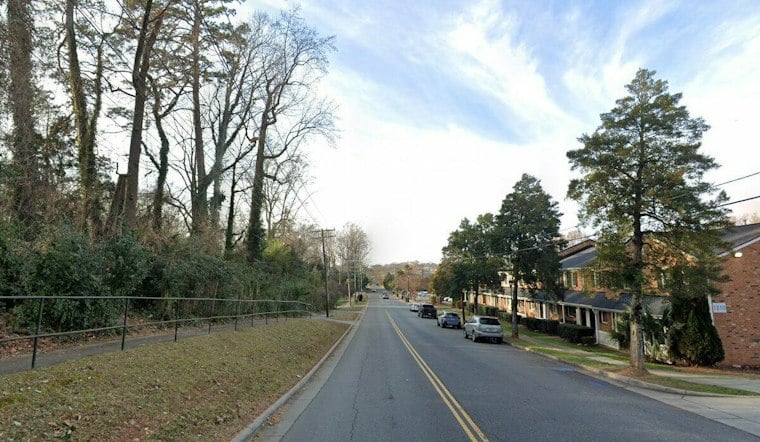
A hillside behind several Plaza Midwood businesses looked like a battlefield this week after crews cleared trees that once muffled the roar of Independence Boulevard traffic. The work, done under a state permit to improve visibility for an Adams Outdoor Advertising billboard, removed a tree buffer between Commonwealth Avenue businesses and the busy highway.
Shannon Binns said she noticed trees being removed behind Undercurrent Coffee on Monday, and by Tuesday afternoon more had come down, according to Axios. More than half of the visible vegetation on the hillside had already been cleared by Monday, the outlet reported, and business owners said they were never notified before the work began.
Clifton Castelloe said owners were blindsided by the clearing and that Independence Boulevard had been easy to overlook from the business district, Axios reported. Todd Huber said he wanted no more trees cut down.
A Permit Tied to Billboard Visibility
The N.C. Department of Transportation permit, dated Aug. 27, allowed Adams Outdoor Advertising to clear selective vegetation around its billboard off Independence Boulevard, Axios reported. The billboard advertises Charlotte FC, which has several billboards around the city. A Tepper Sports & Entertainment spokesperson said the organization had no knowledge of the tree removal.
The permit covers a 500-foot view zone on roads where the posted speed limit exceeds 35 miles per hour, but it does not specify how much tree canopy may be removed, Axios reported. Adams Outdoor sent the permit to the outlet but did not otherwise address questions about the removal.
State Rules Govern What Can Be Cut
North Carolina regulations require sign owners to secure a selective vegetation removal permit before any work begins, and the rules limit cutting to selected vegetation within approved limits, according to the North Carolina Office of Administrative Hearings. Permittees must also give the department 48 hours notice before entering the right-of-way to do the work, the same rules state.
Applicants seeking to remove existing trees must disclose the number, caliper inches and monetary value of the trees in question, according to the North Carolina Administrative Code. When existing trees are removed, compensation can take the form of monetary reimbursement, removal of two nonconforming outdoor advertising signs, or a beautification and replanting plan, the code states.
Owners Hope for a Buffer, But Don't Expect One
Local business owners and Sustain Charlotte have said they hope a wall or fresh vegetation will eventually replace the removed trees as a sound buffer, but they also said that kind of replacement does not seem likely. In a separate case along Irwin Creek off I-77, the Charlotte Observer reported on March 4, 2025, that NCDOT said Adams had a permit allowed by state law for vegetation clearing. The Observer has also reported that clear-cutting around Charlotte billboards has in practice meant stripping all vegetation, trees or otherwise, and leaving mulch behind, with fines reserved for contractors who cut beyond the approved area.
Trees along roadways serve more than cosmetic purposes, providing noise barriers for nearby buildings, reducing air pollution, sheltering wildlife and helping water soak into aquifers, the Observer has reported. For Plaza Midwood business owners, the loss is more immediate: a disappearing screen between their storefronts and the steady grind of highway traffic.
The episode echoes past friction between the city and Adams Outdoor Advertising. Charlotte once struck a deal in which the company promised not to cut down certain trees along Independence Boulevard and Albemarle Road in front of its billboards, according to WBTV, as part of an arrangement that also included $15,000 in free annual advertising for 20 years for public service announcements. That same report noted that a state law gave billboard companies more leeway to clear trees and vegetation from state-owned rights-of-way in front of their signs.
State lawmakers have weighed expanding that leeway further. A proposed bill would have widened the view zone for billboards to 500 feet on roads with speed limits above 35 mph and stripped protection for native redbud trees while keeping dogwoods protected, according to the Raleigh News & Observer, which quoted the North Carolina Outdoor Advertising Association saying some billboards are completely blocked by vegetation as drivers approach. Then-Gov. Roy Cooper vetoed a similar clear-cutting bill in 2019, saying the state's beauty and environment should take priority, according to StarNews Online.
What the available record establishes
The rules cited here are North Carolina regulations governing selective vegetation removal under state permits. The reporting and permit details available for this story do not identify a Charlotte tree-preservation rule or establish whether one applies within the NCDOT right-of-way or a billboard’s view zone. For broader corridor context, WBTV reported in July 2024 that more than 70,000 drivers use Independence Boulevard every day between Matthews and Uptown. That figure is not specific to Commonwealth Avenue; the reporting cited here does not provide a local traffic or noise study or document a noise-mitigation plan for the area.
For now, the hillside behind Commonwealth Avenue remains a visible reminder of how little advance warning businesses got. Whether a replacement buffer ever rises in place of the trees remains an open question for the shop owners who built their days around a line of vegetation they didn't realize they could lose so fast.





