

























































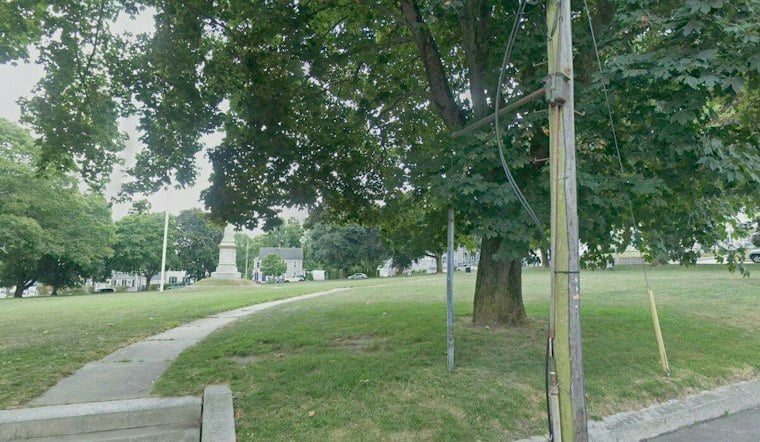
Crumbling walkways, worn stairs, and a lawn that often browns at the height of summer are finally getting attention on Plymouth's Training Green, where town crews have launched a roughly $600,000 restoration aimed at bringing one of the country's oldest working parks back into shape before winter. The project includes repaired stairs, new railings, ADA-compliant paths, an underground sprinkler system, and lighting for the flagpole and the park's Civil War monument — but notably, it won't include pedestrian path lighting that some town officials had pushed for.
A Long-Delayed Fix for a Colonial-Era Common
The park, which dates to 1711 and covers 1.4 acres bordered by Pleasant, Sandwich, North Green, and South Green streets, has been a fixture of Plymouth life for more than three centuries. According to the Plymouth Independent, the current work involves replacing and regrading cracked and uneven walkways, repairing and resetting stairs, installing new railings, and protecting the park's tree root systems from excavation stress. Nick Faiella, the town's parks and forestry superintendent, said the project is about safety and accessibility while respecting the park's history, and he described Training Green as one of the oldest parks still in use in the country.
Town Manager Derek Brindisi called the restoration both a physical and symbolic upgrade for a park he said has been neglected for a long time. The same reporting notes Brindisi has said residents regularly request better lighting in public spaces, and that dark parks and parking lots remain a frequent complaint he hears from the community.
Voters Cut Irrigation and Path Lighting From the Budget
Not everything originally proposed made the final cut. At Plymouth's Fall Town Meeting in October 2025, voters approved the broader restoration plan but stripped out $220,000 earmarked for underground irrigation and pedestrian path lighting, following an amendment from Town Meeting member Kenneth Stone, according to the Plymouth Independent. The current rehabilitation nevertheless includes an underground irrigation system. Brindisi had advocated for the lighting on public safety grounds, while opponents countered that summer lawn browning was simply normal and that sprinklers weren't necessary.
The project's funding still relies heavily on dedicated preservation dollars. The Community Preservation Committee had recommended appropriating $644,000 in Community Preservation Act funds for the rehabilitation, money raised through local property tax surcharges and matched by the state for open space and historic preservation projects, complementing $100,000 previously committed by Plymouth's Visitors Service Board, the outlet reported. At the Annual Town Meeting in April, members again weighed individual capital line items under Article 18, including Department of Public Works funding tied to Training Green irrigation, according to the South Shore Times.
Historic Commission Concerns Over Interior Lighting
Proponents of interior lighting cited ADA access and safety, while the Historic Commission raised concerns.
Fast Eddie's Barbershop supplied archival photos showing gas lanterns once lining the park's perimeter, a detail the Plymouth Independent's reporting included as a reminder that lighting isn't entirely foreign to the green's history — just not the modern, interior kind currently proposed.
A Civil War Monument Returns to the Spotlight
One piece of the project that is moving forward: illumination for the park's Civil War monument and flagpole. The monument's design has been attributed to Peter Blessington with construction dated to 1867, and it is inscribed with the names of 72 Plymouth men who died in the Civil War, per the Plymouth Independent's reporting. Its 1869 dedication reportedly drew a crowd of 5,000 people, according to local historian Bill Fornaciari as cited in that coverage.
Separate historical accounts describe the monument's construction cost at $10,000, raised through community fairs and lectures, and detail a nearly 50-foot column of Hallowell, Maine granite topped by an eagle, a serpent, and a broken chain symbolizing the end of slavery, according to the Massachusetts Civil War Monuments Project. Its primary inscription reads, “Memoria in Eterna: The Soldiers and Sailors of Plymouth who Gave their Lives for their Country in the War of 1861.” Training Green still serves as the terminus for the town's Memorial Day and Veterans Day parades, a tradition tied directly to the monument's military memory and the green's long use as a training field for soldiers until World War II.
An Olmsted Landscape With Deep Plymouth Roots
The park's current form traces back to the late 1880s, when Frederick Law Olmsted's landscape architecture firm was hired by the Plymouth Park Commission to redesign the Training Green layout. According to the Plymouth Patch, that 1889 redesign expanded the park's footprint by incorporating adjacent street land and adding formal stone curbing and cross-cutting walkways. Olmsted's firm also designed Burton Park on Whiting Street and Bates Park at the corner of Allerton and Vernon streets, according to the Plymouth Independent.
Training Green's role in town life has shifted repeatedly over the centuries. In 1716, five years after the common was established, town leaders voted to protect it — along with Cole's Hill and the base of Burial Hill — as perpetual common land that could never be sold to private owners, at a time when Plymouth routinely sold off other common lands, according to the Plymouth Patch. During the 19th century it was also one of the few public areas in Plymouth where residents could legally graze cattle, and in the late 20th century it regularly hosted the Plymouth Guild's Annual Outdoor Art Show before that event moved permanently indoors to the Plymouth Center for the Arts in 2007.
For now, the fencing being added around work areas is meant to protect passersby, Faiella said, as crews push to finish most of the physical repairs before winter sets in. Whether path lighting or irrigation ever returns to a future town meeting warrant remains an open question, but for the first time in years, Plymouth's oldest park is getting the structural attention officials say it has long been denied.





