

























































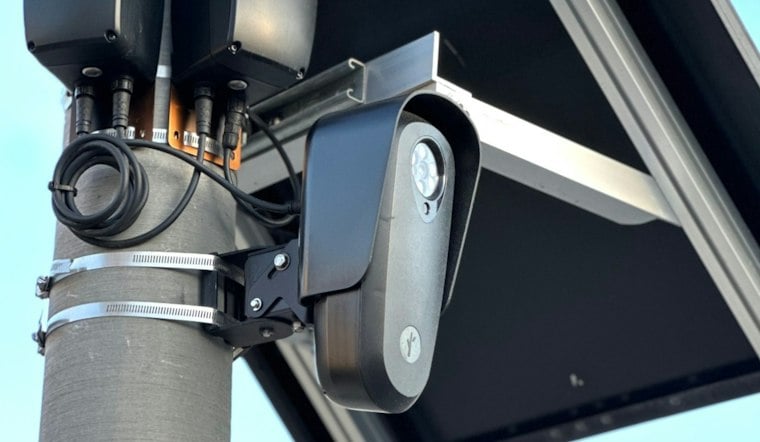
Dozens of people rallied outside Quincy City Hall Tuesday evening ahead of a City Council meeting on the city’s use of Flock automatic license plate readers, a debate that ended with no resolution. The council tabled the issue for further consideration after hearing from Police Chief Mark Kennedy and members of the public who raised concerns about privacy and oversight of the cameras scattered around the city.
The rally began at 5 p.m., with the council meeting following at 6 p.m., according to Boston 25 News. Quincy currently deploys 50 of the automatic license plate readers, which snap photos of the backs of passing vehicles and log their location, as reported by Yahoo News. Flock’s cameras record not just the plate itself but the vehicle’s make, color, and model, and can capture visible details like bumper stickers or roof racks, according to the Boston Globe.
A Staggering Number of Scans, A Tiny Fraction Investigated
The scale of the data collection has become a flashpoint in Quincy. More than 700,000 license plates were captured in the city over the preceding few weeks, but fewer than 200 of those scans were tied to an actual investigation, per WHDH. That gap between mass surveillance and actual police use is exactly what has fueled pushback from residents and some council members.
Quincy police have already narrowed who can use the system. In June, the department limited access to Flock’s platform to just 50 of its roughly 240 officers, the Globe’s reporting shows. Searches must also be audited, conducted within city limits, and linked to an investigation carrying a case number, the same reporting notes.
Police Chief Defends the Technology
Chief Kennedy defended the cameras at the meeting, calling them an important investigative tool and emphasizing that restrictions govern how officers use them, according to WCVB. The council had invited Kennedy specifically to speak about the department’s use of the technology before ultimately deciding not to make a final call, tabling the matter for further consideration.
By default, Flock retains captured data for seven days, uploading it to a cloud server along with a timestamp, location, and direction of travel, according to a Boston Globe explainer on how the technology works. Flock announced changes to its system in August, including an automatic auditing tool meant to flag patterns of misuse, mandatory case numbers for searches, and options letting departments block certain searches from other agencies, per the Globe’s separate reporting on state and local regulation efforts.
Massachusetts Communities Are Pulling Back — But Not All in Step
Quincy isn’t alone in wrestling with Flock. Stoughton held its own meeting the same Tuesday night and voted to cancel its contract with the company entirely, WCVB reported. New Bedford has temporarily stopped using its 20 Flock cameras while it works out stronger safeguards, and Boston ended its own Flock pilot last year only to quietly launch two pilots with competitors Axon and Motorola, according to the Globe’s October 1 reporting.
Just how many Massachusetts communities have backed away from Flock depends on who’s counting. The Globe’s August reporting put the number at a minimum of 13 municipalities that had canceled or paused contracts amid misuse reports and privacy concerns. The ACLU of Massachusetts told the Lowell Sun that more than 30 municipalities have rejected continuing to use the cameras. Page 9 reported that at least 40 municipalities had stopped using Flock. The number of license plate readers statewide has exploded regardless, growing from just 17 at the start of 2025 to more than 1,200 by late September, per Deflock.org data cited in the Globe’s explainer.
Misuse Investigations and Vendor Switches Elsewhere
The scrutiny isn’t purely theoretical. At least four police officers in Massachusetts are under investigation for allegedly misusing the technology, the Globe reported in August. Lynn placed two of its officers on paid administrative leave after an audit flagged a concerning pattern in some of their searches, according to WCVB. Salem planned to seek an alternative vendor.
Framingham’s Flock contract expired on June 30, and its cameras were simply switched off, per WCVB’s statewide camera tracker. In Western Massachusetts, residents in Springfield rallied outside City Hall and addressed the City Council directly to demand an end to the city’s use of the cameras, according to WWLP. Nearby Holyoke, that outlet reported, plans to simply let its own contract lapse when it expires in 2027.
For now, Quincy’s cameras keep running under the existing rules while the council’s debate continues at an unspecified future date. With no vote taken Tuesday night, the fate of the city’s 50 Flock readers remains an open question — one that residents who showed up to rally clearly intend to keep pressing.





