

























































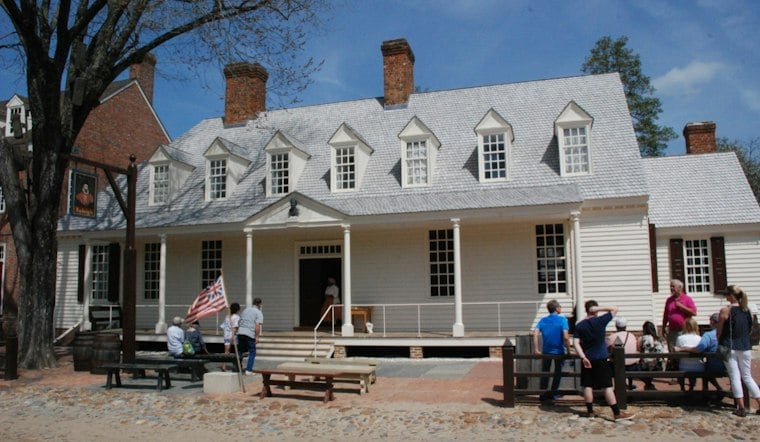
Raleigh Tavern in Williamsburg is turning back the clock to 1770 on Thursday, October 15, when the cast of The Beggar's Opera and Colonial Williamsburg's resident Governor's Musick ensemble take over the historic tavern for a sing-along concert titled Virginian Vices & Beggar's Opera. The 7 to 9 pm show invites attendees to sing along while exploring the notorious vices of 18th-century Virginia, with adult admission priced at $20 and children's tickets at $12.
The opera being revived is no obscure relic. According to Williamsburg Families, The Beggar's Opera was one of the most popular ballad operas of the 18th century, staged in Williamsburg at least three times between 1768 and 1772, and both George Washington and Thomas Jefferson are recorded as having attended performances in the Virginia capital. Written in 1728 by poet John Gay with music arranged by Johann Christoph Pepusch, the work debuted at London's Lincoln's Inn Fields Theatre on January 29, 1728, as a satirical ballad opera that swapped grand opera conventions for popular street ballads and folk tunes, according to Wikipedia. The opera took aim at Italian opera and British politics while focusing on the criminal underside of London, and its enduring punch line, per the seed event listing, is that vices are enjoyed among all levels of society.
A Jailer Once Led the Music
The Williamsburg connection to this opera runs deeper than a single royal visit. In colonial Williamsburg, Peter Pelham — organist at Bruton Parish Church who also served as the local gaoler — acted as musical director when itinerant theatrical troupes staged The Beggar's Opera in the Virginia capital, according to Monticello. Pelham was a central musical figure of the era who also played organ for Thomas Jefferson and public assemblies, giving the production an unusual pedigree: part parish organist, part jailer, part impresario for a show about thieves and highwaymen.
Washington attended a performance of the opera when it opened in Williamsburg in June 1770, placing this week's revival in the footsteps of the city's most famous visitor.
Raleigh Tavern's Own Theatrical Past
Raleigh Tavern's ties to Williamsburg theater predate this week's concert by nearly three centuries. Williamsburg's second playhouse went up in 1751 through a subscription arranged by Alexander Finnie, then proprietor of the Raleigh Tavern, to host traveling theatrical groups like the Murray-Kean Company, according to the Colonial Williamsburg Digital Library. Finnie's subscription funded a standalone playhouse, not a tavern-hosted performance space.
The tavern building itself has its own survival story. Originally constructed before 1735, the Raleigh Tavern burned down in 1859 and was rebuilt between 1930 and 1931 as the first reconstructed building Colonial Williamsburg opened to the public, per SAH Archipedia. The site also served as a key political hub where Virginia burgesses gathered after the royal governor dissolved the House of Burgesses, cementing its reputation as a gathering place for both politics and performance at 413 E Duke of Gloucester St.
The Ensemble Behind the Revival
Leading Thursday's performance is the Governor's Musick, Colonial Williamsburg's resident early-music ensemble, which uses period instruments to perform 17th- and 18th-century chamber and popular music, according to Early Music America.
Part of a Centennial Season
Thursday's concert lands in the middle of Colonial Williamsburg's 100th anniversary year, marking a century of historical preservation and living-history programming since W.A.R. Goodwin and John D. Rockefeller Jr. founded the foundation in 1926, as Hoodline previously reported. The foundation has marked its centennial with programming during 2026, and the Beggar's Opera revival fits squarely into that broader push to reconnect modern visitors with the sounds of 18th-century Virginia.





