

























































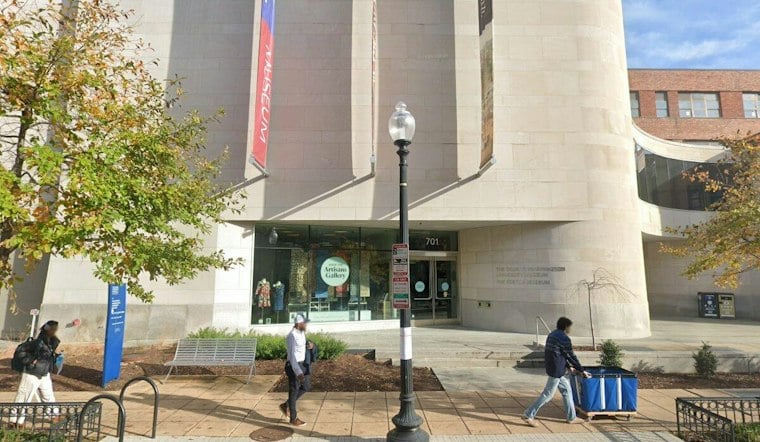
A 500-year-old dress so rare that its curator says she nearly fell over when she first laid eyes on it is now on public display in Foggy Bottom. The garment, woven using a technique found on no other known dress in existence, anchors a new exhibition at George Washington University's Textile Museum that pulls together nearly 50 pieces of Andean clothing and weaving dating back roughly five centuries.
The exhibition, titled “Weaving an Empire: Textiles of the Inka World,” opened August 15 and runs through December 19, according to George Washington University Media Relations. It is a major exhibition dedicated to South American textiles. As WTOP News reports, the show is on display at the Textile Museum through late this year.
Shelley Burian, the museum's Lisa and Bernard Selz Curator, said she about fell over when she first saw the dress, per the same WTOP account. The garment is the only known dress woven using what's called the Inka prestige tapestry technique — a distinction that makes it one of the exhibition's most significant pieces. It features a pattern WTOP describes as resembling both the iconography found on clothing worn by Inka queens and, strikingly, a pattern similar to one worn by Dolly Parton.
A Butterfly Motif Tied to a 1,200-Page Colonial Manuscript
The dress's design is described as a butterfly pattern that includes the Indigenous-language word for butterfly, according to WTOP's report. In a 2024 research paper, Burian analyzed the garment — an aksu, or traditional Andean woman's wrap dress — and found its motif closely matches 17th-century drawings by Indigenous chronicler Felipe Guaman Poma de Ayala, as detailed in UNL Digital Commons. Guaman Poma de Ayala illustrated daily life and colonial-era dress across an extensive 1,200-page manuscript he sent to King Philip III of Spain.
The dress itself was cut apart during the colonial period and is now missing roughly a quarter of its original fabric, per WTOP's reporting. It is displayed in the exhibition as two separate pieces. Burian has noted that clothing details in Inka society could reveal a person's political standing, comparing such garment markers to an office badge indicating someone's security clearance, WTOP reports, while color and iconography also communicated spirituality and ethnic identity.
Weaving Techniques That Reveal Where a Garment Was Made
Beyond the butterfly dress, the exhibition explores how weaving methods themselves can reveal a garment's origin. Coastal communities often combined several weaving techniques, while highland weavers typically relied on just one or two, according to WTOP. One tunic in the show uses multiple sets of threads and bars that stop and interlock with each other — an unusual construction that Burian has suggested may carry cosmological significance, since Andean people liked the idea of two things forming one.
To help visitors picture how these garments were actually worn, museum staff built full-scale outfit reconstructions on two mannequins, based on historical 17th-century drawings held at the Royal Danish Library in Copenhagen, according to GW Today. The exhibition also includes garments worn by both royalty and everyday people, per WTOP, illustrating the range of status the Inka Empire's textile traditions could signal.
Khipus, Keros and an Empire That Stretched 2,500 Miles
The show isn't limited to clothing. It also displays khipus — intricately knotted cord systems used for administrative record-keeping and tax collection. Khipus allowed Inka administrators to track goods and demographics across thousands of miles without a written script, underscoring how deeply textiles and cordage were woven into imperial governance.
At its height in the 15th and early 16th centuries, the Inka Empire — officially Tawantinsuyu, or “land of the four parts together” — stretched roughly 2,500 miles from present-day Colombia to Chile, according to GW Today, incorporating diverse coastal and highland societies under a centralized tribute network. The exhibition also highlights regional independence within that vast territory: an alpaca-fiber woman's wrap dress from the Chuqibamba region on Peru's southern coast shows how local weaving traditions endured even under Inka rule, per GWU Media Relations.
A Collection Decades in the Making
The Textile Museum holds more than 9,000 Latin American textiles, nearly half of its overall 21,000-piece international collection, making it one of the largest holdings of its kind outside South America, GWU Media Relations reports. The collection spans five continents and five millennia of textile history. The museum itself was founded in Washington, D.C., in 1925 by collector George Hewitt Myers with just 335 objects, before joining George Washington University and relocating to its Foggy Bottom campus in March 2015.
Major foundation and private backing for “Weaving an Empire” came from organizations including The Coby Foundation, the Historic Textile Research Foundation, and knitwear brand Peruvian Connection, according to GW University Museum. Burian, who holds a doctorate in art history from Emory University earned in 2019, joined the museum in 2021 after previously working at Emory's Michael C. Carlos Museum. “Weaving an Empire: Textiles of the Inka World” remains on view at the Textile Museum through December 19.





