

























































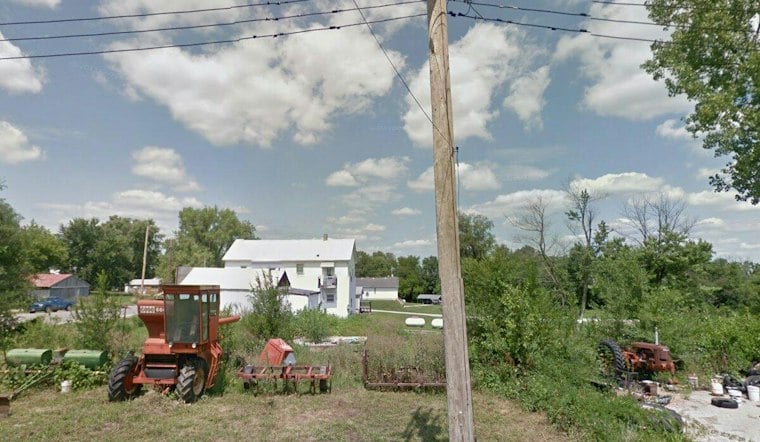
Reason Swafford nearly bled to death on his farm near Rayville, close to Richmond, Missouri, after a barn he was helping a neighbor move collapsed onto his left leg. Months later, after losing that leg to amputation, he walked his daughter down the aisle at her wedding — then handed his crutch to the surgeon who had refused to give up on him.
The accident happened in June 2025, when the falling barn broke Swafford's femur and sliced his femoral artery, according to KSHB 41 Kansas City. Swafford said he almost bled to death and was given just a 5% chance of survival. He was airlifted to University Health in downtown Kansas City, where he said his faith led him. The hospital's Truman Medical Center campus operates one of only two adult Level 1 Trauma Centers in Kansas City, a facility that handles roughly 62,000 emergency visits a year, according to the American Hospital Association.
Word of the accident spread fast through the small farming community. Marshall Holles organized a GoFundMe campaign that June to help cover Swafford's medical bills and keep his farm running while he was incapacitated. The following month, Richmond residents held a blood drive at Richmond Middle School under the slogan “God has a reason for Reason,” organized through a post from the Richmond United Methodist Church, to support his emergency recovery after the severe blood loss from his punctured femoral artery.
The Doctors Who Fought for His Leg — and His Life
Once at University Health, Swafford's care fell to two specialists: Dr. Peter Everson and Dr. David Shanberg, both of whom treated him after the airlift, per the station's report. Everson is an assistant professor of orthopedic surgery at the University of Missouri–Kansas City School of Medicine and serves as the Orthopedic Surgery Medical Student Clerkship Director, according to his UMKC School of Medicine profile, with a specialty in traumatology. Shanberg is a board-certified general and vascular surgeon who completed his general surgery residency at Truman Medical Center and a vascular fellowship in North Kansas City, according to his WebMD profile.
That combination of orthopedic and vascular expertise matters in cases like Swafford's. Clinical research published in PubMed has found that femoral artery injuries paired with bone fractures carry a high risk of mortality and amputation, with blood loss and tissue trauma serving as the primary predictors of poor outcomes. Swafford suffered multiple infections during his recovery, and in January his leg was amputated. He credits Everson with never giving up on him, and the two formed what the article described as an instant friendship during his treatment.
A Goal Set From a Hospital Bed
It was during his recovery at University Health that Swafford set his sights on a specific milestone: walking his daughter down the aisle. He took a FaceTime call from her while still in the hospital, and from that moment, the goal became his focus. The University Health team that treated him reportedly cheered him on, not just toward that wedding day but toward his larger plan of returning to farming.
On the day of the wedding, Swafford walked partway down the aisle on a crutch. Halfway there, he stopped and handed the crutch to Everson, who was in attendance, before continuing the rest of the way on his own. Swafford described the handoff as symbolic — a visible marker of how far he'd come since the barn collapse nearly took his life.
Returning to a Dangerous Line of Work
Swafford now plans to return to farming, a profession that remains one of the most hazardous in the country. The agriculture, forestry, fishing, and hunting sector recorded a fatal work injury rate of 20.9 deaths per 100,000 full-time equivalent workers in 2024, compared with a national average of 3.7 across all industries, according to the U.S. Bureau of Labor Statistics. The Centers for Disease Control and Prevention has noted that the average age of U.S. farm producers climbed to 58.1 years in 2022, with workers 55 and older accounting for 56% of all fatal agricultural injuries.
Incidents involving falling structures, heavy equipment, and object contact — like the barn collapse that injured Swafford — account for 35% of nonfatal lost-time injuries among older agricultural workers, according to NIOSH surveillance data. The financial toll of such accidents is steep as well: a 2024 study in the American Journal of Industrial Medicine found that nonfatal agricultural injuries to self-employed farmers cost an average of $15,613 per case in medical expenses and lost labor, part of an $11.31 billion annual national burden. For Swafford, a lifelong farmer whose livelihood depends on physical labor, that risk didn't stop him from planning to get back to work.





