

























































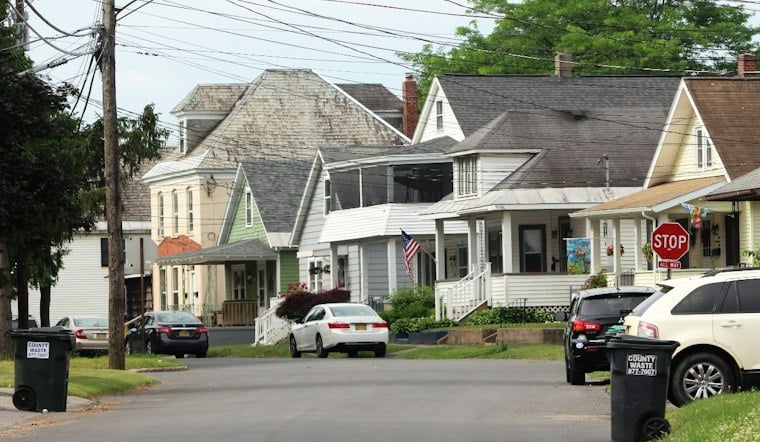
A proposed New York bill would set a 180-day deadline for covered banks and mortgage lenders to sell acquired single- and two-family homes. If a property remains unsold after that window, it would be subject to a required public auction. The measure would create a deadline for lender-owned homes, distinct from existing rules governing properties in foreclosure.
Santabarbara, who represents Rotterdam, said the bill has been introduced and could eventually be folded into a larger package of housing legislation, according to CBS6 Albany. The proposal would also come with penalties and court enforcement for banks that refuse to comply, and it closes an obvious loophole: moving a property to a related company would not restart the clock, per the same report.
CBS6 reported that the idea grew out of conversations between Rotterdam Town Supervisor John Polimeni and Santabarbara about rising home prices and getting bank-owned homes back into circulation. Santabarbara described the goal this way: “Those homes need to get back on the market, so families have more choices and a better opportunity to find a home they can afford,” he said, according to the outlet. He has also said people would like the opportunity to buy these foreclosed homes themselves, per WRGB.
Why Rotterdam Is Feeling the Squeeze
The push comes as Rotterdam's housing market tightens. The town's median home sale price hit $310,000 through August, up from $289,000 during the same stretch in 2025, while new listings fell 7.9 percent according to the Greater Capital Association of Realtors, the station's reporting shows. Santabarbara has said some foreclosed properties need repairs that simply are not being made, and that banks sometimes leave owned properties sitting rather than putting them up for auction right away, per WRGB.
New York as a whole saw an increase in foreclosed and abandoned properties after COVID-19 and the end of the pandemic-era housing moratorium, WRGB reported, and foreclosed property sales dropped off after the pandemic compared with the more than 400 properties sold in October during the 2022-2023 period. Some bank-owned properties on the market now are overpriced, according to the station's reporting.
A Real Estate Agent's Case for Faster Sales
Rebecca Cavaleri, a Capital Region real estate agent, supports the proposal. She has said that when heat, hot water and power are shut off in a foreclosed home, buyers have no way of knowing whether pipes have frozen, and that previous owners sometimes have not even left the property, according to WRGB. Cavaleri has also said neglected properties become decrepit and inaccessible to typical home buyers who are not equipped to take on extensive repair work themselves, per the same report.
Not everyone is convinced a statewide mandate is the right fix. Nick Sokaris, the Republican candidate for New York Assembly's 111th District, agrees that vacant and foreclosed homes should be returned to the market quickly but has raised concerns that a blanket six-month bank-sale mandate or forced auctions could carry unintended consequences, WRGB reported. Sokaris has instead proposed streamlining state approvals, removing unnecessary regulatory barriers, encouraging rehabilitation and adaptive reuse, and reviewing costly building requirements while preserving local control, according to the outlet. He has said housing affordability solutions should address the underlying problems rather than impose a single statewide rule.
The Bigger Picture on Foreclosures
The debate is unfolding against a backdrop of rising foreclosure activity nationally. ATTOM reported 118,727 U.S. properties with a foreclosure filing in the first quarter of 2026, up 6 percent from the previous quarter and 26 percent from a year earlier, according to ATTOM. New York recorded 3,886 foreclosure starts in that same quarter, and lenders repossessed 14,020 U.S. properties through foreclosure nationwide, up 45 percent from a year earlier, ATTOM found. New York also had the third-longest average foreclosure timeline among states, at 1,911 days, per ATTOM's data.
New York already has deadlines for some properties after foreclosure, but they work differently from the proposed lender-sale requirement. Under the state's existing zombie-property law, plaintiffs have 90 days from obtaining a foreclosure judgment to move a property to auction; if the plaintiff buys it at auction, the plaintiff has an additional 180 days to put it on the market for sale or other occupancy, according to the New York Department of Financial Services. Separately, the New York State Office of the State Comptroller has reported that abandoned homes can pose safety hazards, including occupation by squatters using unsafe heating methods, and that more than 28 percent of local officials said lenders were often not meeting their property-maintenance obligations during foreclosure, per the comptroller's office.
Local Property Reuse Takes More Than One Form
Separate local projects illustrate other ways vacant properties can return to use. The Capital Region Land Bank approved funding on May 12, 2026, for eight homes on Van Vranken Avenue in Schenectady, according to the Schenectady County Metroplex Development Authority. In a separate effort, Better Community Neighborhoods announced that eight formerly vacant spaces in Schenectady were being converted into 21 affordable apartments with state funding, according to a release published by the Metroplex Development Authority. These development and rehabilitation projects bring vacant properties back into use; they are not deadlines requiring lenders to sell bank-owned homes.
For now, Santabarbara's bill remains a proposal moving through the legislative process, with no indication yet of a vote or final outcome. Whether it advances as a standalone measure or becomes part of a broader housing package, as Santabarbara has suggested it might, could shape how quickly Rotterdam and the rest of New York see bank-owned homes return to local buyers.





