

























































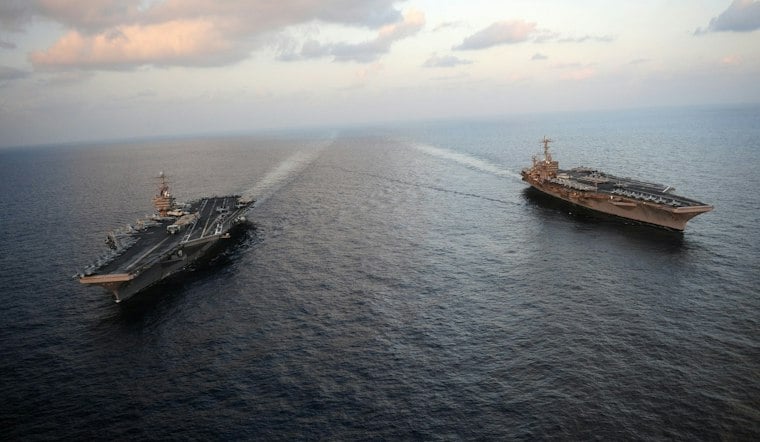
Nineteen-year-old Nicholas McKelvey had spent 255 days aboard the USS Abraham Lincoln when he sprinted along the flight deck and leaped from the ship’s edge into the Arabian Sea off Iran's southern coast. He told people afterward that he did not want to remain there anymore and that he had accepted he might die as a result. Instead of dying, he was pulled from the water by a Navy helicopter crew and returned to the ship about 50 minutes after the jump — and then the Navy moved to discharge him.
The case, reported by The New York Times, offers a rare look at how the military handles mental health crises during extended deployments. McKelvey, a Navy airman and aviation mechanic assigned to a helicopter squadron, had been working 12-hour shifts checking and guiding helicopters on the flight deck throughout the Lincoln's deployment, which coincided with the United States' war with Iran.
McKelvey missed the birth of his daughter during the deployment, and his in-laws were battling cancer back home, circumstances that weighed on him as the carrier remained at sea far longer than planned. Nearly five days passed before the Navy notified her that her husband had gone overboard, she has said.
Guilty Findings and an Oral Reprimand
The Navy initially pursued an absence-without-leave charge against McKelvey but later dropped it, replacing it with a charge of jumping from a vessel while keeping a second charge of malingering — accusing him, in effect, of faking a mental health crisis to end his deployment, according to his wife, Samantha Larry. On Sept. 10, he was found guilty of both jumping from a vessel and malingering and received an oral reprimand, the same reporting shows.
Now the Navy has moved to discharge McKelvey under a general discharge under honorable conditions. Larry says that outcome would make him ineligible for GI Bill education assistance, cutting off a path to college the family had counted on. The Navy has said that suicidal thoughts and suicide attempts are not, themselves, punishable misconduct, and that medical care and disciplinary processes are separate, with one not precluding the other, according to Task & Purpose.
The Lincoln's mental-health support team during deployment consisted of five chaplains, one clinical psychologist, one clinical social worker, three behavioral-health technicians, and an embedded prevention counselor to serve the roughly 5,000 people aboard the carrier, per the same account.
A Deployment Stretched Past Its Limits
The Abraham Lincoln returned to San Diego this month after completing a near-record 322-day deployment. NBC News reported 286 days without a port call, while The Guardian reported more than 250 consecutive days without a significant port visit. A typical aircraft-carrier deployment runs closer to six months and normally includes port visits, retired Vice Admiral Robert Murrett told The Guardian. The Lincoln's stretch at sea was not unique this year — the USS Gerald R. Ford returned home after a 326-day deployment, the longest for a U.S. carrier since the Vietnam War, while the USS Harry S. Truman's eight-month deployment was extended twice during combat operations against Iran-backed Houthi rebels.
Iran destroyed a key regional supply hub, and food aboard the carrier fell into short supply as a result, according to the same reporting. After the Lincoln's deployed resiliency counselor left six months into the deployment, roughly 5,000 service members were left with just two licensed mental-health clinicians, and some providers said their weekly hours jumped from 40 to as many as 90 to meet demand.
At Least Eight Suicide Attempts Associated With Lincoln Deployment
At least eight suicide attempts were associated with the Lincoln's deployment.
Still, Navy officials maintain they have not identified an increase in reported suicidal ideation or suicide attempts aboard the ship itself, per a statement reported by Task & Purpose. For McKelvey and his wife, that framing sits uneasily alongside what they describe as a disciplinary process that followed a mental health crisis rather than treated it — and a looming separation board that could determine not just his Navy career, but his family's plans for the future.





