

























































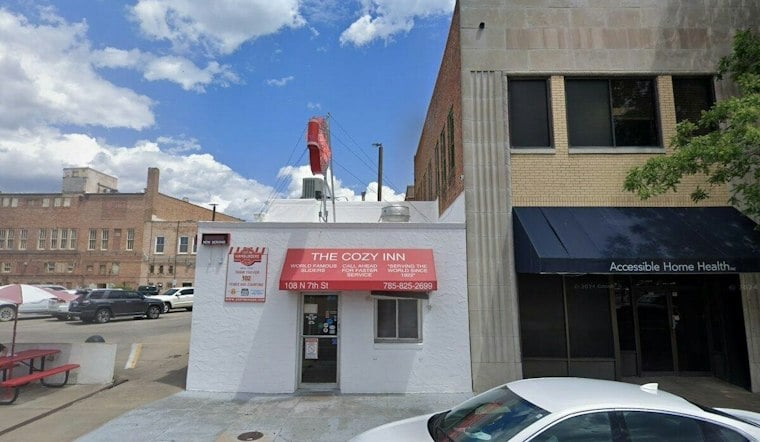
A federal appeals court has ruled that the city of Salina, Kansas violated the free speech rights of a 104-year-old hamburger stand by refusing to let it finish painting a mural of flying saucers made to look like burgers. The U.S. Court of Appeals for the Tenth Circuit affirmed a trial court's ruling that Salina's treatment of the Cozy Inn's UFO-themed artwork amounted to an unconstitutional restriction on speech, in a dispute that began when city officials informed Howard of their decision and asked him to stop work in 2023.
The fight centers on the Cozy Inn, which has served hamburgers from its small Salina storefront since 1922 and is owned by Steve Howard. The trouble started when Salina officials told Howard to stop painting the mural, which depicted whimsical, hamburger-esque flying saucers piloted by aliens attacking the restaurant with blasts of ketchup and mustard, according to the Tenth Circuit's opinion. City officials told Howard on November 6, 2023 to pause the artist's work, the court noted, because they considered the display too large to qualify for a sign permit.
Howard applied for that permit, but Salina never approved or rejected it. Instead, per the same opinion, the city sent him a letter on February 8, 2024 putting the application on indefinite hold rather than granting or denying it outright. Howard, with help from the Kansas Justice Institute, filed a lawsuit that year challenging the city's handling of the mural.
Why Salina Called It a Sign, Not Art
Salina's position was that the artwork wasn't a protected mural at all, but a regulated sign subject to the city's permitting rules. As reported by The Sentinel, the city said the mural depicted UFOs that looked too much like hamburgers, the Cozy's signature item, which it argued pushed the artwork out of mural territory and into advertising. Kansas Justice Institute litigation director Sam MacRoberts put a finer point on the city's logic, saying Salina's code would have allowed a mural of flying pizza slices but not burger-esque UFOs because the Cozy sells sliders.
The Tenth Circuit wasn't persuaded. The court agreed that Salina had to produce evidence that its restrictions actually advanced, and were tailored to, its stated interests, and found the city failed to do so. The Sentinel's report notes the court concluded that Salina's evidence failed to justify the distinction between regulated signs and unregulated murals, and did not show that signs pose greater danger to the city's interest in safety, aesthetics, and property values.
Three Years Without an Answer
The court also zeroed in on how long Salina let Howard's application sit untouched. The city's own code required its zoning administrator to issue or refuse a permit within ten days unless the applicant agreed to a longer wait, according to the appellate opinion. Howard's application had aged for three years without his consent, and the court found that delay itself amounted to a prior restraint on his speech, as The Sentinel reported.
The case drew attention well beyond Salina's city limits. The National Federation of Independent Business, the Institute for Justice, the Pacific Legal Foundation, the Liberty Justice Center, the Alliance Defending Freedom, and a joint brief from the Goldwater Institute and Manhattan Institute all filed friend-of-the-court briefs supporting the Cozy's challenge, per the Tenth Circuit's docket. The Kansas Justice Institute said the Tenth Circuit's reasoning, that government restrictions on speech require hard evidence rather than mere speculation, carries implications that reach beyond the Cozy Inn and its mural.
A Hometown Win for the Cozy
Howard, for his part, framed the fight in personal terms, saying Salina is his hometown and that he loves it there, and he thanked the community for its support throughout the case. MacRoberts said he was proud of Howard for standing up for his First Amendment rights, and separately called Salina's code and its enforcement unconstitutional. He urged Kansas cities more broadly to stop acting as art critics, and said he was happy the mural could remain up, adding that Salina's mural scene is better for it.
That broader mural scene has been growing. The city's Salina Kanvas Project has commissioned more than a dozen additional murals around town, according to KCUR, even as the Cozy's own flying saucers became the subject of a federal lawsuit. As KSAL News reported, the Tenth Circuit's decision stands as a win not just for one Salina burger stand, but for the question of how far cities can go in deciding what counts as art versus advertising on a storefront wall.





