

























































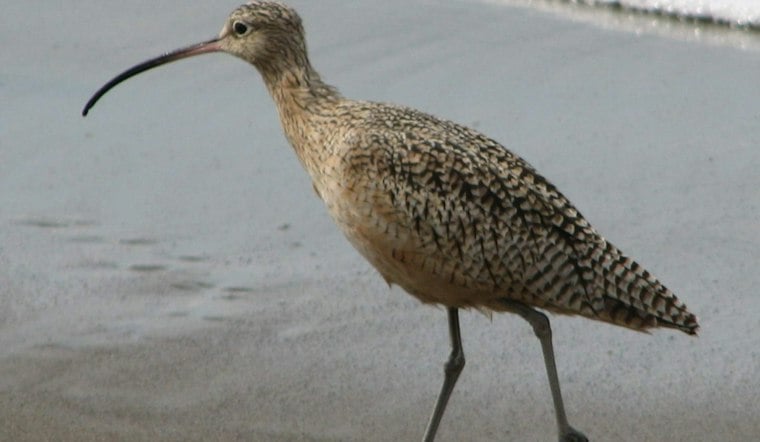
San Diego Bay's mudflats are busy again this fall, with shorebirds using the habitat as birds migrate through the region. BirdCast's regional tracking dashboard modeled bird movement across San Diego County for the night of October 24 into October 25.
That figure comes from BirdCast's migration dashboard, which models nightly bird movement across the region. The dashboard notes that birds usually begin migrating 30 to 45 minutes after sunset, with the greatest number aloft two to three hours later, and that most species pass through the contiguous United States from early September through October during fall migration. It's a reminder that the numbers moving through San Diego's skies are part of a much larger continental pulse, not an isolated local event.
Down at the water's edge, San Diego Bay has long drawn attention for what it offers birds willing to make the trip. Despite decades of port, naval, recreational and salt-evaporation uses, BirdNote describes it as one of the best bird habitats on the West Coast.
The Bay's Biggest Beak Belongs to the Curlew
Among the shorebirds working that habitat, none stands out quite like the Long-billed Curlew, which the Audubon Field Guide calls the largest shorebird in North America. The species breeds in western grassland habitat and probes soil and mud for insects, worms and burrowing spiders.
That same long bill has a complicated history. Audubon's field guide states that in more recent decades the species has decreased across much of its nesting range as grassland has been converted to agriculture. The bird's modern range still bends toward the water, however, whenever winter sends it looking for coastal mudflats to forage in.
Yellowlegs and Sandpipers Round Out the Mix
Shorebirds share the bay's muddy real estate with a cast of smaller, more understated species. The Greater Yellowlegs is one of San Diego County's most widespread shorebirds, found at inland reservoirs and small ponds as well as along the coast, according to the San Diego County Bird Atlas. The atlas describes it as common during fall migration, generally uncommon in winter and spring, and rare in summer — and notes that across the second half of the 20th century there was no clear trend in its countywide numbers.
Its smaller relative, the Lesser Yellowlegs, is fairly common in migration but rare in winter, preferring salt marshes, brackish coastal lagoons and shallow freshwater ponds, per the same atlas. Decades-old monthly counts cited by the atlas put the November-through-April average for Greater Yellowlegs at San Elijo Lagoon at 4.3 birds, based on data gathered between 1973 and 1983 — a small but telling snapshot of how thin some shorebird numbers can run even in good habitat.
Warmer Water, Uncertain Food Supply
The backdrop to all this bird traffic is a stretch of unusually warm ocean water. KPBS reported that temperatures along the West Coast have run 3 to 4 degrees Fahrenheit above normal for months, with the ocean off La Jolla reaching 73 degrees on October 20. Ryan Terrill, the San Diego Natural History Museum's new curator of ornithology, who oversees a collection of nearly 53,000 bird specimens, told the station that warmer water disrupts the upwelling seabirds depend on for food.
“As the water gets warmer, less of that happens and there's less food,” Terrill said, according to KPBS. It's a note of caution amid an otherwise busy migration season, a reminder that the birds moving through San Diego Bay right now are navigating conditions that aren't static year to year.
The San Diego Union-Tribune has described San Diego's mild winters as a draw for migratory shorebirds, with the region's mudflats, lagoons and wetlands active long after summer crowds thin out. Whatever the precise mix of factors pulling birds here, the overnight numbers out of BirdCast and the steady presence of species like the curlew and the yellowlegs suggest San Diego Bay will keep earning its reputation as prime shorebird territory this fall.





