

























































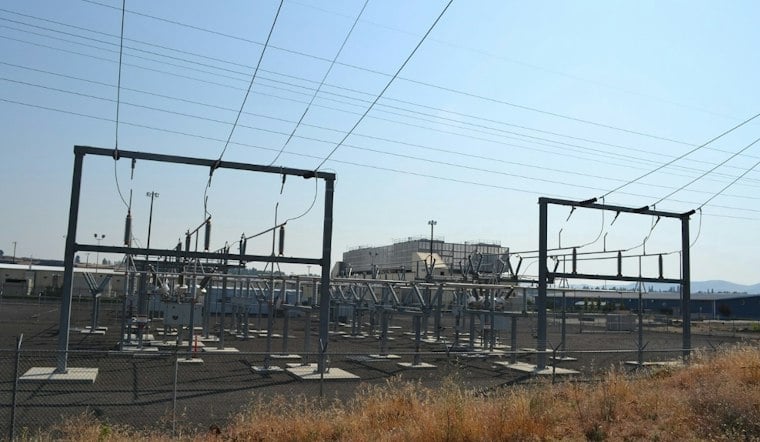
A proposal to build one of the largest data centers in California on 70 acres of Navy land in San Diego's Midway District is running into resistance from local elected officials, who say they were left out of the loop as talks advanced behind closed doors. Manchester Financial Group has been discussing a possible 400-megawatt data center as part of a sweeping redevelopment of the NAVWAR campus, a site that currently houses the Navy's cybersecurity operations between Pacific Highway and Interstate 5.
The talks were first reported by Voice of San Diego, which found that Manchester Financial Group is in discussions with the Navy and local power officials about building the massive facility on the property. The data center would not stand alone — it would be folded into a larger overhaul of the site that developers have floated could also include a new command headquarters, housing, hotels, retail and other amenities. Manchester Financial Group President and CEO Ted Eldredge has said the data center is just one of several proposals under consideration and might never get built at all, according to the outlet.
City Councilmember Marni von Wilpert, who represents the district, says she only learned the data center was part of the mix through press coverage. She told KPBS that Manchester Financial Group had briefed her on the broader redevelopment project earlier, but that no one mentioned a data center could be part of it. Von Wilpert, who is running for California's 48th Congressional District, criticized the development team for the lack of transparency.
A Congressman Says the Land Should House People, Not Servers
Rep. Scott Peters, whose 50th District includes the NAVWAR site, has come out against the data center concept entirely. He told KPBS the property is ideally positioned for housing and neighborhood-serving amenities given its proximity to downtown, I-5 and the Old Town Transit Center. A data center, he said, is not neighborhood-serving and belongs in a more remote industrial area instead.
The scale of what's being discussed is notable even by national standards. Per the same Voice of San Diego report, the QTS Phoenix 2 data center in Arizona occupies 80 acres of land to host at least 210 megawatts of computing capacity — roughly half the computing capacity being floated for the much smaller NAVWAR footprint. The outlet also noted that a highly controversial data center proposed in California's Imperial Valley would run 330 megawatts, meaning the San Diego proposal, if built, would exceed it.
San Diego Councilmember Sean Elo-Rivera has raised concerns about whether the city's grid can handle that kind of load, according to Voice of San Diego's reporting. For scale, Elo-Rivera told FOX 5 San Diego that 400 megawatts, as he understands it, is the equivalent of 300,000 homes.
Grid Talks Began Before Local Leaders Were Briefed
Compounding the transparency concerns, the developer engaged in talks with San Diego Gas and Electric, the region's monopoly electric-grid builder, and San Diego Community Power, an energy agency, before local elected leaders knew about the project, Voice of San Diego reported. SDG&E officials have said they would update the grid to meet additional demand regardless of whether it came from a data center or a new hospital. Eldredge has said the team held early informational conversations with energy providers to assess feasibility, but that no negotiations or agreements were underway.
The financial stakes behind the scenes are steep. At a quoted electricity rate of 11 cents per kilowatt-hour, the outlet's report found it would likely cost over $1 million a day just to run a 400-megawatt data center in power costs alone. The developers have suggested the complex could be phased in at 100-megawatt increments every six months until completion, according to Voice of San Diego's reporting on the proposal.
Under the arrangement being discussed, the Navy intends to lease the land to the development team in exchange for a new office complex built nearby, with Manchester receiving a 99-year lease to develop the rest of the property, per Voice of San Diego. KPBS reported that the redevelopment would require no appropriation from Congress and that the site, being federally owned, requires no permits from the city of San Diego. The Navy had been in redevelopment talks with Manchester Financial Group and Edgemoor Infrastructure & Real Estate for more than two years, and has separately described its broader plan as a revitalization of the 70.3-acre Naval Base Point Loma Old Town Campus intended to provide new facilities for Naval Information Warfare Systems Command, according to a statement from the U.S. Navy.
Beyond Servers: Stadiums, Hospitals and a University Floated Too
Eldredge has said the development team was weighing a wide range of possibilities for the site beyond a data center, including a hotel, medical center, university campus, defense industry campus and life science facility, according to KPBS. The team has also considered a stadium and a hospital, Voice of San Diego reported separately. Eldredge has said the broader NAVWAR redevelopment will ultimately include homes, retail, commercial and industrial uses.
The debate in San Diego fits into a much larger statewide pattern. Between 2019 and 2023, electricity use and carbon emissions by California data centers nearly doubled, while on-site water consumption slightly more than doubled, according to a CalMatters report. The outlet found that data centers used 10.8 terawatt-hours of electricity statewide in 2023, up from 5.5 terawatt-hours in 2019, with demand potentially rising as high as 25 terawatt-hours by 2028. On-site water use, per the same report, grew from 1,078 acre-feet in 2019 to 2,302 acre-feet in 2023.
Data-center researcher Jonathan Koomey has pointed to a broader speculative rush playing out across the industry, telling Voice of San Diego, “There's a bunch of people who don't know much about data centers who are trying to do this… to make money.” For now, Manchester Financial Group maintains that the potential plans for the NAVWAR site continue to be refined, and that no final project has been approved.





