

























































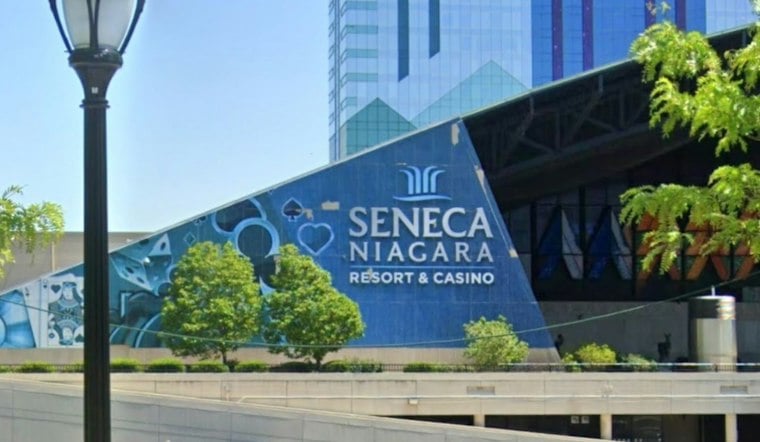
A campaign fundraiser for Republican gubernatorial candidate Bruce Blakeman turned into a flashpoint this week after Seneca Nation President J.C. Seneca hosted the event at Seneca Niagara Casino in Niagara Falls, drawing protests from tribal citizens even as a separate fight over a new gaming compact threatens tens of millions of dollars for three Western New York cities. The dispute, which pits the Seneca Nation against Gov. Kathy Hochul's administration over whether a new compact will include any revenue sharing with the state, has now bled directly into the race to succeed her.
The Seneca Nation said on October 2 that it had reached an agreement in principle on a new gaming compact that, notably, contains no revenue sharing provision with New York State, according to btpm.org. Hochul's office pushed back hard on that characterization, telling the outlet that there is currently no agreement and conversations are ongoing with stakeholders. As Spectrum News 1 reported, Hochul has disputed the Seneca Nation's account of where negotiations currently stand.
What's Actually at Stake for Niagara Falls, Buffalo and Salamanca
Under the original 2002 compact, the Seneca Nation was required to share a portion of slot-machine revenue with the state in exchange for certain exclusive gaming rights in Western New York, with the state historically collecting 25% of certain slot-machine revenue before that agreement expired in December 2023, per the same btpm.org report. Since then, the compact has continued through quarterly extensions, and revenue-sharing payments have kept piling up in an escrow account rather than flowing to host communities. New York State has distributed portions of that gaming revenue to Buffalo, Niagara Falls and Salamanca for years, per Spectrum News 1.
If a new compact drops revenue sharing entirely, those payments could dry up for good. Niagara Falls Mayor Robert Restaino has said the city stands to lose roughly $10 million to $13 million a year without its casino revenue share, the station's report notes, while Yogonet cited the mayor putting the potential loss between $11 million and $13 million. Salamanca's exposure may be even steeper in proportional terms: casino revenue from the compact represents 30% of that city's operating budget, according to NY State of Politics.
The Seneca Nation says it pushed back against that outcome at the negotiating table. The nation advocated to protect the cities of Buffalo, Niagara Falls and Salamanca during talks, per a report from WAMC. For her part, Hochul said New York remains committed to financially supporting Niagara Falls, Buffalo and Salamanca and that the state does not want those cities to be adversely impacted, according to Spectrum News 1.
A Casino Fundraiser Becomes a Political Lightning Rod
The controversy took a sharper turn when J.C. Seneca co-hosted a fundraiser for Blakeman at Seneca Niagara Casino, an event held at the nation's casino with donation levels ranging from $150 to $9,000, btpm.org reported. Seneca Nation citizens showed up to protest both outside the casino, objecting to Blakeman's policies and to their own president's decision to host him, according to Spectrum News 1, which said it was not allowed inside the fundraiser itself.
Protesters' objections centered partly on Blakeman's stance on prediction markets. Leslie Logan said Blakeman's support for prediction markets could threaten tribal gaming revenue, a concern described in a City & State New York report. The California Nations Indian Gaming Association has separately argued that prediction-market operators could use federal commodities law to offer nationwide gambling, sidestepping the framework Congress built through the Indian Gaming Regulatory Act and decades of tribal-state compacts, according to ReadWrite. Protesters at the Niagara Falls event opposed both Blakeman and Hochul over how each has handled the gaming compact fight, Spectrum News 1 reported.
Candidates Spar as the Vote Nears
Blakeman has criticized Hochul's handling of the Seneca Nation, saying New York State had not been a willing negotiating partner, according to Spectrum News 1. He has previously said he's ready to sit down and talk about a new compact, btpm.org reported, though no compact has been signed between the state and the nation. Blakeman's campaign was asked what a Blakeman administration would seek in a new gaming compact and whether he and Seneca discussed the agreement during the fundraiser, per Spectrum News 1's report; Blakeman separately faced a question about whether he would support a compact without revenue sharing if elected governor.
Mike Schindler has called for New York State and the Seneca Nation to return to the negotiating table and finish an agreement, according to the same Spectrum News 1 report. With the election now less than a month away, the compact dispute has become part of the broader gubernatorial campaign, pulling a technical question about casino revenue formulas into the center of a statewide race. The Seneca Nation has said it expects a finalized compact to be sent to the New York State Legislature sometime in the spring, per btpm.org.
The Seneca Nation currently owns and operates three casinos — Seneca Niagara Resort & Casino, Seneca Allegany Resort & Casino and Seneca Buffalo Creek Casino — according to the nation's own description of its gaming compact. Past casino-revenue disputes have carried similarly high stakes for the region; a previous round of hearings put roughly $110 million in revenue for Niagara Falls, Salamanca and Buffalo on the line, per the Buffalo News.



