

























































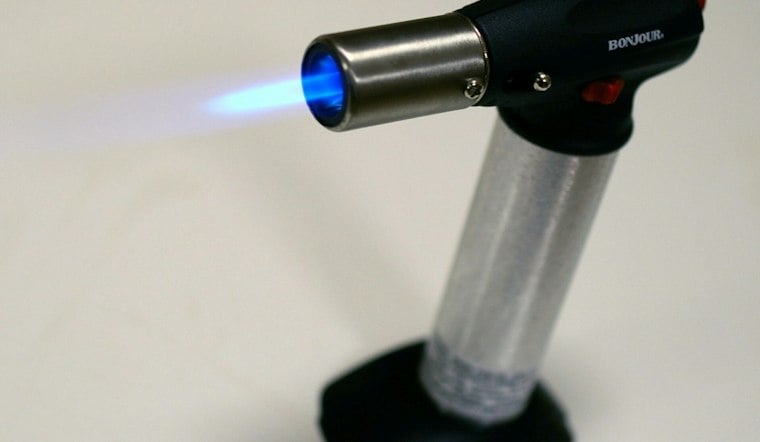
A locked butane torch left burning unattended has already cost one San Francisco resident their life and left another, Kimberly Saunders, facing the amputation of a second finger after the first was lost to flames that spread to her hand, leg and bed. Now City Hall wants the devices off store shelves entirely, with San Francisco Board of Supervisors President Rafael Mandelman introducing legislation to ban the sale of lockable butane torches with plastic components.
A Pattern of Fires Tied to a Single Design Flaw
Mandelman planned to propose legislation on a Tuesday. As reported by ABC7 News, San Francisco Fire Department Chief Dean Crispen said the city had three fires specifically involving locked butane lighters this year, and that one of those fires resulted in the death of a community member. Fire officials have linked the torches to fires, injuries and at least one death, and the problem traces to the locking mechanism itself, which can leave a torch burning if a user falls asleep or passes out, allowing a continuously burning flame to ignite nearby items and potentially an entire building.
The scale of the damage has been steep. Butane torch-related fires have caused an estimated $3.2 million in property losses over five years, per the same ABC7 account, and citywide fire department data shared on Facebook shows incidents climbing from 3 in 2020 to 21 in 2025 — meaning roughly two-thirds of all such fires occurred last year alone, according to the San Francisco Board of Supervisors. Fire officials suspect the spike is heavily tied to open-air fentanyl smoking across the city.
Voices From the Street
Derrick Joyce, who displayed multiple lockable torches to ABC7 and said he could show his larger one, explained that a fire can start if someone locks a torch and then passes out or drops it. Dylan Mesirow told the station that people also use larger torches attached to propane canisters, that the devices are quick and hotter than regular lighters for lighting and heating items such as bong pipes, and that he uses torches while on the streets just to stay warm. Michael Arnold said a torch burned his throat when he used it with his marijuana pipe, while another man attributed burn marks on his body to a lockable butane lighter. Fire officials say the torches produce a hotter, more powerful flame than traditional lighters, and the devices have become increasingly common on San Francisco streets since 2020, per fire department accounts relayed by ABC7. The outlet reported observing numerous residents carrying the lockable torches in the Tenderloin.
A Behavioral Shift Behind the Demand
The surge in torch use traces back to a broader change in how people use drugs. A study led by University of California, San Francisco researchers documented a major transition among San Francisco drug users between 2018 and 2020, as users shifted from injecting black tar heroin to smoking fentanyl amid difficulties accessing veins and changes in fentanyl availability, according to findings published on PubMed Central. When used to heat fentanyl, lockable devices can provide a continuous flame without continuous trigger pressure—a feature that can make fires harder to prevent.
The risks are especially acute in the city's Single Room Occupancy hotels, where residents may use substances alone in small spaces with flammable furnishings.
Carving Out Room for Legitimate Uses
Mandelman said city officials spent more than a year consulting fire officials and stakeholders before drafting the legislation, and the proposed rules aim to preserve legitimate uses of butane lighters while restricting the plastic lockable devices specifically. The Golden Gate Restaurant Association noted that commercial kitchens rely on higher-end torches for tasks like preparing crème brûlée. Laurie Thomas, who represents the association, said Mandelman's team sought industry cooperation and did not intend to harm legitimate commercial uses.
Under the proposal, stores caught selling the prohibited devices would face a $500 fine, with subsequent violations carrying a $1,000 penalty. The proposal also includes fines for non-compliant vendors.
Following — and Learning From — Vancouver's Lead
San Francisco's proposal follows the city's earlier efforts to rein in smoke shops, including a 2024 Tenderloin midnight curfew enacted under then-Mayor London Breed that Supervisor Matt Dorsey expanded into the South of Market neighborhood this year, according to Wisevoter. Vancouver, British Columbia banned retail sales of continuous-flame butane lighters in 2024, according to the City of Vancouver. That city recorded six deaths and 79 injuries tied to the devices between January 2023 and April 2024, per ABC7's reporting.
Other West Coast jurisdictions are now weighing similar moves. In October, the city council of Nanaimo, British Columbia voted unanimously to request a staff report on banning lockable butane torches after requests from housing and mental health providers, according to the Victoria Times Colonist. San Francisco's own ordinance would restrict local retail sales and deliveries within city limits, but it would not stop residents from buying lockable butane lighters online from vendors outside the city, a limitation Wisevoter identified as a potential loophole in the legislation. No U.S. cities have yet banned use of the lighters outright, leaving San Francisco's proposal as an early domestic test of whether a local sales ban can meaningfully cut into the fires, injuries and deaths tied to the devices.




