

























































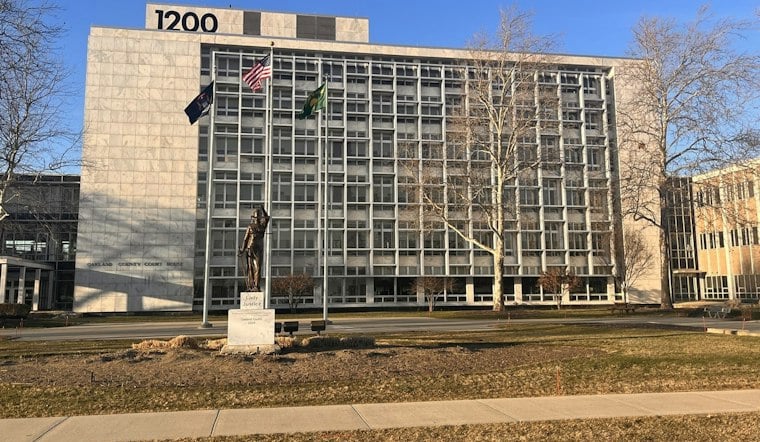
A federal appeals panel in Cincinnati heard arguments Wednesday over whether Michigan courts must give the public access to audio and video recordings of courtroom proceedings, not just written transcripts — a fight that began when a Michigan woman said an Oakland County judge lost her temper with her brother and denied him a chance to explain himself.
The case, according to Law360, centers on Samantha Hallman, who filed a federal lawsuit in Michigan in April 2025 after courts in Oakland County and Novi denied some or all of her requests for recordings tied to her brother's court proceedings. Oakland County courts had released a transcript of the proceeding but withheld the audio recording itself, and a federal judge later dismissed Hallman's case, ruling that court recordings are not protected by the First Amendment, the outlet reported.
Hallman has said she wanted the recording made public in part to encourage voters to elect a better-qualified judge, and she argued that the state court rule blocking its release violates the First Amendment. The dossier contains conflicting descriptions of the underlying hearing: Courthouse News Service reported that Hallman sought audio from her brother's sentencing hearing in a misdemeanor marijuana-possession case, while Michigan Advance reported that she alleged abusive conduct during a probation-violation hearing. Michigan Advance also reported that Hallman was allowed to view a recording but was denied permission to disseminate a copy to the public, legislators or other policymakers.
Arguments Before a Three-Judge Panel
The case was heard by a three-judge panel of the Sixth Circuit made up of Judges Jeffrey S. Sutton, Eugene E. Siler Jr. and Karen Nelson Moore. Hallman's attorney, Sophia Miller, told the court that denying access to recordings amounts to a First Amendment violation, arguing that the Constitution and principles governing access to judicial proceedings support release of the recording, per Law360's report. Lawyers for the Oakland County judges countered that there is no constitutional right to access or copy the recordings, and that written transcripts already satisfy transparency requirements.
Those lawyers also argued that whether recordings should be publicly available is ultimately a policy question for lawmakers rather than the courts, telling the panel the official record of a proceeding is the written transcript, not the audio or video. Judge Sutton, who was appointed by former President George W. Bush, pressed on the practical consequences of ruling for Hallman, warning that constitutionalizing the issue could lead to the opposite of what plaintiffs are seeking if courts respond by declining to record proceedings at all.
A Panel Reluctant to Tip Its Hand
The panel appeared skeptical of Hallman's claim that the public has an outright right to publish court recordings, and it did not issue a decision from the bench, Courthouse News reported. Siler, appointed by former President George H.W. Bush, and Moore, appointed by former President Bill Clinton, rounded out the panel alongside Sutton.
Michigan's Patchwork of Recording Rules
The fight lands amid broader uncertainty over recording access across Michigan's courts. The State Bar of Michigan has said there is no consistent rule in Michigan trial courts governing public access to recordings of courtroom proceedings, and it has noted that several courts livestreamed hearings during the COVID-19 pandemic only to later stop livestreaming or archiving those streams, according to a State Bar of Michigan proposal. That same proposal argued recordings can capture information transcripts omit, including demeanor, nonverbal communication and possible transcript errors, and noted that Kentucky, Ohio and Tennessee — the other three states within the Sixth Circuit — generally make court recordings available to the public.
A separate Michigan State Court Administrative Office standard for virtual courtrooms states that public and press access must be provided during a proceeding or immediately afterward via video recording, unless the proceeding is closed or access is otherwise limited by statute or rule. Federal court records reviewed via GovInfo identify the underlying case as Hallman v. Reeds et al., filed in the U.S. District Court for the Eastern District of Michigan, naming Lisa L. Asadoorian, Jeffery S. Matis and Travis Reeds as defendants.
Precedent Cuts Both Ways
Courts elsewhere have grappled with similar questions. The Sixth Circuit itself held in a 1986 case, United States v. Beckham, that denying media copies of audio recordings played at a criminal trial did not violate the media's constitutional right of access, according to a summary on Reason. In a separate case, Stevens v. Boyd, a federal judge similarly concluded the First Amendment does not provide a right of access to audio recordings when transcripts are already available.
Not every ruling has cut the same way. A Pennsylvania federal court found in 2020 that a rule banning the public from making its own audio recordings of Philadelphia bail hearings was unconstitutional, though the court also said such recording could be barred if official recordings or transcripts were obtainable, per Ballard Spahr. A Reuters column also flagged a related 2024 appeals question over whether viewers of a publicly livestreamed state-court hearing have a First Amendment right to record or photograph it themselves.
Federal appeals courts and the Supreme Court already offer audio streams of most hearings, and some federal district courts stream audio of their own proceedings as well. The Supreme Court added an audio livestream of its oral arguments in 2020 during the pandemic, though it remains resistant to cameras in the courtroom. Michigan Advance separately reported that a video from a Hamtramck hearing, involving a judge accused of berating a cancer patient, drew voter attention and was followed by the judge's apology — an example cited in reporting on the broader push for recording access, though it is not part of Hallman's case.




