

























































Four plexiglass panels holding hundreds of colorful handmade lace roses, arranged into the shape of a bird in flight, now hang inside the rotunda of Milwaukee City Hall. The installation, called Bird of Hope for Peace, is the work of internationally recognized Slovenian artist Eva Petrič, and it is on view in the historic civic space through October 14.
The piece began far from Wisconsin. According to Urban Milwaukee, Petrič started assembling the work after she saw a bird-like image formed in lace on the grounds of a former Nazi concentration camp on the Slovenian-Austrian border. That site was the Ljubelj camp, a forced-labor subcamp of the Mauthausen concentration camp, where Petrič laid out individual lace roses during a performance piece to form the dove shape, according to Urgent Matter.
The nearly 1,000 lace flowers that make up the finished piece, known as Roses of Hope, were woven by more than 500 lacemakers from 11 countries, per Urban Milwaukee's reporting on the unveiling. The pattern was designed by Maja Svetlik following a 2023 open call co-organized with the Idrija Lace School and the Idrija Tourist Board, as detailed by Slovenia.si. The individual roses were donated during the 2024 Idrija Lace Festival before being woven into the final installation, the outlet reports.
A Craft With Deep Roots
The bobbin lace-making tradition centered in Idrija carries real cultural weight beyond Slovenia's borders. UNESCO added the centuries-old technique to its Representative List of the Intangible Cultural Heritage of Humanity in 2018, according to OIDFA, the international lace organization. That recognition underscores why the artwork's delicate material carries such symbolic force for Petrič, who said lace's combination of fragility and durability symbolizes human connection, per Urban Milwaukee's account of the unveiling.
Petrič holds degrees in psychology and visual arts from Webster University in Vienna and an MFA from Transart Institute Berlin, and she was awarded the Prof. Hamano Special Award at the Utazu Art Award Biennial in Japan last year, according to the Arts and Architecture Conservancy at Saint Peter's. The artist works across Vienna, Ljubljana and New York in photography, installation and performance art, the conservancy notes.
Before reaching Milwaukee, the installation had already traveled widely. Urban Milwaukee reports it was previously shown in Idrija, Slovenia; Vienna, Austria; and the Narthex Gallery in Manhattan. That Manhattan stop ran from March 11 to July 31 this year at Saint Peter's Church near the United Nations headquarters, part of New York City's longest-running public arts program, according to the conservancy. The Manhattan exhibition was paired with photographs and a documentary video recording the names of all the contributing lacemakers, the conservancy adds.
Milwaukee's Slovenian Ties, and Civic Backing
The unveiling at City Hall drew Lafayette Crump, commissioner of the Department of City Development, who spoke at the event. Crump said the work began in a place of human suffering and became a shared symbol of hope, Urban Milwaukee reports, adding that art reminds people of their shared humanity and that this particular piece resonates in Milwaukee.
Jeffrey Martinka, president of the Milwaukee Slovenian Arts Council, thanked Rob Frank for introducing the idea of bringing Petrič's work to the city, according to the same report. Milwaukee has deep Slovenian roots to draw on: immigrants began establishing a distinct community in the city's Walker's Point neighborhood in the late 19th century, opening social halls and founding St. John's Catholic Church in 1916, according to the Slovenian Cultural Society Triglav.
That legacy still shows up in the numbers. Wisconsin ranked third-highest in the country for people with Slovene ancestry in 2024, with 8,508 people, per World Population Review data cited by Urban Milwaukee, while Milwaukee ranked fifth among 52 U.S. metro areas for Slovenian population, with 3,554 residents, according to Neilsberg figures in the same report. Petrič said she has been observing and learning from the Milwaukee community during her visit, per the outlet.
A Fitting Civic Stage
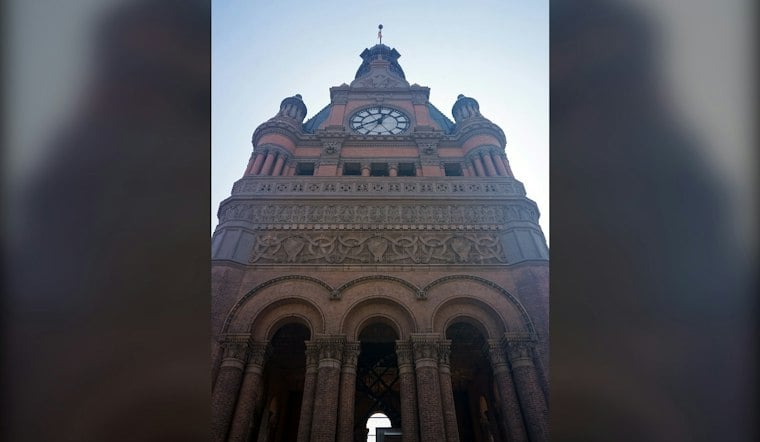
Milwaukee City Hall itself adds another layer of gravity to the display. Completed in 1895 in German Renaissance Revival style with an eight-story open atrium rotunda, the building was designated a National Historic Landmark in 2005, according to the National Park Service. The rotunda has become a regular stage for civic art, having hosted a Ukrainian flag display ceremony in August 2025 and the Growing in Numbers exhibit honoring female common council members, which Hoodline reported on last year.
Bird of Hope for Peace will not stay in Milwaukee long. Urban Milwaukee reports it remains at City Hall through October 14 before heading to the International Institute of Wisconsin's Holiday Folk Fair at Wisconsin State Fair Park from November 20 to 22. Billed as the largest indoor international festival in the United States, the Holiday Folk Fair has been organized annually by the International Institute of Wisconsin since its founding in 1943, according to Wikipedia's entry on the event, and it draws thousands of visitors each November.
The move from a Manhattan gallery near the UN to a Midwest civic rotunda, and then to a folk festival exposition hall, traces a path from international diplomacy to grassroots heritage celebration. For a fragile artwork built from thousands of hand-tied lace roses, each stop adds another layer of meaning to a piece that started as one artist's response to a place of atrocity.





