

























































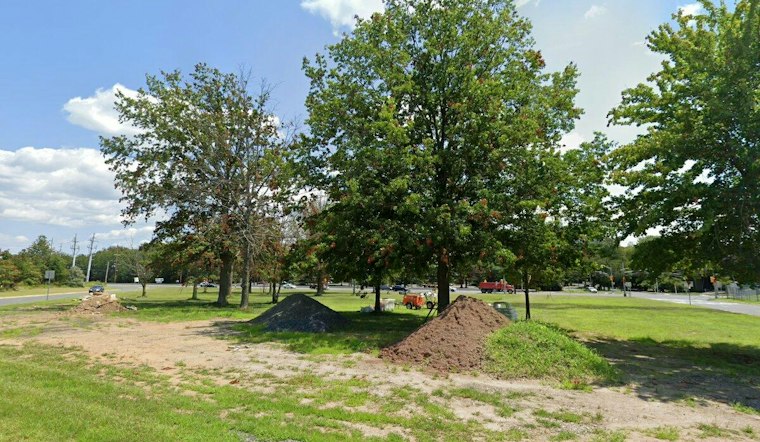
A sprawling data center rising on the old Princeton Nurseries land along Route 1 in South Brunswick wants state approval to run 12 diesel-fired emergency generators, and the fight over that permit has pulled in Princeton's mayor, a university professor, and hundreds of nearby residents. New Jersey officials are weighing whether to approve the air pollution permit, which would let the facility operate the generators during power outages, construction and repairs, and grid-ordered voltage reductions, while limiting routine testing to 28 hours a year per unit.
A 143-Acre Project Already Under Construction
The 341,000-square-foot data center sits on roughly 143 acres at 4405 Route 1, on what was once part of the historic Princeton Nurseries property, according to NJ.com. The site sits near the Princeton border in Mercer County and is adjacent to Kingston, an unincorporated community spanning South Brunswick and Franklin Township, per the same report. Sentinel Data Centers is developing and will operate the facility, though the identity of the eventual tenant has not been made public. Construction has continued despite legal challenges, and completion is expected by the end of 2026, CentralJersey.media reports.
South Brunswick approved the project in May 2025. NJ.com also mentions a lawsuit over the project. Princeton University sold the site to WRV in 2024, the outlet adds.
Draft Permit Sets Limits, But Residents Say It Undercounts Risk
The draft permit, covering all 12 backup diesel generators, sets annual emissions caps of 12.65 tons of nitrogen oxides and 3.52 tons of carbon monoxide, according to Town Topics. It would restrict simultaneous generator testing and bar routine testing on days with unhealthy air-quality forecasts, and NJDEP's health-risk assessment described the potential danger from air toxics as negligible under the department's guidelines, the outlet reports. The permit would also require hour meters on each generator, logs of every run, and fuel-sulfur records, per NJ.com.
Critics argue those numbers rest on a narrow scenario. Kip Cherry said, per NJ.com, that the permit assumes only one generator running at a time for limited testing and fails to represent the facility's full potential emissions. Kirk Frost told officials that all 12 generators appeared already installed while the facility awaits an operating permit, and separately said a permit that counts only the smallest-use scenario while ignoring others cannot fulfill NJDEP's healthy-air mission, NJ.com reports. The draft permit classifies the data center as a minor source of air pollution, which entails lighter monitoring and reporting requirements than a major-source designation would bring, including stricter limits and more rigorous federal review, according to the outlet.
That classification has become a flashpoint. Sentinel's attorney previously indicated the developer planned 20 generators, and Princeton's mayor and council said in an October 1 written statement that the data center would have 20 generators, describing the emissions classification as misleadingly characterized as minor sources, NJ.com reports. The town's governing body urged NJDEP to deny the air permit application for the center in its present form, a statement Town Topics also captured. Princeton officials have said the generators will undoubtedly send emissions across municipal boundaries and into Princeton neighborhoods and toward two elementary schools, per the same account.
Neighbors Describe Schools, Eagles, and a Scramble for Information
Kirstin Valdez Quade, a Princeton University professor who owns a home bordering the site, said emissions would be inhaled by young children and children with autism living near the facility, according to NJ.com. The outlet reports that nearby properties include a nursery school, an autism school, two private K-12 schools, and senior housing, while the Mapleton Preserve immediately adjacent to the site is described as home to nesting eagles and other wildlife. Prabhakar Shanmugam, who represents roughly 600 families in nearby Princeton Landing, was also among those raising concerns, per the report.
Jane Lafferty said the project felt like it was under the wire and that she struggled to find information online, NJ.com reports. Some hearing attendees learned of the project only two days before NJDEP's September 23 session at the Princeton Marriott at Forrestal, which NJ.com says drew roughly 100 people over about three hours. Speakers at the hearing opposed the proposed permit, with some asking the state to classify the facility as a major source of air pollution instead. An NJDEP hearing officer said the department will publish a written response to comments alongside its final decision, NJ.com reports.
Comment Deadline Pushed Back as Opposition Organizes
State officials extended the written-comment deadline, which NJ.com reports had run from an original date to November 9, 2026, with written comments carrying the same weight as in-person testimony. Comments should reference program interest number 19525 and permit activity number PCP250001, the outlet notes. Town Topics likewise reports the comment period was extended to November 9, while Patch's account frames the extension similarly in its own coverage of the DEP's decision.
Opponents also point to the scale of the backup system itself: roughly 400,000 gallons of diesel fuel would be stored on-site to supply the generators, per CentralJersey.media. A South Brunswick resident's petition seeking to stop or suspend the project's approvals had attracted hundreds of signatures by early summer, the outlet adds. Food & Water Watch organized a rally calling for a statewide data center moratorium, according to NJ.com. A proposed New Jersey bill would require NJDEP to study data centers' environmental and infrastructure impacts and temporarily halt new construction while that study is completed, Town Topics reports.
A Vineland Case Looms Over the Debate
Opponents frequently cite a separate enforcement action as a cautionary tale. NJDEP announced a $1.07 million penalty against the DataOne data center in Vineland after it allegedly installed and operated 62 large natural-gas generators without required permits and operating certificates, according to Town Topics. NJ.com reports that the Mikie Sherrill administration ordered DataOne to obtain permits immediately or shut down the generators, and that Vineland neighbors sued over constant noise from the site.
The Vineland case fits a broader pattern residents say they are watching closely: data centers run 24 hours a day and consume large amounts of power and water, and some residents near other facilities complain about a constant hum from machines supplying computing power for AI companies, per NJ.com. Middlesex and Hudson counties account for more than half of New Jersey's operating data centers, and roughly 100 New Jersey towns have moved to ban them outright, the outlet reports. The region's air-quality stakes were also raised by South Brunswick critics, who note the EPA reclassified the New York-New Jersey-Connecticut ozone area from moderate to serious under the Clean Air Act in 2024, according to NJ.com.
For now, the data center's day-to-day power source is not detailed in the draft permit or the state's public notice, and no final decision date on the air permit has been announced. State officials have said they will post a response to public comments on NJDEP's website before issuing a final ruling, giving Princeton officials, Sentinel's critics, and South Brunswick residents until November 9 to make their case in writing.




