

























































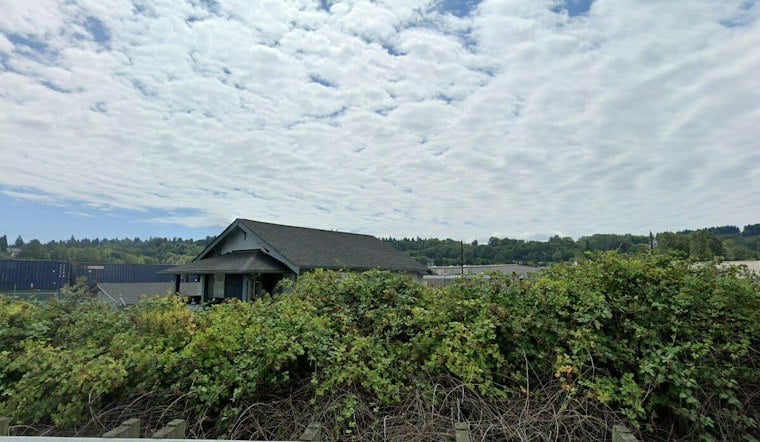
Seattle's largest tiny house village has opened its doors in South Park, giving 90 people experiencing homelessness a locking door, a bed and a path toward stability. Cloverleaf Village includes fully insulated 8-by-12-foot homes equipped with heat, air conditioning, electricity, windows and furnishings, along with a community kitchen, 10 bathrooms, a laundry facility, case management offices, community gathering spaces and a dog run.
The village is run by the Low Income Housing Institute, which describes Cloverleaf as its newest and largest tiny-home development, according to KOMO News. LIHI already operates 19 tiny house villages across King and Pierce counties and manages more than 4,000 affordable apartments, and the nonprofit says it sheltered more than 1,663 adults and children in tiny houses last year alone. Staff are on-site at Cloverleaf around the clock, and referrals into the village are facilitated through the Seattle Human Services Department.
A Grand Opening With City Leaders
Cloverleaf's grand opening drew Seattle Mayor Katie Wilson and former Washington Gov. Christine Gregoire, who now leads Challenge Seattle, as featured speakers. Wilson said the village provides shelter, stability, case management, a kitchen, a lockable door and a path to getting back on one's feet, per the station's report. LIHI Executive Director Sharon Lee said Seattle faces a housing crisis in which shelter and affordable housing options have not kept pace with growing need.
According to the Low Income Housing Institute, the project was developed with New Direction Missionary Baptist Church serving as its faith sponsor, and it will operate as a 24/7 enhanced shelter open to individuals, couples and people with pets. LIHI says the village is designed to help residents obtain identification, apply for income support, and access health care, supportive services, employment and housing, a scope of case management also confirmed by the West Seattle Blog, which reports that behavioral health services are planned to be available onsite as well.
Funding From Microsoft, Starbucks and a City-Backed Accelerator
Nearly $2.8 million in grants from the Shelter Accelerator Fund helped make Cloverleaf possible, per LIHI's own account. That fund is described as a joint effort of the City of Seattle and Challenge Seattle, supported by the Seattle Foundation, and LIHI says it enabled the organization to respond to the housing crisis by building the village. LIHI also says $3 million in private contributions came from Microsoft, T-Mobile, Starbucks, John Stanton and Terry Gillespie. KOMO News previously reported that the city had finalized a lease for the South Park property and expected the site to open within a few months, a timeline that has now played out with Cloverleaf's opening.
Oversight of the village will come from a Community Advisory Committee made up of local residents, business owners, faith leaders and community representatives, which is set to meet monthly to provide input and oversight, according to LIHI. LIHI says it plans to offer wrap-around services and pathways to permanent housing for residents who move through Cloverleaf.
Part Of A Broader, Uneven Shelter Push
Cloverleaf's opening lands amid a citywide push to add shelter capacity that has fallen short of its original goal. KOMO News reported that Seattle's plan to open 500 emergency shelter units before the World Cup will not be met, though Mayor Wilson said she now expects as many as 300 shelter units to be online by the end of summer. Other projects in the pipeline include a 75-unit pallet shelter in Interbay along with Glassyard Commons, Brighton Village and Capitol Hill Village, per KOMO's reporting.
South Park is not new to this kind of shelter work — the neighborhood is already home to Camp Second Chance, and KIRO 7 reports that camp is the leading candidate to expand from its current 69 units to 250. Nearby, the planned Glassyard Commons site is expected to add 72 RV spaces and 20 tiny homes, KIRO 7 reported. Elsewhere in the city, Belmont Village on Capitol Hill opened with 31 tiny houses measuring the same 8-by-12 feet as Cloverleaf's, built in just 75 days for $1.1 million after construction began in May, according to Capitol Hill Seattle. The Olympic Hills Tiny House Village in Lake City, meanwhile, opened with 45 houses, eight of them ADA compliant along with the village's support buildings, offering residents case management, health care coordination, benefits enrollment, employment connections and legal-system navigation, per the King County Regional Homelessness Authority.
The Numbers Behind The Need
The scale of the need driving these projects is stark. LIHI notes that the January 2024 Point-in-Time count recorded 16,868 homeless individuals in King County, with 58%, or 9,810 people, living unsheltered. Statewide, the 2025 Point-in-Time Count found 22,173 people experiencing homelessness in Washington, a 4.4% increase from 2024 and a 25% jump from 2022, according to the Washington State Standard. That same count found 33% of people experiencing homelessness statewide were unsheltered while 67% were in some form of shelter, a split that underscores why villages like Cloverleaf matter even as they fall short of covering the full need.




