

























































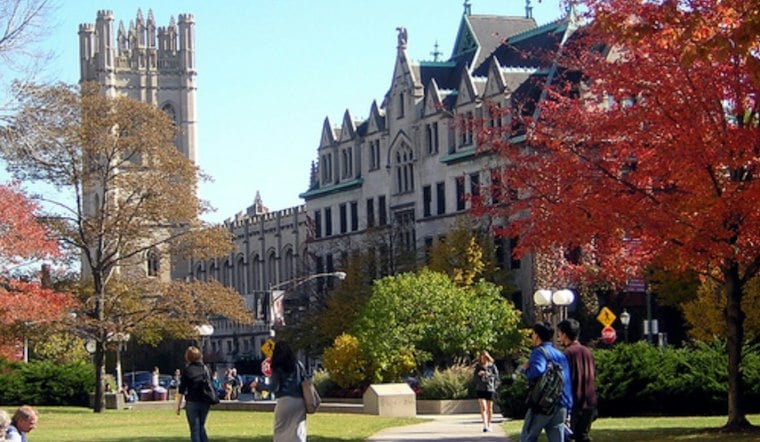
Thousands of children and adults streamed onto the University of Chicago campus Saturday for the fifth annual South Side Science Festival, where more than 130 hands-on demonstrations covered everything from biology and aerospace to physics. Families played games, ran experiments, and fired off questions to professional scientists during the free, single-day event.
The festival, as WBEZ reports, drew on a model familiar in Germany: the Long Night of Sciences, a public science festival in which universities and research labs throw open their doors to the public for a night of exploration. UChicago organizers set out to replicate that spirit while zeroing in on South Side communities specifically, with the explicit goal of closing the gap between neighborhood residents and the researchers working just blocks away.
More than 600 UChicago faculty members, graduate students, postdocs, and staff volunteers helped run the day's 130 interactive demonstrations, according to UChicago News. The event is co-organized across the university's Biological Sciences Division, Physical Sciences Division, Pritzker School of Molecular Engineering, and Office of Civic Engagement, reflecting a deliberately cross-departmental effort to pull the whole campus into one day of public outreach.
Born Out of Pandemic-Era Distrust
The festival's roots trace back to September 17, 2022, when it launched on UChicago's science quads explicitly to address growing public skepticism and trust gaps around medicine and research in the wake of the COVID-19 pandemic, per the Chicago Quantum Exchange. Luke Dyer, an organizer of the festival, said the event was a direct response to fears and distrust in medicine that surfaced after the initial COVID-19 outbreak, according to WBEZ. He said the festival brings people onto campus to see UChicago science up close and get their questions answered directly.
Maanasa Raghavan, an associate professor in the Department of Human Genetics and a founding organizer of the festival, said it was designed to replicate the Long Night of Sciences model while focusing squarely on South Side communities. She told WBEZ that polarizing opinions about science professionals, along with federal funding cuts in science, can be demoralizing for researchers. Seeing thousands of people turn out each year, she said, demonstrates the importance of scientists' work and may even help foster the next generation of young scientists.
Student Volunteers Find Their Own Reward
The payoff isn't only for visitors. Michelle Bessiake, a Ph.D. student who has led demonstrations at the festival for the past three years, spends upwards of 60 hours a week researching and running experiments in her own work, per the same WBEZ report. She said volunteering at the festival grounds her and pushes her to do better work, and she described watching children play with slime while asking questions that, without realizing it, connected to scientific concepts like vaccination.
Elsewhere on the quads, specific exhibits translated advanced research into kid-friendly form. Immunoengineering Ph.D. student Madhumitha Prakash led a demonstration showing how introducing geometries makes microfluidic flow more turbulent to produce green, according to the Pritzker School of Molecular Engineering. Chemistry Associate Professor John Anderson, a lead faculty organizer, returned once again as “Dr. DiNitrogen,” freezing and shattering fruit with liquid nitrogen for the crowd, per the UChicago Event Calendar.
Competitions Push Scientists to Talk Plainly
Beyond the booths, the festival built in formats meant to sharpen how researchers communicate. The program included a Science Slam and an Upgoer 5 challenge, in which researchers had to explain complex scientific principles using only common, basic vocabulary, according to a Facebook video posted by the university. The idea, consistent with the festival's broader mission, is to strip away jargon and make research more accessible.
Academic research on public science engagement has classified the South Side Science Festival as a centralized, single-day university campus festival, a model designed to minimize campus disruption while still giving the community concentrated access to facilities, per a study published in MDPI. The festival brought more than 2,500 people to campus.
A South Side Family's Day Out
Among this year's visitors was Nijel Mottley, a south suburb resident who brought his 4-year-old son, Remy, to the festival specifically to nurture the boy's budding interest in science. Remy enjoys mixing things and watching science shows on YouTube, WBEZ reports, and his father said he believes more scientists are needed to help solve the country's broader societal issues.
The festival's growth also reflects institutional backing well beyond UChicago's own quads. Chicago Public Schools promoted this year's event district-wide as an official anchor of STEAMtober, a two-week campaign encouraging students to explore science, technology, engineering, arts, and math, according to a community letter from Chicago Public Schools. UChicago has also framed the festival as a public-facing piece of its broader Inclusive Innovation initiative, a partnership with the University of Illinois Urbana-Champaign, Argonne National Laboratory, and Fermilab aimed at building a more diverse STEM workforce on Chicago's South Side, per UChicago News.





