

























































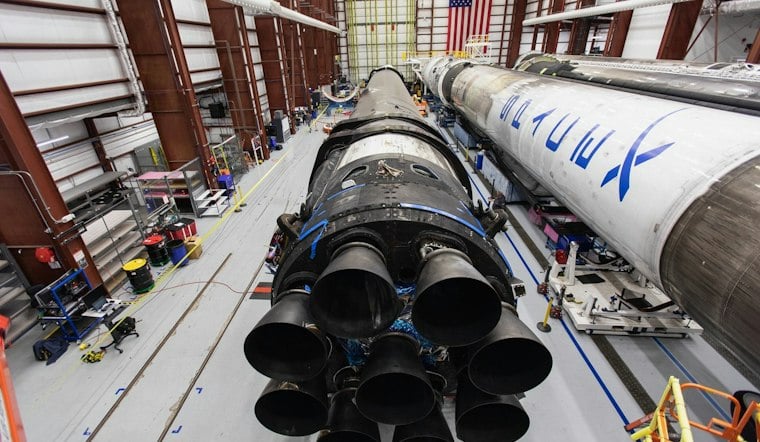
SpaceX shares climbed nearly 8% in after-hours trading Tuesday after the company reported its first profit as a public corporation, posting $4.4 billion in net income on revenue that beat Wall Street's expectations. The results, covering the quarter ended September 30, also reignited speculation about a possible merger with Tesla that would rank as the largest corporate combination in history.
According to the Los Angeles Times, SpaceX shares rose $1.71 to $159.50 after hours, building on a stock that closed 19% higher on its first trading day following the company's $86 billion initial public offering on June 12, 2026, at $135 a share. The stock had dipped to a July low of $104.83 before rebounding. Tesla shares, meanwhile, rose a more modest 1.2% on the merger chatter.
The quarterly net income swung sharply from a $1.1 billion net loss in the same period a year earlier, beating analysts' estimate of $1.88 billion, the Times reported. SpaceX posted revenue of $14.6 billion for the quarter, up from $7.8 billion in the second quarter, with capital expenditures of $19.59 billion directed mainly toward artificial intelligence computing — an arena where the company competes directly with OpenAI and Anthropic, maker of the Claude chatbot.
Three Business Lines, All Firing
SpaceX president Gwynne Shotwell said the company had strong momentum across all three of its business segments, according to the Times, as SpaceX livestreamed its investor presentation on X and showed footage of Starship's September 28 flight. The company also renamed its artificial intelligence division its Super Intelligence business, following President Trump's decision in September to rebrand the broader AI industry.
That AI unit recorded $7.56 billion in quarterly revenue and $431 million in operating income, a sharp reversal from a $1.26 billion loss on $2.56 billion in revenue just the quarter before. SpaceX's connectivity segment, which includes Starlink, posted $5.25 billion in revenue and $2.37 billion in operating profit, exceeding its second-quarter marks. Starlink added 1.6 million subscribers worldwide, excluding enterprise contracts, and now counts nearly 14 million customers across 174 markets, the Times reported.
Mobile connectivity is also expanding fast: SpaceX reported 22 million mobile users worldwide, up 37% from the second quarter, as the company buys spectrum from other carriers to grow that business. The expansion comes as regulators have cleared the runway — the Federal Communications Commission approved a dedicated 15,000-satellite V2 Mobile constellation on October 6, according to RV Mobile Internet, designed to connect ordinary smartphones directly to Starlink without special hardware. The FCC had already granted SpaceX an international Section 214 license for Starlink Mobile the prior month, per BASENOR, authorizing the company to carry mobile voice and data traffic across U.S. borders.
Launches, Starship and a Rocky September Test
SpaceX's space business, the segment that includes launches, posted $1.77 billion in revenue, up from $962 million in the second quarter, with losses shrinking to just $7 million from $542 million. The company conducted 35 launches in the space-business segment during the quarter, 21 of them to deploy Starlink satellites, per the Times.
Starship's September test flight reached orbit for the first time but was cut short due to safety concerns, even as it managed to deploy Starlink satellites carrying data capacity equivalent to ten Falcon 9 launches. CEO Elon Musk said the company's future hinges on Starship, which is slated to eventually carry astronauts to the moon and launch hundreds of thousands of communications satellites and orbiting data centers. Musk predicted Starship could fly weekly or twice weekly by the end of 2027, and SpaceX said it plans to try capturing both the rocket's first and second stages on the launch pad during its next flight.
Vandenberg Space Force Base in Santa Barbara County remains central to that launch cadence. Hoodline previously reported on a Falcon 9 launch from the base involving a booster on its sixth flight and a military payload.
A Merger That Would Reshape Hawthorne
Perhaps the quarter's biggest headline wasn't financial at all: SpaceX and Tesla have formed special committees to explore a potential merger, which the Times reports would be the largest merger of all time if it happens. Musk, who serves as chief executive of both companies, said combining them has merit and could help develop superintelligence software, but he said he is not participating in the committee discussions because he is a conflicted party.
The conflict runs deep. Musk controls roughly 85.1% of SpaceX's voting power through a super-voting share class, compared with about 20% equity in Tesla, according to Deep Research Global — a voting-power asymmetry that creates significant hurdles for independent committees tasked with evaluating fair terms. The two companies, per the Times, have yet to agree on terms.
Tesla already holds an indirect financial stake in SpaceX: when SpaceX acquired xAI in February 2026, Tesla's existing $2.0 billion Series E investment in xAI Holdings converted into a Class A common equity stake in SpaceX worth less than 1% of the company, according to Benzinga, citing SpaceX's SEC filings. Wall Street analyst Dan Ives of Wedbush Securities had predicted as early as March that the two companies would formally merge in 2027, pointing to shared artificial intelligence initiatives and joint infrastructure projects such as a planned shared Terafab facility, as reported by Seeking Alpha.
Both companies' Texas footing could also shape where any merger fight plays out. Tesla shareholders voted in June 2024 to reincorporate in Texas after a Delaware Court of Chancery decision invalidated Musk's $56 billion Tesla pay package, aligning Tesla's jurisdiction with SpaceX, according to the Columbia Law Review.
Still Hawthorne's Biggest Employer
Even with its corporate headquarters now in Texas since 2024, SpaceX was founded in El Segundo in 2002 and still retains large operations in Hawthorne, the Times noted. That local footprint is substantial: SpaceX remains Hawthorne's largest employer, with more than 7,600 Los Angeles County employees at its 1 Rocket Road campus as of 2025, and the company recently acquired an additional six-acre parcel on Wilkie Avenue for $22 million, according to LA County Politics.
That computing buildout is a big part of why Wall Street is watching the AI division so closely. SpaceX ended the quarter with 1.7 gigawatts of computing capacity and plans to add at least 13 more gigawatts by the end of 2027, building new computing centers in Memphis and Mississippi to power its cloud and AI operations. The company's Grok bot AI agent is gaining customers quickly, the Times reported, part of why widespread merger speculation has taken hold on Wall Street even before Tesla and SpaceX's committees have reached terms.
Other Headlines Swirling Around Musk
The earnings came just two days after Musk posted on X that he would give a share of SpaceX stock to every child in the country, without providing details on how such a gift would work — a pledge that followed Anthropic's announcement the same day of a plan to put 5% of its shares into a new public benefit fund. Hoodline has detailed the legal hurdles facing that proposal.
Separately, the Ukrainian government this month blamed temporary speed restrictions on its military-grade Starlink network for slowing its drone operations; Musk said SpaceX had nothing to do with the restrictions, while reports have suggested the U.S. government may have been behind them, the Times reported. The quarter capped a volatile stretch for SpaceX stock since its record-setting IPO, including an August lockup expiration that freed up roughly $116 billion in previously restricted insider shares, a moment Hoodline covered in depth as L.A. traders braced for the share flood.





