

























































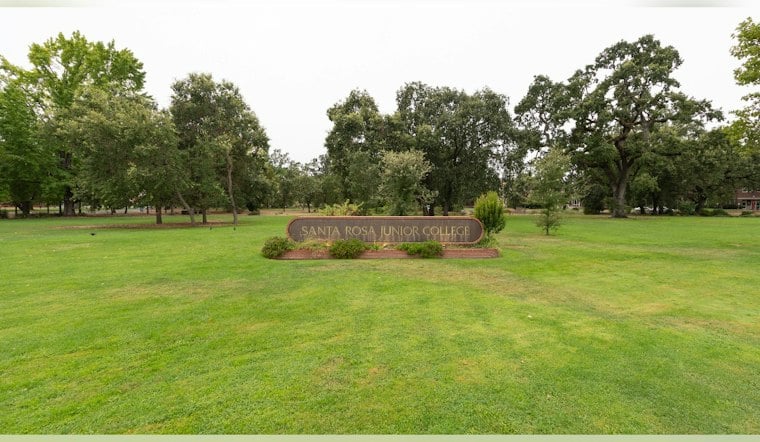
Santa Rosa Junior College is asking voters to approve a record $830 million general-obligation bond this election, and some of the biggest checks funding the Yes on Measure AB campaign are coming from architecture, engineering and construction firms with a history of working on the college's campuses. Among the business and labor donors are companies that built facilities funded by SRJC's last big bond, as well as unions representing tradespeople who could do the work if Measure AB passes.
A Record Bond Backed By Familiar Industry Names
Measure AB is a proposed $830 million bond measure that would fund facilities construction, renovations and repairs across the college, according to The Press Democrat. JGM Architecture Design Construction, which provided construction-management services for projects funded by the college's 2014 Measure H bond, contributed $1,000 to the Measure AB campaign on September 16, after giving $10,000 to the Measure H campaign back in 2014, per the same report. The firm also hosted the Yes on Measure AB campaign kickoff in downtown Santa Rosa in September, and said in a company LinkedIn post dated September 29 that the measure would help SRJC maintain its status as a leading transfer institution and expand its educational programs.
Brelje & Race Consulting Engineers gave $5,000 to Yes on Measure AB in September, after contributing $10,000 to Measure H in 2014, the newspaper's report notes. That firm worked on the Lindley Center for STEM Education, a math and science facility on Elliott Avenue that the college's bond program funded. The Press Democrat describes the Lindley Center as a $75 million, 100,000-square-foot facility, while Brelje & Race's own project page describes it as a $100 million facility with 95,000 square feet of labs, classrooms and offices — the two accounts diverge on cost and size.
More Donors With Past Bond Ties
Quattrocchi Kwok Architects and Wright Contracting each gave $10,000 to Measure AB, after each having contributed to Measure H in 2014 — $10,000 and $15,000, respectively, according to the same Press Democrat report. Labor also showed up with money: the Building Trades Council PAC/Let's Build Responsibly PAC gave $10,000 to Measure AB on October 5, and the North Coast States Regional Council of Carpenters Issues PAC gave another $10,000 on October 26. Individual donor Ryan Gales contributed $10,000 to the campaign on August 17.
As of earlier in the week, the campaign had received 85 contributions totaling $595,590, including 26 donations of $1,500 or more and 59 contributions of $1,000 or less. The college's own foundation gave $175,000 to the campaign, and the Federated Indians of Graton Rancheria contributed $100,000.
Campaign and Experts Defend the Overlap
District contracts funded by the bond would follow bidding processes under California Public Contract Code Section 20651. Sonoma State political science professor David McCuan said contributions supporting large bond measures are common practice and legal.
Similar patterns have shown up elsewhere in California. A 2012 review by SFGATE found that underwriters made 155 political contributions since 2007 to successful school-bond campaigns statewide, totaling $1.8 million, and that in only five of 111 successful campaigns did a donating underwriter fail to land a bond-selling contract. In one Newark Unified School District example cited in that report, De La Rosa & Co. signed a contract to sell bonds for up to 1 percent of a $63 million bond — potentially $630,000 in compensation — before donating $20,000 to the bond measure. A 2011 community-college bond campaign that included Canada College also drew $68,500 from 22 corporate and institutional donors, with construction firms Hensel Phelps, McCarthy Building Companies and Swinerton each giving $25,000 and builder Robert A. Bothman Inc. contributing $50,000, according to The Almanac.
What The Money Would Actually Build
If approved, Measure AB priorities include upgrading classrooms and labs, replacing roofs and HVAC systems, modernizing nursing and healthcare training facilities, and expanding public safety and first-responder training space. The measure would also fund improvements to skilled trades and agricultural education spaces, upgrade technology infrastructure and cybersecurity systems, and pay for accessibility, sustainability and energy-efficiency work — part of what the college describes as a $1.75 billion wish list of modernization and expansion projects. Bond proceeds may be used only for voter-approved capital projects and cannot go toward administrator salaries, pensions or operating expenses, per Santa Rosa Junior College, which also says the measure requires annual independent financial and performance audits, public disclosure of expenditures and oversight by an independent Citizens' Oversight Committee.
Measure AB needs approval from at least 55 percent of voters. The Sonoma County Junior College District Board of Trustees voted in June to place the measure on the ballot, with the district saying it would modernize and repair aging facilities, expand workforce training programs, improve public safety and instructional facilities, and upgrade technology infrastructure.
How It Compares To Past SRJC Bonds
SRJC voters approved a $252 million bond known as Measure A in 2002 and the $410 million Measure H in 2014 — two measures that together brought the college $662 million, with those funds now spent or allocated.
Measure AB is framed to avoid increasing current district tax rates, which currently sit at just under $30 per $100,000 of assessed property valuation. Even so, the bond is estimated to cost taxpayers $1.76 billion including interest by the time it fully matures in 2059, with repayment delayed for a few years before extending through that date. At $830 million, Measure AB would be more than twice the district's previous record bond.





