

























































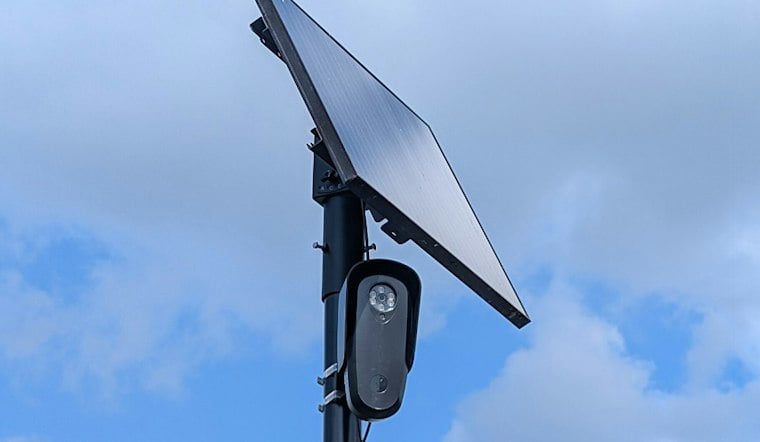
Sugar Hill will keep its two license-plate reading cameras after Mayor Brandon Hembree stepped in to break a tied city council vote against an ordinance that would have shut them off. The mayor cast the deciding vote against the measure, then broke a second tie moments later to hand city staff — rather than the council — control over writing the policy that governs how the cameras can be used.
The ordinance came from council member Gary Pirkle, who wanted the cameras turned off entirely and required council approval before any new ones could be installed, according to WSB-TV. Pirkle said the two cameras were installed roughly two years earlier without any council discussion at the time, a detail that fueled frustration from residents who felt shut out of the decision.
Resident Stephen Greenewald asked the council to shut off the cameras back in September, telling members that Sugar Hill residents never got the chance to approve or reject the technology in the first place. “It's a broad dragnet of all data. And data does not equal safety,” Greenewald said, warning that people may not realize their rights are going away.
A Split Council and a Different Approach
Not every council member wanted the cameras gone. Alvin Hicks argued for safeguards rather than an outright ban, and said he had questioned police departments in four nearby cities about what protections they have in place. He reported that those agencies told him they had seen no misuse because auditing and other protections were already built into their systems — among them Johns Creek police, who operate 55 of the cameras, per Matt Johnson's reporting for WSB-TV. Gwinnett County police, for comparison, operate roughly 1,100 license plate cameras countywide.
That reassurance stands in sharp contrast to what has surfaced elsewhere in Gwinnett County this year. Three Gwinnett County police officers — Renee Downer, Derric Holmes and Matthew Lau — faced termination and criminal charges after an internal investigation revealed misuse of the department's license-plate reader system, according to FOX 5 Atlanta. On Sept. 4, authorities charged Holmes with six counts of misuse of license-plate data and Lau with one count, while all three officers lost their jobs.
Gwinnett Tightens Its Own Rules
In response, Gwinnett police mandated retraining for every officer and cut the department's data retention period from 30 days to 15 days, the station's report notes. The department also overhauled how officers access the database, requiring them to submit search requests with written justifications to a direct supervisor, who now evaluates the need and performs the search rather than letting officers search on their own.
The scale of the problem extends well beyond one department. As of Friday, just under 50 unauthorized access incidents had been disclosed or uncovered across Georgia, with nearly 30 of those in metro Atlanta alone, per the same FOX 5 Atlanta investigation. The company behind the technology, Flock, has since announced its own safeguards nationwide — lowering its default data retention from 30 days to seven and requiring officers to supply a case number or crime type before running a search, according to the Georgia Recorder. That figure differs from what Gwinnett police reported locally, where the department said it moved to a 15-day retention window rather than seven.
What the Cameras Actually Do
Automatic license-plate readers capture plate numbers along with details like a vehicle's make and color, storing everything in a searchable database, the Georgia Recorder reports. Agencies with Flock contracts can tap that database to track stolen vehicles, locate missing people and help solve other crimes. Data from Flock's roughly 120,000 cameras nationwide can also be shared between police departments, though cities can limit which offenses other agencies are allowed to search for, according to ABC News.
A working paper examining Flock deployments across more than 200 law-enforcement agencies found that motor-vehicle theft declined after the cameras went in and clearance rates for vehicle-theft cases rose, though researchers cautioned that some of those improvements had already begun before deployment, as CBS News Atlanta reported.
Other Georgia Cities Are Watching Closely
Sugar Hill is far from alone in wrestling with this. Doraville's city council discussed Flock cameras and other surveillance tools at a recent meeting but stopped short of taking a vote, FOX 5 Atlanta reported. The ACLU of Georgia has said that communities including Doraville, Savannah and others across the state have sought its advice on the cameras, and the organization notes that CCOPS ordinances — which build in oversight requirements — have been adopted in 26 cities nationwide, covering nearly 18 million people.
Some communities have gone further and simply walked away. Stow, Massachusetts, ended its relationship with Flock after an officer was accused of improperly using the system to look up someone he knew, per CBS News Atlanta. In Illinois, Evanston cut ties with Flock after its mayor learned the city's data had been accessed by federal immigration agents and out-of-state prosecutors enforcing abortion bans, according to the Chicago Sun-Times. And in New York City, at least two dozen police officers ran more than 1,700 searches in Flock's nationwide database between March 2023 and December 2025 despite the NYPD having no contract with the company, The New York Times found.
Georgia lawmakers are also taking notice at the state level. State Sen. John Albers said he is working with the Georgia Sheriffs' Association and the Georgia Association of Chiefs of Police on a new task force to examine how to address misuse of the readers statewide, the Georgia Recorder reported. For now, Sugar Hill's two cameras stay on, with city staff — not the council — set to write the use policy Hembree's tiebreaking vote put in their hands.





