

























































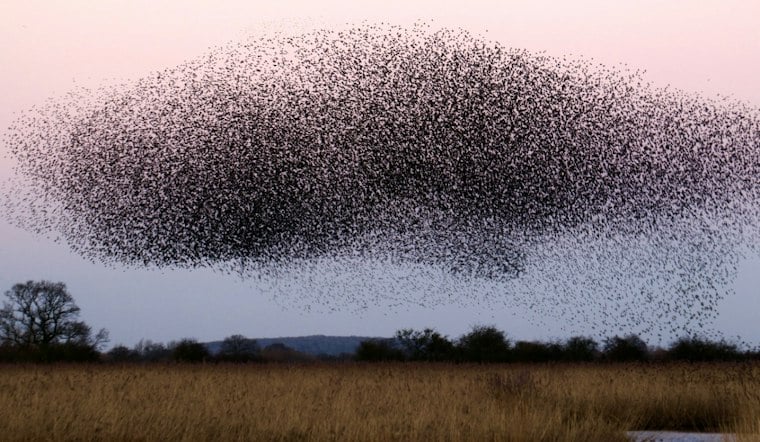
What looked like light rain sweeping across the Tampa Bay area early Monday morning was actually something else entirely: millions of birds in flight. Max Defender 8 radar picked up the signal during peak fall migration, and meteorologists determined the reflectivity values were showing migrating birds rather than precipitation.
According to WFLA, more than 55 million birds crossed Florida overnight during peak fall migration. The station's meteorologists used the correlation coefficient tool on dual-polarization radar to distinguish the biological scatter from actual precipitation, since the coefficient measures how consistent object sizes are within the radar beam and flags lower consistency as nonmeteorological material. That same tool is typically used to spot flying debris from severe storms and tornadoes, but it can also reveal biological scatter from bugs, bats, and birds, the station's report notes.
BirdCast also estimated that more than 55 million birds crossed Florida overnight. In Hillsborough County specifically, BirdCast estimated that roughly 6.7 million birds crossed overnight, with local flight traffic peaking at about 2.8 million birds aloft at once at an average altitude of 2,400 feet.
Why the Signal Shows Up Only After Dark
The reason Tampa's radar caught a migration bloom overnight rather than during the day comes down to bird behavior. More than 80 percent of migratory bird species in North America fly nocturnal routes, typically departing 30 to 45 minutes after sunset and reaching peak flight density two to three hours into the night, according to the Cornell Lab of Ornithology. Flying at night lets small songbirds avoid daytime predators while taking advantage of cooler air and calmer atmospheric conditions.
The technology behind these detections traces back more than a decade. NOAA completed a nationwide dual-polarization upgrade across its NEXRAD radar network between 2011 and 2013, adding vertical electromagnetic signals to the existing horizontal pulses so radars could characterize particle shapes and biological targets, not just storms. The correlation coefficient variable that resulted from that upgrade produces high values near 1.0 for uniform, spherical raindrops, but significantly lower values for the irregular, tumbling shapes of birds, insects, or storm debris, according to the NOAA National Severe Storms Laboratory.
A Continental-Scale Phenomenon
The scale of these movements can be staggering. A record-breaking national migration event detected by radar on September 25, 2025, showed more than 1.2 billion birds flying simultaneously across the continental United States after sunset, representing roughly 10 percent of the continent's total bird population, per the Cornell Lab of Ornithology.
The same radar technology that spots migration blooms can detect birds that pose aviation hazards. Birds accounted for 95.8 percent of reported wildlife strikes on U.S. aircraft in 2015, federal data shows.
Urban Lights Pose a Hidden Danger
While most of the birds crossing Florida overnight travel safely at altitude, bright city lighting presents a serious hazard for the ones that pass low over metro areas like Tampa Bay. Artificial nighttime lighting disorients nocturnal migrants, contributing to an estimated one billion bird collision deaths against glass windows and buildings across North America each year, according to the National Audubon Society. Skyglow can disorient birds, contribute to exhaustion, and increase collision risks with glass.
Some Florida municipalities have responded with formal policy. Atlantic Beach established an official Lights Out migration protection period running from September 15 to November 15, urging property owners to turn off non-essential lighting between 11 p.m. and 6 a.m., according to the City of Atlantic Beach. The city also encourages residents to close blinds and use warmer, shielded lights during peak migration.
The birds moving through Tampa's radar signal are part of the same broader seasonal exodus that has drawn attention elsewhere in Florida this fall. Tracking studies cited in Hoodline's earlier sandhill crane migration report found that 97 percent of radio-tagged eastern sandhill cranes winter in wet prairies and pastures across Florida and southern Georgia, with an 85 percent return rate to the same wintering grounds each year.





