

























































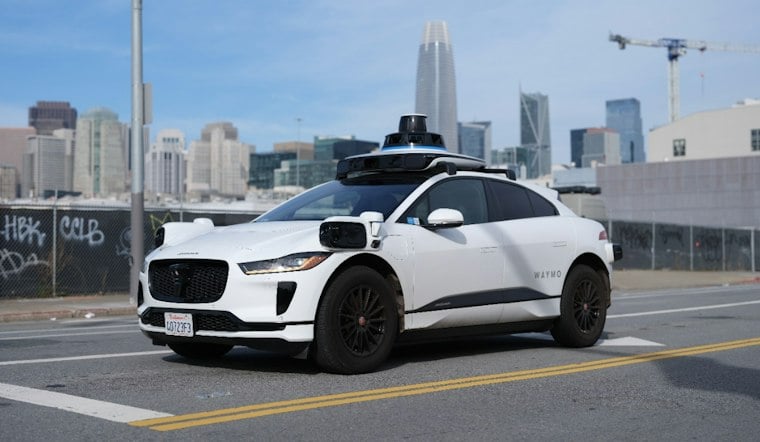
A group of young men riding in a driverless Waymo outside Raymond James Stadium got more than they bargained for Sunday when their robotaxi turned north onto North Himes Avenue, straight into a wall of oncoming post-game traffic. The passengers abandoned the vehicle out of concern for their safety as it got stuck and blocked a lane, according to video of the incident.
The episode unfolded on October 4, 2026, after a Buccaneers game let out at Raymond James Stadium, as reported by WFLA. All lanes on North Himes Avenue had been redirected for southbound-only traffic to help clear the stadium's parking lots, but the driverless Waymo headed north as if it were a normal travel route, appearing unaware that the street had been flipped. A video of the incident's exterior view was sent to the station by Michael Ripatranzone, while a separate clip was uploaded to TikTok by Matt Reardon, per WFLA.
Inside the car, the panic was audible. “I thought we were done for a second there,” one passenger said, while another shouted, “Guys, like, I'm outta here!” before leaving the vehicle. A third passenger summed up the group's frustration more bluntly: “Your driver sucks!”
A Predictable Collision With Game-Day Logistics
The wrong-way move points to a specific blind spot in how autonomous vehicles read the road. Raymond James Stadium seats over 60,000 spectators and relies on temporary contraflow lanes directed by police officers and message boards to clear traffic after games, according to the Tampa Bay Buccaneers. Those post-game procedures systematically convert North Himes Avenue to southbound-only traffic specifically to clear stadium parking lots — a temporary, human-directed change that static digital maps are not built to anticipate.
Waymo confirmed it is looking into the incident. “The trust and safety of the communities we operate in is of paramount importance,” a Waymo spokesperson said, adding that the vehicle briefly entered a temporary one-way street in Tampa before correcting the issue. The company said it plans to learn more from the event and improve, per the spokesperson.
Not the First Wrong-Way Robotaxi in Tampa
This is not an isolated hiccup for autonomous ride-hailing in the city. On July 22, 2026, a driverless Tesla Robotaxi was filmed traveling the wrong way down North Armenia Avenue, just one day after Tesla launched its driverless ride-hailing service in Tampa, according to 93.3 FLZ. North Armenia Avenue is a permanently designated one-way northbound thoroughfare, making that incident a more basic mapping failure than Sunday's temporary contraflow confusion.
The Himes Avenue incident arrived barely a month after Waymo opened its driverless service to the general public in Tampa on September 1, 2026, expanding across a 50-square-mile zone that includes Raymond James Stadium, Ybor City, Water Street, and the Westshore district, as reported by FOX 13 Tampa Bay. The company had mapped Tampa streets in late 2025 before initiating rider-only operations. Despite the rough patch, Waymo met with St. Petersburg transportation officials in August 2026 to discuss expanding its commercial driverless fleet across Tampa Bay into Pinellas County, the station's report notes.
Temporary Lanes Remain a Known Weak Spot
Sunday's confusion echoes a problem Waymo has run into before outside Florida. In March 2026, a driverless Waymo robotaxi caused traffic delays in downtown Houston after attempting to drive the wrong way into a reversible HOV lane on St. Joseph Parkway during rush hour, requiring remote assistance to guide it out, Hoodline previously reported. Waymo relies on remote assistance teams to guide vehicles when automated routing fails, and the pattern suggests temporary or reversible lane directions remain a systemic navigation challenge for the company's software.
None of this has stopped Waymo from touting its broader safety record. The company logged over 271 million rider-only autonomous miles through June 2026, with internal data indicating its automated driving system experienced 90% to 94% fewer serious-injury crashes than human driver benchmarks, according to Waymo. The company currently operates commercial driverless services in over a dozen U.S. markets.
Federal Scrutiny Continues Alongside State Protections
Even so, federal regulators have been paying closer attention. The National Highway Traffic Safety Administration expanded safety evaluations and software recall reviews into Waymo in 2026 following incidents involving vehicles entering flooded roads, failing to recognize construction closures, and passing stopped school buses, according to CBS News. NHTSA requires autonomous vehicle operators to submit incident reports under Standing General Orders.
Tampa city leaders have little room to respond on their own, however. Under Florida Statute § 316.85, fully autonomous vehicles are legally allowed to operate on public roads without a human driver, and state law explicitly preempts local municipalities from creating their own autonomous vehicle regulations, according to the Florida Senate. Separately, Florida Statute § 627.749 mandates that autonomous vehicles operating on on-demand ride-hailing networks carry at least $1 million in primary commercial liability coverage for bodily injury and property damage — far above the $10,000 in personal injury protection required of standard Florida drivers.
Waymo has also been experimenting with ways to smooth out stadium traffic elsewhere. The company partnered with the Las Vegas Raiders at Allegiant Stadium in August 2026 to establish dedicated pickup and drop-off zones aimed at alleviating post-event traffic bottlenecks, Hoodline reported in August. Whether similar measures come to Raymond James Stadium remains to be seen, but for now, Tampa Bucs fans calling a robotaxi after the final whistle may want to keep an eye on which way the car turns.



