

























































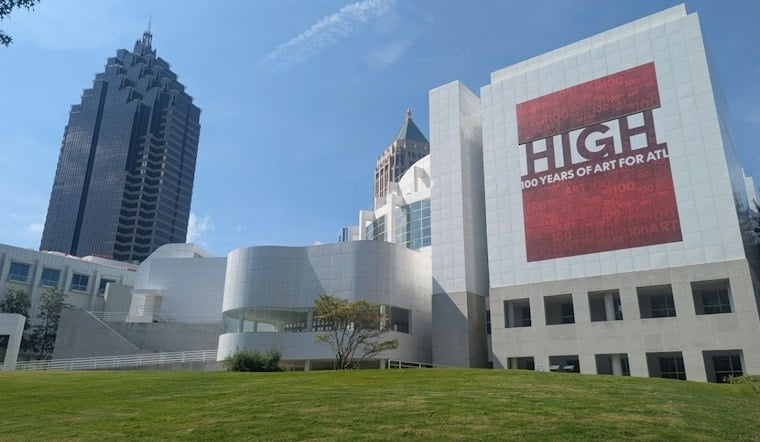
On June 3, 1962, more than 100 Atlantans died when Air France Flight 007 crashed on takeoff at Orly Field near Paris, wiping out much of the city's arts community in a single catastrophic moment. The passengers were arts patrons, collectors and supporters heading home from a European tour, and their deaths would go on to reshape Atlanta's cultural landscape for generations.
The group had just wrapped a whirlwind trip through England, Italy, Holland and Switzerland, many of them members of Atlanta's arts community, according to the Atlanta History Center. They were booked on Air France Flight 007, an Atlanta-bound Boeing 707 known as the Chateau de Sully, for the final leg of their journey home. As 11Alive reports, the crash killed more than 100 Atlantans and left a legacy that continues to shape the High Museum today.
Accounts of the full death toll vary. The Atlanta Journal-Constitution has reported the crash killed 130 people total, including 106 Atlanta arts patrons returning from the tour of European capitals, and described it at the time as the worst disaster in aviation history. The Georgia Encyclopedia, meanwhile, states that 122 passengers died, 106 of them Atlantans, with eight crew members also killed. Two flight attendants seated in the rear of the aircraft survived, according to the AJC's account.
What Investigators Found
Atlantamagazine.com describes the scale of loss in stark terms: gone were much of the city's cultural elite — its artists, collectors, and those who sustained the still-embryonic High Museum and its school, the Atlanta Art Institute, as Atlanta magazine put it. An accident investigation later attributed the crash to a considerable out-of-trim condition combined with a failure of the trim servo motor control system, according to a summary from aviation-safety.net.
Rather than crippling the city's cultural institutions, the tragedy became what the magazine calls a tipping point for Atlanta. In the disaster's aftermath, the Atlanta Art Association evolved into the Atlanta Arts Alliance, per the Georgia Encyclopedia, and the idea of building a single, unified arts center took hold — one intended to make Atlanta a premier destination for arts and culture, according to the Woodruff Arts Center's own account of its history.
From Grief to the Memorial Arts Center
That vision moved from concept to concrete within a few years. Builders broke ground for the Atlanta Memorial Arts Center on June 3, 1966 — four years to the day after the crash — and the center opened to the public in 1968, according to the Georgia Encyclopedia. Coca-Cola leader Robert W. Woodruff donated $6.5 million that year to help establish it, Atlanta magazine reports, and the community's broader response to the tragedy helped fund what would eventually bear his name: the Memorial Arts Center, now known as the Woodruff Arts Center, as WABE has noted.
The new complex became home to the High Museum, the Atlanta Symphony Orchestra, the Alliance Theatre and the Atlanta College of Art, according to High Museum of Art records held by the Atlanta History Center. France itself sent a tribute: a cast of Auguste Rodin's sculpture The Shade, given as a gift to honor the lives and legacies of the Atlantans who died, according to the Woodruff Arts Center. The sculpture still stands on the campus today.
A Legacy Still Visible Today
The arts complex born from the tragedy kept growing for decades. The Richard Meier-designed High Museum building opened in 1983, followed by a $178 million expansion designed by Renzo Piano in 2005, according to Atlanta magazine's reporting. An Americans for the Arts research project later ranked Atlanta first among the 100 largest American cities for its per-capita number of arts-related businesses, the magazine notes — a marker of just how far the city's cultural footprint has traveled since 1962.
The Memorial Arts Building remains part of the Woodruff Arts Center campus, still serving, per the Georgia Encyclopedia, as a vibrant memorial to those who devoted their energies to Atlanta's cultural life. More than six decades later, the crash that devastated a generation of Atlanta's art patrons is remembered not only for what was lost at Orly Field, but for the museum, orchestra and theater halls that rose because of it.




