

























































Three sisters once lived in a 6-by-8-foot shack behind a padlocked gate in downtown Kansas City, Kansas, guarding their family's burial ground with a shotgun that was never actually loaded. Congress had approved selling the cemetery where their relatives were buried, and Lyda, Helena and Ida Conley were not going to let that happen without a fight.
The Wyandot cemetery holds the remains of as many as 600 Wyandots, according to Axios. The tribe was forced from Ohio and Michigan to Kansas, arriving in 1843 after the Delaware tribe gave them land for a burial ground, Axios reports. Nearly 100 Wyandots died within the first year, as measles and other illnesses spread through the group, according to the same report. That grim founding is also documented by KCUR, which describes the hill near the confluence of the Missouri and Kansas rivers and recounts illness and flooding during the group's arrival.
Part of the Wyandot tribe later moved to what is now Oklahoma, and a land surveyor secured the cemetery's sale in federal law for that Oklahoma Wyandot group, per Axios. Lyda Conley, who grew up in Kansas City, Kansas with family buried in the cemetery, earned a law degree in 1902 and sued the government over the planned sale, arguing the government had promised the Wyandot the land forever. That argument traced back to an 1855 treaty that stipulated the enclosed public burying ground in Kansas City, Kansas shall be permanently reserved and appropriated as a cemetery, according to the Wyandot Nation of Kansas.
A Padlocked Gate and an Unloaded Shotgun
While the legal case moved slowly, the sisters took matters into their own hands. They padlocked the cemetery gates, hung a trespassers beware sign, and occupied their small shack on the grounds for years, guarding the graves with a shotgun, the Axios report states. Wyandot Nation of Kansas Chief Judith Manthe, who is related to the Conley sisters as a first cousin three times removed, said the gun was never loaded and the sisters bluffed people with it to keep the grounds safe.
Police jailed the sisters at one point, and Lyda Conley chose 10 days behind bars rather than pay a $10 fine, according to the same report. Manthe has described burial grounds as the most sacred thing because they preserve remembrance, a sentiment that frames why the sisters were willing to risk arrest to protect the site.
A Historic, Losing Supreme Court Case
Lyda Conley eventually argued her own case before the U.S. Supreme Court in 1910, becoming the first Native American woman to argue before the nation's highest court. The Supreme Court Historical Society recounts her argument before the justices. She appeared pro se, without a Supreme Court bar sponsor, after she was unable to find a lawyer to vouch for her admission to the Supreme Court bar.
She lost. In the unanimous January 31, 1910 ruling in Conley v. Ballinger, Justice Oliver Wendell Holmes Jr. held that Conley lacked standing, finding that the 1855 treaty did not legally oblige the federal government to protect the cemetery, per the Supreme Court Historical Society. Holmes noted in his opinion that the court had examined Conley's arguments with great care even as it ruled against her.
The courtroom defeat did not end the fight. Congress repealed the cemetery sale in 1913, and Kansas Senator Charles Curtis — a member of the Kaw Nation who later became vice president — sponsored 1916 federal legislation protecting the cemetery from commercial sale and setting aside $10,000 to maintain it, according to the National Women's History Museum.
The Threats Did Not Stop There
Even with federal protection on the books, the cemetery faced more pressure in the decades that followed. Congress authorized another attempt to sell the cemetery in 1956, but protests stopped that sale, Axios reports. Decades later, the Wyandotte Nation threatened to build a casino over the cemetery, prompting the Kansas and Oklahoma Wyandot groups to reach a 1998 agreement that the cemetery cannot be used for anything else, according to the Wyandot Nation of Kansas. That settlement ended earlier proposals for a gaming facility on the site, and the U.S. Department of the Interior later designated the cemetery, also known as the Eliza Burton Conley Burial Site, as a National Historic Landmark on December 23, 2016, according to the WikiTree record of the site.
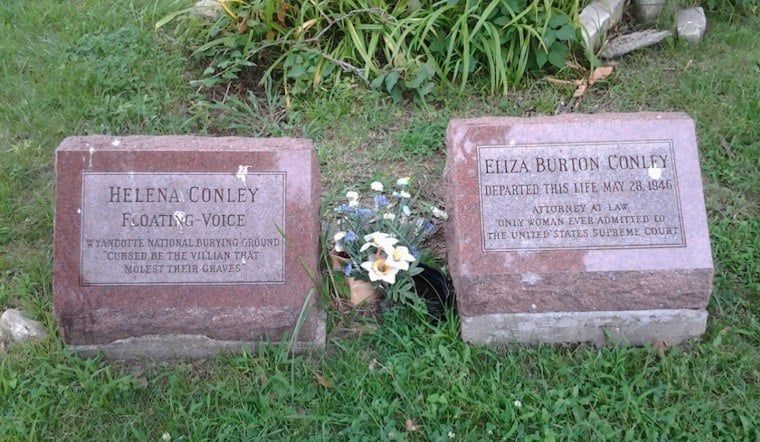
Lyda Conley was killed during a robbery in 1946. Her sister Helena, who gave an interview in the 1950s that the Wyandotte County Museum later found, told the interviewer that nobody would remember the sisters, per Axios.
Keeping the Conley Sisters' Story Alive
That prediction has not held up. The University of Missouri-Kansas City's Starr Women's Hall of Fame inducted Lyda Conley into its Class of 2025 during an anniversary ceremony at the Kauffman Center for the Performing Arts on February 20, 2025, according to UMKC.
A traveling public art installation called Fort Conley, a portable replica of the sisters' shack, has visited sites around the Kansas City metro since debuting at the Wyandotte County Historical Museum in August 2025, according to Axios. The piece, co-created by Monumenta and the Wyandot Nation of Kansas, moved to Johnson County Community College's Nerman Museum, where Chief Manthe has visited Helena Conley's grave during a cemetery tour, per the same report.
Kansas City PBS will premiere a new documentary, Lyda: Wyandot Warrior, produced by Mid-America Emmy winner Emily Woodring in collaboration with Chief Manthe. The film incorporates historical photographs and documents curated alongside the Wyandotte County Historical Museum, according to Kansas City PBS.



