

























































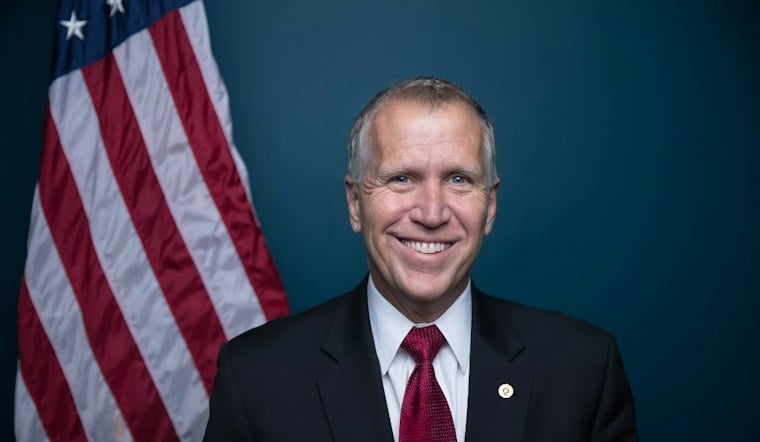
Retiring U.S. Senator Thom Tillis told an energy conference in Cary that Republicans are courting political disaster with their handling of electricity policy, warning that poorly designed rules hand opponents easy attack lines just as North Carolina wrestles with who should pay for the power infrastructure feeding the state's data center boom. “When you make dumb policy, the ads write themselves,” Tillis said, according to the gathering's coverage.
Tillis made the remarks at the Making Energy Work conference, criticizing federal decisions to halt renewable energy projects and abruptly withdraw clean energy incentives, arguing the country needs more electricity and businesses need certainty to build it, as reported by WRAL. He questioned why federal officials would cancel large-scale renewable power purchase agreements and create uncertainty when, in his view, all available generation is needed to keep up with demand. Tillis announced in June 2025 that he would not seek re-election in 2026 after breaking with the party over federal tax and spending legislation, a decision that left him free of campaign considerations when he criticizes his own party's energy strategy, according to POLITICO.
His warning landed as North Carolina regulators sort through exactly the kind of policy fight he described: how to meet surging electricity demand without forcing ordinary households to subsidize infrastructure built for data centers, per the WRAL report. North Carolina Attorney General Jeff Jackson and Governor Josh Stein have said Duke Energy's proposed customer protections leave a gap because they do not require data centers to pay for new power plants outright, the station's report notes. Jackson has argued that large customers should pay for new generation their own demand makes necessary and has called for a separate rate class to track data center costs specifically.
Duke's October Settlement and Its Limits
Duke Energy announced a proposed agreement on October 7 with North Carolina Public Staff, technology companies, and other parties that would require upfront payments for equipment built specifically for large customers, long-term contracts, and minimum monthly bills even when usage falls short of projections, with financial protections if customers leave early. The deal, which still needs approval from the North Carolina Utilities Commission, lowers the threshold for mandatory large-load protections from 100 megawatts down to 50 megawatts for facilities running at an 80% load factor, according to Colocation Scout. Duke Energy's Kendal Bowman said data centers will pay upfront for all costs to connect to the grid, and the company has said the agreement would strengthen existing protections for other customers.
Jackson called the proposal a massive step forward in ensuring data centers pay their fair share, while cautioning that more action remains. Former House Speaker Tim Moore has echoed that companies building and profiting from data centers should bear the costs of serving them, saying those costs should not be passed on to ratepayers. Matt Abele of the North Carolina Sustainable Energy Association said questions remain about whether large customers will cover all system-upgrade costs and argued that data centers should be powered clean while covering 100% of their own expenses.
Federal Regulators Weigh In, But Don't Settle It
Federal regulators approved Duke Energy Carolinas' rules for delivering electricity to large users over high-voltage power lines on October 9, requiring data centers and other large-load customers to pay for at least 75% of their planned load under a 15-year minimum payment floor, even if actual usage falls short, according to Utility Dive. FERC commissioners noted the rule offers essential, if imperfect, ratepayer safeguards while national standards remain under review. The federal decision does not resolve the separate proposal still pending before North Carolina regulators, and Jackson has continued to call for requirements that data centers cover new power plants along with a separate billing category to track large-customer costs.
State regulators have already shown a willingness to push back on Duke's own growth projections. The North Carolina Utilities Commission voted 3-1 on September 18 to deny Duke Energy Progress a certificate for a $584 million, 255-megawatt gas-fired peaker turbine at the Smith Energy Complex, with commissioners declaring Duke's projections of data-center-driven load growth “insufficiently reliable.” That decision came from three Republican-appointed commissioners who cited concerns that costs could shift onto residential ratepayers, as reported by Utility Dive.
Tillis Pushes Back on Clean Energy Rollbacks
Tillis called for a mix of energy sources rather than exclusive reliance on renewables or fossil fuels, while saying renewable energy businesses should eventually operate without government subsidies. He said abrupt policy changes disrupted investments already underway without accounting for the portfolio of businesses already operating. Tillis said health care concerns were the primary reason he opposed President Donald Trump's tax-and-spending bill, with energy policy registering as a secondary concern.
Moore, for his part, said ending federal credits for home energy improvements was part of a broader effort to lower taxes, acknowledging that some beneficial programs could not be carved out while lowering the overall rate. Federal law ended the energy-efficient home improvement credit and the residential clean energy credit, which had covered 30% of qualifying solar and battery storage costs, for new qualifying work after December 31, 2025. Moore said solar and electric vehicles can still make financial sense without the federal credits, and Abele said rising electricity costs keep solar and battery storage attractive to homeowners despite the lost incentives.
Congress is weighing a permitting deal intended to speed approval of energy projects, which Tillis said has better-than-even odds of passing after the election, though he cautioned that political disagreements and year-end deadlines could still sink it. Abele said passing the agreement could help North Carolina bring more clean energy onto the grid, calling expedited permitting imperative. Tillis closed by urging Republicans to focus on affordability and to challenge their own party's president when policies fall short, saying the GOP should stop caving when the White House is controlled by their own party.
A Broader Pattern of State Pushback
North Carolina lawmakers overrode Governor Stein's veto in July 2025 to enact Senate Bill 266, repealing the state's 2021 deadline requiring a 70% cut in power-plant carbon emissions from 2005 levels by 2030, while retaining the state's ultimate goal of net-zero emissions by 2050, according to the Charlotte Business Journal. Supporters said repealing the deadline would improve reliability and affordability, while critics warned that greater reliance on natural gas could expose customers to higher fuel costs and price volatility. An August 2026 Elon University Poll found 53% of North Carolina adults oppose data center developments in their own communities, up from 44% in March, with opposition spanning Democratic, Republican, and independent voters alike, per CityView NC.
That public unease tracks with dozens of local moratoriums Hoodline has reported across the state this year, as more than 30 local governments have paused new data center development over grid capacity and water-use concerns. Duke Energy had already signed 2.7 gigawatts of new data center service agreements near Charlotte as of May, bringing its contracted regional pipeline to roughly 7.6 gigawatts, part of a five-year, $103 billion capital spending plan the company has outlined. As the Utilities Commission weighs Duke's October settlement against its own recent skepticism of the company's growth forecasts, the fight over who ultimately foots the bill for North Carolina's AI-driven power demand remains far from settled.





