

























































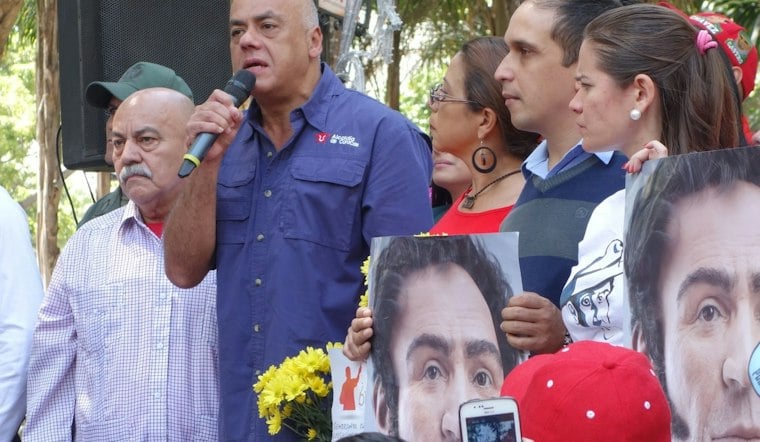
The Trump administration has removed Jorge Rodríguez, brother of Venezuela's acting president Delcy Rodríguez, from its list of sanctioned individuals, stripping away financial restrictions that had been in place against one of the country's most powerful political figures since 2018. The move comes as Rodríguez, president of Venezuela's National Assembly, sits at the center of ongoing negotiations with opposition factions and as Washington continues deepening its cooperation with the interim government his sister now leads.
The Treasury Department's Office of Foreign Assets Control announced the delisting of Jorge Jesús Rodríguez Gómez, who had been on the Specially Designated Nationals list since the United States first sanctioned him in September 2018, according to the Miami Herald. At the time, Washington accused Rodríguez and other Maduro allies of helping the former president consolidate his grip on power. The Treasury notice included his November 9, 1965 birth date, his Venezuelan identification number, and five name variations used to identify him, but it did not explain the reasoning behind his removal or indicate whether it was connected to Venezuelan cooperation with U.S. authorities, the Herald reported.
Jorge Rodríguez's delisting follows his sister's own removal from the sanctions list on April 1, 2026, six months before his, according to Venezuelanalysis. Delcy Rodríguez described her own removal at the time as a key step toward normalizing relations, having originally been sanctioned alongside her brother back in 2018. The pattern reflects what the Herald describes as Washington's growing cooperation with the government she now heads.
A Brother's Long Climb Through Chavismo's Ranks
Jorge Rodríguez is no minor functionary. He served as Venezuela's vice president under Hugo Chávez in 2007, later became mayor of Caracas's Libertador municipality, and in 2017 was named Maduro's minister of communication and information, per the Miami Herald's reporting. He has since held several senior government posts and is now described as a central member of his sister's leadership team, wielding pivotal political leverage over the country's democratic transition.
That leverage is on full display this week. Rodríguez leads the government's negotiating delegation in U.S.-backed talks with opposition factions that resumed Wednesday to discuss judicial and electoral reforms, according to Investing.com. The discussions are focused on reforming Venezuela's top courts and electoral authority ahead of planned national elections, the outlet reported.
Cooperation on Corruption Cases
The delisting arrives days after a separate but related development in Washington's dealings with Caracas. Colombian businessman Álvaro Pulido Vargas, a longtime associate of Maduro financier Alex Saab, arrived in Miami earlier in the week to face federal money laundering charges stemming from allegations involving nearly $2 billion in Venezuelan government funds, the Miami Herald reported. The U.S. Department of Justice says the charges trace to roughly $1.6 billion in corrupt Venezuelan food distribution contracts.
Pulido had been imprisoned in Venezuela since 2023 in connection with the PDVSA-Cripto corruption investigation before his transfer to U.S. custody, the Department of Justice said. Colombian outlet El Tiempo reported that DEA agents removed Pulido from a Venezuelan prison with the consent of Delcy Rodríguez's government, according to the Herald's account of that report. The Herald notes that the delisting of Jorge Rodríguez does not, on its own, establish that Treasury cleared him of the allegations underlying his original designation, nor does it confirm that every legal restriction tied to him has been lifted.
Energy Deals Underpin the Diplomatic Thaw
The sanctions relief fits into a broader transactional relationship that has taken shape since Maduro's removal from power in January 2026. The U.S. and Venezuela's interim government signed a bilateral energy agreement on August 28, 2026, granting 100-year concessions over 17 Venezuelan oil fields holding an estimated 65 billion barrels of proven crude, according to a White House fact sheet. The framework involves North American Blue Energy Partners and grants the U.S. government a 35 percent equity stake in its corporate parent.
Under that same framework, the U.S. Department of State secured guaranteed rights to purchase 20 percent of off-take production at cost from those fields, aimed at refilling the Strategic Petroleum Reserve, which had fallen below 300 million barrels by early August, PBS reported. U.S. reserves had dropped by more than 100 million barrels during 2026 amid rising gas prices and foreign energy market disruptions, according to the same report. Venezuela holds the world's largest proven crude reserves at an estimated 303 billion barrels, roughly 17 percent of global supply, though infrastructure decay and mismanagement had restricted national output to between 1.1 and 1.25 million barrels per day by mid-2026.
Skepticism Over What the Sanctions Relief Actually Buys
Not everyone views the delisting as a sign of genuine reform. Many Venezuelans, particularly opponents of Maduro, see Delcy Rodríguez's leadership as a continuation of the same authoritarian system, with critics tying her to political repression, economic devastation and the exodus of millions of Venezuelans, the Miami Herald reported. Those critics worry that deepening U.S. engagement may end up preserving the very political system Washington once sought to dismantle.
The original 2018 sanctions against Jorge Rodríguez were imposed alongside designations of Delcy Rodríguez, Cilia Flores and Vladimir Padrino López, with the Treasury Department at the time accusing the Maduro government of systematically looting Venezuela's wealth and using loyal officials to maintain political control. A 2018 Treasury statement identified both Rodríguez siblings as senior officials placed in influential government positions by Maduro. Treasury had said then that sanctions were meant to change behavior rather than serve as permanent punishment, and could be lifted for officials who restored democratic order, renounced human rights abuses and helped fight corruption — though the Trump administration has not specified whether Jorge Rodríguez met any of those conditions, according to the Herald.
Delisting generally lifts asset-blocking restrictions and the prohibition on U.S. persons transacting with a designated individual, restoring access to banking services, though other legal restrictions may still apply under separate laws, the Herald noted. Delcy Rodríguez herself addressed the 81st Session of the United Nations General Assembly in September, declaring a democratic transition for Venezuela and meeting privately with President Trump on the sidelines, according to The Guardian — the first visit by a Venezuelan head of state to the U.S. since 2018. Whether that transition yields genuine elections or simply reshuffles the same apparatus under new management remains the open question hanging over Jorge Rodríguez's negotiating table.





