

























































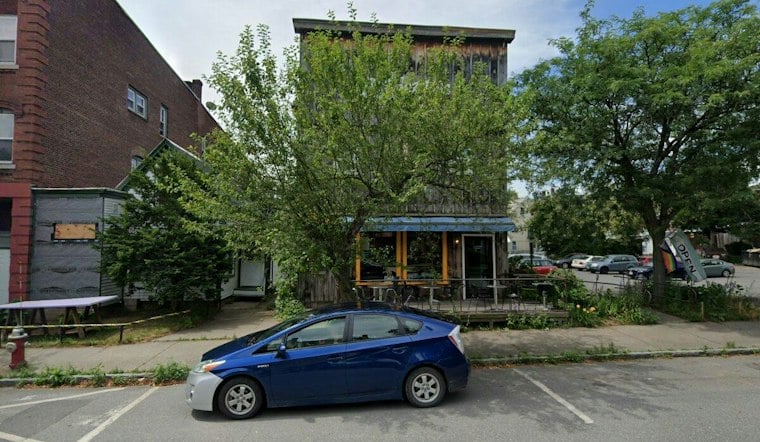
The owners of The Rendezvous, the longtime restaurant and bar in downtown Turners Falls, are moving to sell the business to a mix of employees and community members who would run it as a multi-stakeholder cooperative. About 10 of the bar's roughly 25 full-time and part-time workers plan to buy ownership stakes for $1,000 apiece, giving them a vote in the business and the chance to run for its board.
The plan, first reported by The Shoestring, would see current owners Chris Janke, Emily Brewster and Mark Wisnewski step back from a business they bought, renovated and reopened in 2007. The Rendezvous and its assets, which include the building and an upstairs residential apartment, were appraised at $690,000, and the owners have agreed to sell everything to the new cooperative for $590,000, according to the outlet.
Financing the sale will require piecing together several funding streams. The Cooperative Fund of the Northeast may loan the cooperative $390,000, leaving about $200,000 to be raised from the community, per The Shoestring's reporting. The deal has been in the works for years: discussions about converting the Voo into a cooperative began back in 2018, but the effort was sidelined by the COVID-19 pandemic before resuming.
Why Workers Are Buying In
Sage Thames, the Rendezvous's front-of-house manager, is among the employees planning to buy a stake and work while paying it off. She told The Shoestring that the cooperative arrangement could give employees more control over the business, and said collective ownership could help address the staffing and scheduling problems that often drive burnout in the service industry.
Cambrie Carme, who has worked at the Rendezvous since 2017, also plans to buy in, the outlet's report notes. Employees who choose not to buy a stake will keep their jobs but won't have voting rights on cooperative decisions, while co-owner Chris Janke said the owners simply want the workers' efforts to be rewarded, according to The Shoestring.
Current owner Emily Brewster said the owners intend to stay on and support the transition for as long as they're needed, the same report states, with managers and staff continuing to handle most day-to-day operations in the meantime. Wisnewski, meanwhile, described the Rendezvous as a cornerstone of downtown Turners Falls, per the outlet's account.
How the Cooperative Would Be Run
Under the proposed structure, the cooperative would be overseen by a five-member board: three worker-owners elected by their colleagues and two community stakeholders elected by at-large members, The Shoestring reports. Community membership would require a one-time $200 contribution, and members could vote on major decisions, serve on committees and receive occasional food and drink discounts — though no member, worker or community, could own more than one share.
Getting to this point required legal groundwork. The owners spent several thousand dollars on lawyers to figure out how to transfer the Rendezvous's liquor license to the cooperative and how tip pooling among co-owners would work, and they consulted cooperative-development agencies including the Cooperative Fund of the Northeast along the way, according to the same account.
The Rendezvous has a long history in the building on Third Street, having served over its 130 years as a French-Canadian social club, a speakeasy and a local dive bar before taking its current name in the 1930s. Fran Carme owned it from the 1970s through the 1990s before Janke, Brewster and Wisnewski took over in 2007. Today it's open seven days a week for lunch and dinner and hosts live music, bingo nights and art exhibits.
Part of a Broader Co-op Push
The Rendezvous's move fits into a wider regional trend of aging business owners turning to employee ownership as a succession plan. The Northeast Transition Initiative works specifically to promote cooperatives as viable exit strategies for owners looking to retire, and the Massachusetts Center for Employee Ownership announced a new grant program this month to help cover the cost of studying whether worker ownership is feasible, per The Shoestring's reporting.
That state support tracks with a separate Massachusetts state announcement, which describes a program covering 50 percent of eligible costs — including feasibility studies, valuations, legal services and transaction planning — for businesses assessing a shift to employee ownership. Program details are further outlined on the state's MassCEO Technical Assistance Stipend Program page.
The stakes for that kind of planning are significant: as of 2023, people aged 55 and older owned 53 percent of small businesses in Massachusetts, representing roughly 68,000 companies, according to The Boston Globe. The Globe also reported that the Massachusetts Center for Employee Ownership counted 57 worker cooperatives statewide, that many avoided layoffs during the pandemic, and that a MassCEO survey found 58 percent of the state's co-ops are majority female or nonbinary while 40 percent are majority BIPOC.
Western Massachusetts has seen several similar conversions in recent years. Greenfield's Real Pickles converted from a sole proprietorship into a worker-owned cooperative in May 2013 after staff raised $500,000 from 77 local investors, with each worker-owner contributing $6,000 toward a voting share, according to a case study from Project Equity. In Easthampton, the Heavy Culture Cooperative opened in 2023 as a multi-stakeholder co-op after raising community funds to renovate and launch its venue, per The Shoestring's reporting. Not every attempt has succeeded, however — Northeast Biodiesel closed its Greenfield biofuel manufacturing facility in 2024 after 16 years of trying to make a sustainable multi-stakeholder model work, the outlet also noted.
The Cooperative Fund of the Northeast, founded in 1975, now manages a $50 million loan fund supporting 150 cooperatives across New England and New York, including River Valley Co-op, Collective Copies, Dean's Beans and Real Pickles, per the same Shoestring report. Nearby in Bellows Falls, Vermont, the Flat Iron café operates as another cooperative example in the region.





