

























































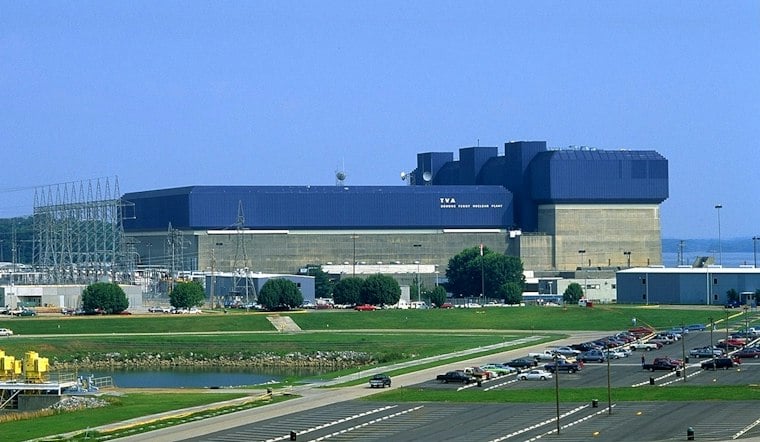
The Tennessee Valley Authority is in discussions with Trump administration officials about tapping into a $120 billion South Korean investment deal that could help fund a new nuclear reactor somewhere in TVA territory, though no site, schedule, or firm commitment has been nailed down. The talks center on a sprawling proposal to build eight new nuclear reactors across the United States using South Korean money, and Tennessee is one of several states that have been floated as a possible landing spot.
As reported by Knoxville News Sentinel reporter Mariah Franklin, TVA is weighing whether to draw on the South Korean funding package as it looks for ways to expand nuclear capacity without blowing past its own financial limits. The $120 billion South Korean investment is intended to fund eight new U.S. nuclear reactors, according to the newspaper's reporting, with two of those reactors slated to use a South Korean design and six set to use Westinghouse's AP1000 design. The arrangement, known as Project Power, lists the U.S. and South Korean governments, Westinghouse, Korea Electric Power Corporation and Korea Hydro & Nuclear Power as signatories, according to ans.org, which reported the program would deploy two APR1400 reactors alongside six AP1000 units.
No Site Has Been Chosen
Specific construction timeframes and locations for the eight reactors have not been determined, ans.org reported. Commerce Secretary Howard Lutnick named Tennessee, Kentucky, Ohio and South Carolina as possible locations at a late-September briefing, according to the Knoxville News Sentinel. TVA serves all of Tennessee and part of Kentucky, which places both states squarely within the utility's footprint even though no reactor has been assigned to either one. The U.S. government is expected to decide where the reactors will be located by the end of 2026, per the newspaper's reporting.
The $120 billion figure breaks down into $100 billion for construction costs and $20 billion reserved for contingencies, according to ans.org. The U.S. and South Korea also agreed to transfer a $10 billion advance payment by the end of the year to cover long-lead items, the outlet reported. South Korea has said it will only invest in commercially viable projects, according to asia.nikkei.com.
Federal Officials Frame It as Cost Offset
Tim Walsh, assistant secretary for environmental management at the U.S. Department of Energy, said a separate Japan trade deal is set to boost TVA's nuclear plans by up to $40 billion, and that Japan's U.S. energy investment will help offset some of the costs of nuclear expansion, per the Knoxville News Sentinel. Walsh said South Korea's investment could similarly offset those costs. The push comes as the Trump administration aims to quadruple U.S. nuclear capacity by 2050, a target that aligns with the broader industry trend the newspaper described: interest in nuclear energy has rebounded nationally as electricity demand grows amid a surge of AI data centers, according to the New York Times.
White House officials deferred questions about the arrangement to the Department of Commerce, the Knoxville News Sentinel reported, and the Department of Commerce did not respond when asked about it. The South Korean Ministry of Foreign Affairs likewise did not respond to questions about the arrangement, per the same reporting.
Why TVA Can't Simply Build It Alone
TVA officials have been candid about why the utility needs outside capital. Mike Skaggs said TVA cannot build the plants alone under the federal act because they would not meet its requirements, and he described TVA's constraints as tied to its capital needs, according to the Knoxville News Sentinel. Unlike many federal agencies, TVA relies on electricity sales rather than congressional appropriations to fund its operations, and its borrowing for projects is capped at $30 billion by federal law. TVA has already cut nearly $1 billion from operations and maintenance costs, the newspaper reported, even as it has said it supports new nuclear power.
TVA has separately estimated that the first 300-megawatt Clinch River small modular reactor could cost about $5.4 billion before tax credits and interest, according to the Knoxville News Sentinel's reporting. That figure sits apart from other estimates circulating around the broader South Korean-backed program; Reuters has put the cost of the proposed large reactors at roughly $15 billion apiece. Lazard also reported in July that nuclear power costs more to build than many other electricity-generation sources, per the Knoxville News Sentinel.
TVA's Own Reactor Project Still Awaits a Green Light
Separate from the South Korean talks, TVA is already pursuing its own small modular reactor at the Clinch River site near Oak Ridge. The Nuclear Regulatory Commission issued TVA a construction permit for a 300-megawatt BWRX-300 reactor there, but the TVA board still must approve a final commitment to build, according to enr.com. The construction permit does not authorize TVA to operate the reactor; a separate operating license from the NRC is required before it can load fuel. TVA has not announced a construction start date, and nuclear construction at the site has not begun, enr.com reported.
TVA's board previously authorized $350 million for the Clinch River project, and the utility is leading a team that applied for an $800 million federal grant to help finance small modular reactors there, according to knoxnews.com. The New York Times has reported that the first small reactor at Clinch River could cost as much as six times the price of building a comparably sized gas-fired plant, based on a previous TVA estimate. For comparison, Ontario Power Generation received Canadian regulatory approval in April 2025 to build the first BWRX-300 reactor at its Darlington site, according to enr.com.
Other states are chasing similar nuclear ambitions tied to the broader South Korean-linked reactor push. In Kentucky, a proposed project called Prosperity One could eventually include up to six Westinghouse AP1000 reactors generating a combined 6.6 gigawatts, with developers aiming to start construction in 2028 if regulators sign off, according to wkyt.com. For now, whether any of the eight South Korean-backed reactors — or TVA's own Clinch River project — ends up in Tennessee remains an open question awaiting the federal government's decision later this year.





