

























































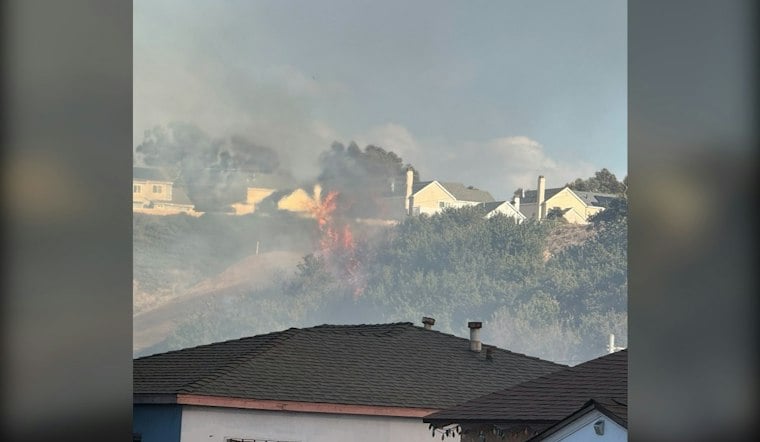
A pair of vegetation fires covering three acres broke out late Sunday afternoon near Imperial Avenue and Market Street in San Diego's Lincoln Park neighborhood, threatening nearby homes before crews managed to stop the flames. Helicopters responded immediately as ground crews worked to knock down the blaze, which has been identified as the Market Fire.
San Diego Fire-Rescue reported that crews stopped the twin ignitions before they could reach structures, though crews remained on scene near Imperial and Market Street as of Sunday evening, according to a post shared by Mayor Todd Gloria
, who retweeted the department's update. The fire's location places it squarely within the kind of terrain that has repeatedly put San Diego neighborhoods at risk: Lincoln Park sits along the South Fork of Chollas Creek, where residential streets run directly alongside natural creek channels and canyon brush, according to background compiled on
Wikipedia
.
A City Laced With Fire-Prone Canyons
The Market Fire is only the latest vegetation fire to threaten a San Diego neighborhood built against dense brush. The city contains more than 500 linear miles of wildland-urban interface where residential blocks directly border canyon vegetation and open space, according to the City of San Diego. Those urban canyons create direct pathways for flames to move from open brush toward homes, a dynamic that has played out in several recent incidents across the county, including a quarter-acre brush fire Hoodline covered near Streamview Drive late last month.
Hoodline has also reported on brush fires near I-5 in Sorrento Valley, along the SR-125 corridor in Bonita, and near Sycuan Casino in Dehesa this year, underscoring how frequently vegetation fires threaten homes across San Diego County's canyon terrain.
Defensible Space Rules Collide With a Backlog
San Diego Municipal Code §142.0412 requires 100 feet of defensible space around habitable structures near Very High Fire Severity Zones, divided into distinct management zones, per city code cited by the City of San Diego. Incoming state rules under Assembly Bill 3074 will go further, requiring property owners in those zones to maintain a 5-foot ember-resistant Zone 0 with no vegetation at all — a mandate that takes effect for new construction after February 28, 2026, and for existing homes by February 2027, the city says.
Enforcing those standards across the city is another matter. San Diego Fire-Rescue oversees 46,000 canyon-rim parcels in high-hazard zones, but limited staffing means full proactive brush inspections take more than six years to complete, according to a 2024 report from Voice of San Diego. The same reporting notes that four code compliance inspectors completed 7,411 inspections in fiscal year 2024 — a volume that illustrates the scale of the gap between the parcel count and available staffing.
Oversight of high-fire-risk land is also fragmented. A 2023 city audit found that 10 different city departments manage high-fire-risk land without a central inventory or proactive monitoring program, relying mostly on resident complaints, as reported by Times of San Diego. City-owned parcels largely depend on Get It Done user reports rather than scheduled sweeps, per that same account.
Seasonal Habitat Rules Shrink the Clearing Window
Brush management near canyons like the one bordering Lincoln Park is also constrained by wildlife protections. To shield endangered species such as the California gnatcatcher, municipal regulations prohibit brush clearing in sensitive coastal sage scrub and chaparral habitats between March 1 and August 15, limiting routine clearing work to the window between August 16 and January 31, according to the City of San Diego. Property owners hoping to clear brush on adjacent city-owned open space must also complete a Right of Entry request requiring site verification and formal approval from the City Attorney before any work can begin, the city notes.
New Equipment Aimed at Faster Response
The rapid helicopter and ground response to the Market Fire comes after San Diego Fire-Rescue had not yet added two $750,000 600-gallon brush rigs and a $14 million Bell 412 EPX helicopter to its operational fleet by August 2025; the rigs were expected to come online in fall 2025 and the helicopter by the end of November, according to Firehouse Magazine. The additions were meant to improve maneuverability and rapid water drops in canyon terrain like the brush corridors running through Lincoln Park.
The department has also been working with state regulators to update its understanding of where risk is highest. In July 2025, the Office of the State Fire Marshal and San Diego Fire-Rescue released updated Local Fire Hazard Severity Zone maps reclassifying high-risk areas across San Diego neighborhoods, according to city fire department records. Those updated maps are meant to inform both brush management enforcement and building code standards going forward.
As of Sunday evening, crews remained stationed near Imperial and Market Street following the Market Fire, with no immediate word on what sparked the twin ignitions or whether the burned parcels had undergone recent brush clearance.




