

























































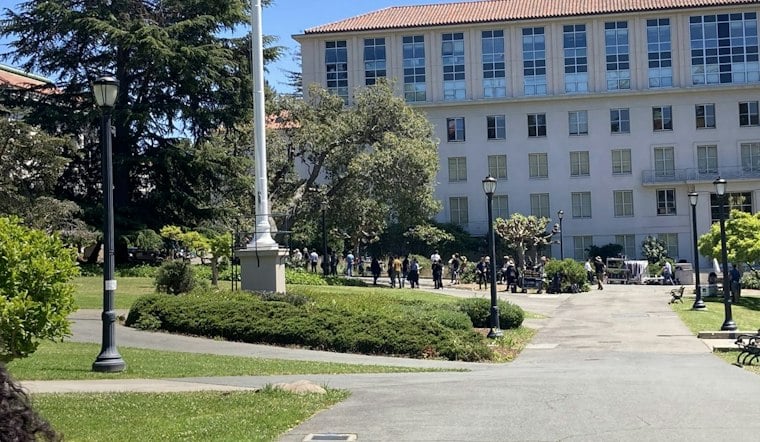
UC Berkeley is now charging new in-state students living in campus housing an all-in cost of attendance of $54,674 a year, a figure that covers tuition, room, board, fees and other expenses. It is the highest listed price among University of California campuses, and it lands at a moment when housing, not tuition, has become the single biggest driver of what students pay to attend a UC school.
The $54,674 figure comes from East Bay Times, which drew on reporting originally published by the New York Times, where writer Ron Lieber detailed how Berkeley posted an all-in price of $54,674 this year for new in-state students living in a campus residence hall. Berkeley itself describes that number differently than a sticker price: according to its financial aid office, a student's budget is the estimated average and reasonable cost of completing an academic year at the university, used to determine financial need and aid, not a fixed bill every student actually pays.
That distinction matters because UC Berkeley also says the 2026-27 tuition and fee figures underlying the total are still estimates. The financial aid office notes that final approved 2026-27 tuition and fee levels may be higher or lower than the amounts presented, pending action by the Board of Regents. And the costs are not uniform across students: financial aid reduces these direct costs and will cover the cost of tuition and fees for over a third of Berkeley students, per the same source. New out-of-state students, meanwhile, pay an additional $39,270 in nonresident supplemental tuition on top of the standard budget.
Housing, Not Tuition, Drives the Number
Housing is the real story behind Berkeley's rising total. The university's own budget estimates housing and utilities at roughly $1,609 a month over nine months, and residence-hall contracts for 2026-27 all include a $6,885 Blue & Gold Meal Plan, according to Berkeley's housing office. Those contracts also include laundry costs, the office notes. Statewide, EdSource has reported that in California, housing can cost more than tuition and fees for students — a dynamic playing out across the UC system as campuses add dorms largely financed through donations, state grants, borrowing or private-development partnerships, with student rents intended to cover the construction costs.
Berkeley is adding capacity by building a new dorm in People's Park, a small park the university has owned for decades, and has surrounded the construction site with shipping containers topped with barbed wire. Kyle Gibson, director of strategic communications for Berkeley's administration division, said he takes pride in the role new housing has played in creating competition, and the university points to falling off-campus rents on older Berkeley properties in recent years as evidence that strategy is working. UC Berkeley's Blum Center on Poverty, Inequality and Democracy, led by director and Black studies professor Gaye Theresa Johnson, published an 85-page guide to the university's housing crisis in 2024. Johnson said stable housing is fundamental to well-being and student performance.
Berkeley Leads, But Every UC Campus Is Climbing
Berkeley's $54,674 total now sits above every other UC campus's listed cost, but it is far from alone above the $50,000 mark. UC Santa Barbara lists an all-in cost of attendance of $50,946, while UC Irvine lists $50,130 for an undergraduate living off campus — Irvine guarantees on-campus housing for only two years. UC Santa Cruz estimates its on-campus cost at $48,537. Further down the list, San Francisco State lists $38,238, Cal State East Bay lists $31,555, Sonoma State estimates $31,192, and San Jose State lists $27,483.
Those UC totals dwarf the national picture. The College Board reported that average list tuition and fees at four-year public universities nationwide stood at $11,950 during the 2025-26 school year, a figure it says rose by $340, or 2.9% before adjusting for inflation, from the prior year. After inflation, the College Board notes that average net tuition and fees actually paid by first-time, full-time in-state students at public four-year schools declined to an estimated $2,300 in 2025-26. Families at California universities may pay roughly $200,000 over four years, and out-of-state students may pay over $300,000 over that span, though flagship state schools in Colorado, Connecticut, Illinois, Michigan, New Jersey, Pennsylvania and Virginia have also posted in-state undergraduate prices over $40,000 for at least some programs.
What UC Says It's Doing About Cost
The University of California has tied future tuition growth to a formula meant to keep increases predictable. For students who enter UC in 2026-27, tuition and fees will increase by inflation plus 1 percent, with total increases capped at 5%, according to the University of California. That plan pins inflation to a three-year rolling average of the California Consumer Price Index. Under UC's Tuition Stability Plan, eligible undergraduates have their tuition and mandatory systemwide fees set when they first enroll and held flat until graduation or for up to six years — though the university cautions the plan is not a guarantee, and systemwide tuition and fees may still rise if the Regents approve changes tied to unexpected shifts in the UC budget, per the Office of the Registrar.
UC also points to its aid programs to argue the sticker price overstates what most Californians pay. More than half of current California-resident undergraduates have all their UC tuition and fees fully covered by grants and scholarships, the university says, and nearly 70% of California undergrads get an average of $24,000 in grants and scholarships, according to UC's admissions office. Separately, UC Berkeley's registrar notes that tuition and fees will not be refunded if instruction occurs remotely for any part of the academic year, and UC says that establishing California residency for tuition purposes is extremely difficult for undergraduates with nonresident parents.
The Housing Squeeze Beyond Berkeley
The affordability strain shows up vividly at UC Santa Barbara, where Nicole Meng, a student team leader at the campus's Blum Center, pays $2,988 a month split three ways with roommates for a 450-square-foot one-bedroom apartment. The campus is bounded by an airport and bodies of water including the Pacific Ocean, limiting where new housing can go, and borders Isla Vista, an unincorporated neighborhood of roughly 50 square blocks that was the site of a 1970 fire at a Bank of America branch set in part over high rents. UC Santa Barbara has announced a housing guarantee extending on-campus availability for incoming undergraduates to two years, up from one, but that guarantee depends on long-planned, delayed construction of new campus residences.
Nearby private developments illustrate the cost pressure directly. Breakpointe & Coronado advertises starting rent of $1,336.65 per month per person for a shared room and is already accepting wait-list applications for fall 2027, while The Penthouse plans to begin leasing 330 apartments, town houses and duplexes in early January 2027. Willie Brown, Santa Barbara's associate vice chancellor for housing, dining and auxiliary enterprises, said university housing rates would be far below Isla Vista rents. Jasmine Hsieh, external vice president for statewide affairs for Associated Students of UC Santa Barbara, has been tracking the issue as the system works to add capacity; EdSource reports California colleges have built more than 9,000 state-supported student beds since 2021, even as about one in four California university students recently reported feeling unable to afford housing and utilities. That construction isn't cheap — a 1,423-bed UC San Diego dorm that opened in 2024 cost $260,000 per bed to build, and two Cal State Northridge residence halls that opened in 2025 cost $360,000 per bed for 200 beds.





