

























































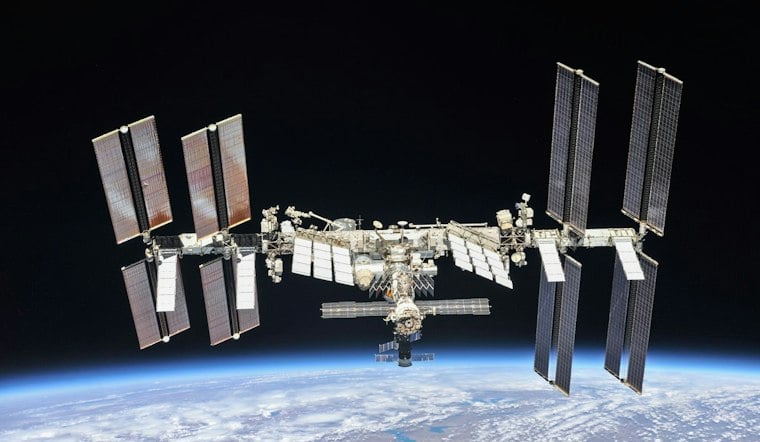
Four undergraduates from the University of South Florida built a wound-healing gel that is about to leave the planet. The hydrogel experiment is scheduled to launch from Space Launch Complex 40 at Cape Canaveral Space Force Station, Florida, aboard the SpaceX CRS-35 cargo resupply mission to the International Space Station on October 13, becoming the first USF student-designed project ever to fly to space.
As reported by FOX 13 Tampa Bay, astronauts aboard the orbiting laboratory will soon be testing the students' wound-care research firsthand. The team behind the project is led by mechanical engineering major Krystal Walford, alongside biology major Jaiden Brick and biomedical sciences majors Jade Fei and Hannah Kirschenmann, according to University of South Florida. The launch vehicle and mission timeline were also detailed by NASA, which oversees the commercial resupply flight delivering supplies and scientific payloads to the station.
A Shellfish-Derived Gel Built for Wound Care
The experimental hydrogel relies on chitosan, a naturally antimicrobial and biodegradable biopolymer derived from crustacean and insect shells, per the university's account. Chitosan's biocompatibility makes it effective for retaining moisture and delivering therapeutic agents to wounds, a property the Student Spaceflight Experiments Program highlighted when the project was selected for flight.
Researchers hypothesize that microgravity will allow the hydrogel to form a stronger, more uniform pore structure than on Earth, where gravity typically causes uneven liquid settling during gellation, the university's report notes. Understanding how weightlessness alters that biomaterial matrix formation could lead to improved wound-healing materials for both space missions and terrestrial medicine, the same account states.
Mixing Chemistry in Orbit, With an Earth-Bound Twin
Aboard the space station, astronauts will mix two liquid solutions inside a specialized tube to form the hydrogel in microgravity. After a four-week stay in space, researchers plan to compare pore structure, stability, and water retention between the space-formed sample and a preformed Earth-control sample once they return to USF laboratories.
The stakes behind the research go beyond laboratory curiosity. Extended spaceflight alters human immune function and can increase bacterial resistance, while bulky spacesuit designs heighten risk for cuts and skin abrasions on astronauts, according to a USF Research social media post. These risks highlight the importance of wound care for astronauts.
Beating Out More Than 400 Other Proposals
Getting this far required clearing a steep national bar. USF's experiment was selected as one of 20 national flight projects out of 441 proposal submissions, marking the first time a USF student-designed project will fly to space, the university reports. Eleven student teams comprising 35 USF scholars competed internally before the winning proposal was ever submitted to national reviewers, according to the university's points-of-pride accounting.
Space biotechnology company Rhodium Scientific served as the commercial spaceflight implementation partner, supplying containment hardware and spaceflight certification support for the biological payload, per the Student Spaceflight Experiments Program. USF electrical engineering professor Dr. Sylvia Thomas served as the primary faculty mentor guiding the undergraduates through the process, the university notes.
A Mission Patch From an Apollo Beach Third Grader
The payload will not travel alone. It will fly alongside a winning mission patch designed by Eeshan Kallu, a third-grade student at the Dorothy C. York Innovation Center in Apollo Beach, according to the university. USF partnered with Hillsborough County Public Schools to host a mission patch competition that drew more than 11,000 student entries across elementary and middle schools, illustrating the K-12 STEM engagement that surrounded the project locally.
The USF team's flight is part of a much larger national effort. Student Spaceflight Experiments Program Mission 21 engaged 3,663 students across 20 participating communities in North America during the 2025–2026 competition cycle, according to the program, which has flown student experiments to orbit since 2010 under the National Center for Earth and Space Science Education. Once the CRS-35 mission lifts off and the samples complete their four weeks in orbit, USF researchers will get their first chance to see whether the vacuum of space really can build a better bandage.



