

























































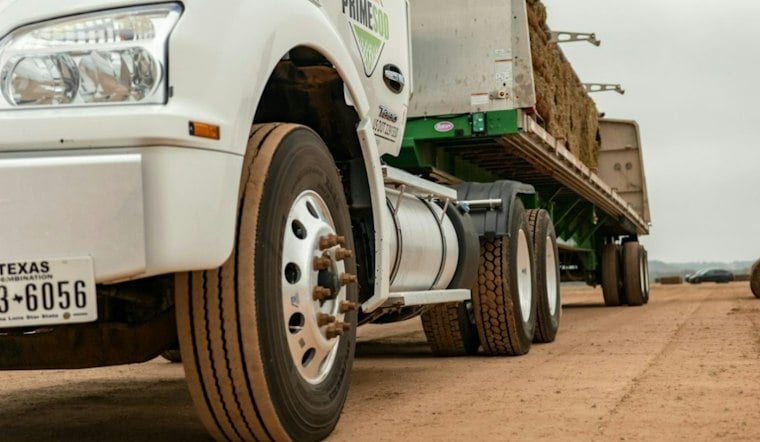
Self-driving semi-trucks built by Volvo and powered by Waabi's autonomous-driving software have started hauling freight along the Dallas-Houston corridor for logistics network Warp, marking the first customer deployment of the Volvo-Waabi partnership. The trucks are delivering freight directly to third-party facilities rather than sticking to tightly controlled routes between company terminals, with an observer currently still riding in the driver's seat.
A New Kind of Delivery for the Volvo-Waabi Partnership
Volvo Autonomous Solutions and Waabi announced Monday the start of autonomous operations for Warp in Texas, according to a news release. The Volvo VNL Autonomous, powered by the Waabi Driver, is now transporting freight directly to third-party facilities along the corridor, the companies said, calling it the first customer operation under their partnership. Warp itself is described as an open-source freight network providing both less-than-truckload and full-truckload services for shippers and carriers.
As the Dallas Express reports, the setup differs from Volvo and DSV's earlier corridor operation, which used Aurora's driving system, by pairing the truck directly with freight bound for outside facilities rather than keeping deliveries confined to terminal-to-terminal runs. Warp CEO Daniel Sokolovsky said the network brings together shipments from multiple customers and aligns routes, capacity, and timing, so progress on one lane can ripple outward to the rest of its operations. Volvo Autonomous Solutions President Nils Jaeger said the experience from the Dallas-Houston lane will help strengthen the partnership and improve the ecosystem as it scales, while Waabi co-founder Lior Ron said the Warp deployment shows autonomous freight moving beyond tightly controlled terminal-to-terminal routes.
An Observer Still Rides Along
Despite the milestone, the current hauls are not fully driverless. The companies confirmed that autonomous hauls are run with an observer in the driver's seat, and no timeline has been given for when that observer might be removed. The Volvo VNL Autonomous is built with redundancies covering six safety-critical systems, engineered to integrate autonomous-driving software from partners such as Waabi.
Volvo Autonomous Solutions isn't new to this corridor. The company previously began carrying freight for logistics giant DSV between Aurora's terminals in Dallas and Houston, using the Volvo VNL Autonomous integrated with Aurora's driving system, with a safety driver present during that initial phase, according to DSV. Volvo says it has logged more than one million miles in regional and local freight since 2023, and both companies intend for the Dallas-Houston work to form a scalable foundation they can build on for additional lanes over time.
Crowded Highway, Competing Approaches
The roughly 240-mile Dallas-Houston stretch of I-45 has become one of the most closely watched proving grounds in American trucking, drawing several companies with different technologies and operating philosophies. Waabi reported that commercial autonomous freight volumes on the corridor grew more than 80% in 2026, according to Trucknews, and the company plans to keep expanding by adding loads and customers on the lane in the months ahead.
Kodiak AI has named the same corridor — which it measures at 219 miles between the Dallas-Fort Worth and Houston metro areas — as the site of its first planned fully driverless long-haul operation. Per Kodiak, the company has delivered freight on the route with safety drivers since 2019, logging more than 3.5 million autonomous miles there, and has been running daily test drives and closed-course driverless validation since August. Kodiak's Autonomy Readiness Measure for long-haul driving stood at 93% at the end of August, with the company aiming to reach 100% before launching unsupervised driverless service by the end of 2026 — a launch it has said will include retailer Ikea, according to Trucking Dive.
Aurora Innovation has already moved further down that path, having launched commercial driverless trucking between Dallas and Houston in 2025 and later expanding its driverless runs to include nighttime driving along I-45, per Aurora. That progress hasn't been without setbacks: less than three weeks after Aurora's driverless runs began, the company paused them and put observers back in the front seat at the request of truck manufacturer Paccar, according to the New York Times. That same report notes industry estimates that a driver's salary makes up roughly 26% to 40% of the per-mile cost of operating a truck — a cost structure helping explain why the corridor has drawn so much competing investment.
Jaeger has said he expects different autonomous freight models to coexist rather than one approach winning out, telling Transport Topics that hub-to-hub and end-to-end operations will both make sense as the market develops. For now, the Dallas-Houston corridor remains a live test bed where Volvo and Waabi's observer-supervised Warp runs operate alongside Kodiak's push toward unsupervised driving and Aurora's nighttime driverless service — each company betting on a different path to the same destination.





