

























































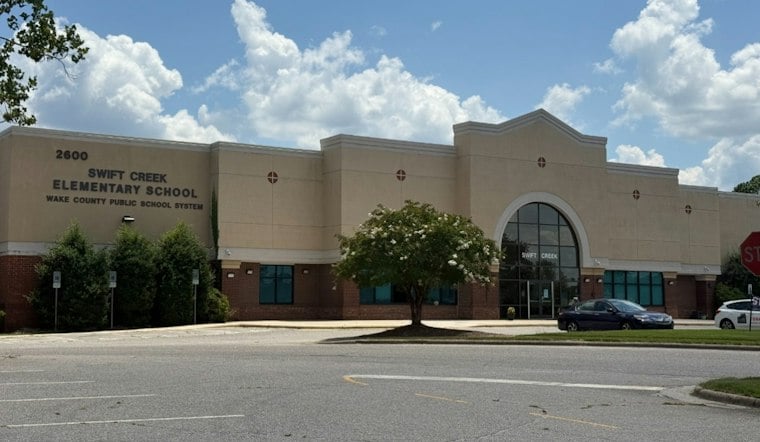
Wake County Republicans are telling voters to reject nearly every local bond on the November 3 ballot, including a combined $829 million package for Wake County Public Schools and Wake Technical Community College. It would be the first time county voters have turned down a school bond since 1999, and the party's pushback has set up a fight with business leaders and Democrats who say the money is overdue.
The Wake County Republican Party is opposing both the $680 million school system bond and the $149.1 million Wake Tech bond, according to The News & Observer. Party leaders argue Wake County Public Schools already receives billions of dollars in public funding, claiming the district gets 54 percent of local tax dollars and 60 percent of available state funds — figures attributed to the Wake GOP's own statement, as reported by the News & Observer. The party is urging a no vote on the school bond specifically, while also opposing every other county and local bond on the ballot this cycle.
Supporters see it differently. Melanie Dubis, co-chair of Friends of Wake County — a group formed by the business community — said the school bond remains necessary and is the best way to fund critical needs, per the News & Observer's reporting. The $680 million bond is just one piece of a larger $832.3 million construction program, since Wake County Commissioners also committed $152.3 million in pay-as-you-go cash funding on top of the bond request, according to Wake County Public Schools.
Where the School Money Would Go
The bond would fund three new elementary schools and major renovations at nine other campuses, along with HVAC repairs and security system upgrades, the News & Observer reports. The three new elementary campuses are planned for Marshburn Road, Poole Road, and Little Creek, while major renovations are slated for older high schools including Athens Drive, Cary, and East Wake, according to the Holly Springs Update.
One of the largest single pieces of the bond is a new Ligon Magnet Middle School facility in Raleigh, which would receive roughly 17 percent of the bond's funding, per the News & Observer. The Wake County Board of Education selected a $121.8 million plan in May to build the new campus on Ligon's existing athletic fields before demolishing the original 1953 structure, according to Wikipedia. Ligon opened in 1953 as Raleigh's only all-Black secondary school before integrating in 1971.
The Wake Tech bond, meanwhile, would fund campus improvements and an expansion of workforce training programs, the News & Observer notes. Of the $149.1 million total, $65 million is earmarked for Southern Wake Campus facility renovations and $41 million for workforce training facilities — including $20 million for public safety training and $12 million for skilled trades education — according to the Holly Springs Update. School facilities are the legal responsibility of the county, since North Carolina school districts cannot issue bonds on their own and must rely on county governments to finance capital projects.
What It Would Cost Taxpayers
Approval of both bonds would raise the property tax rate by half a cent, adding about $25 in annual cost for a home assessed at $500,000, per the News & Observer. But that's only the near-term sticker price. Wake County financial estimates project that servicing the full $829.1 million in combined school and college bonds will generate $443.1 million in total interest payments, bringing the lifetime taxpayer obligation to roughly $1.27 billion, according to the Holly Springs Update, which notes the projections use conservative interest rates reflecting the highest rates Wake County has paid on comparable debt over the past 20 years.
Backers of the bonds point to the physical state of the district's buildings as justification for the cost. Wake County Public Schools entered 2026 with an estimated $800 million deferred maintenance backlog, including $200 million in needed HVAC repairs, after 46 school closures or early dismissals tied to air conditioning failures during the 2024-2025 school year, according to the John Locke Foundation.
A Crowded Ballot Beyond the Schools
The school and Wake Tech measures aren't the only bonds on the table. Raleigh voters will also decide on a $101.5 million transportation bond and a separate $101.5 million affordable housing bond, while Knightdale voters weigh a $55 million parks and recreation bond, per the News & Observer. The Raleigh transportation bond includes $51.5 million for three road corridor projects — Marsh Creek Road, Ebenezer Church Road, and Southern Bus Rapid Transit general-purpose lanes — with the rest going toward bike lanes and pedestrian safety improvements, according to the City of Raleigh, which estimates the package can be issued without raising the city's municipal debt service tax rate.
On the housing side, Raleigh's previous $80 million bond, approved by voters in 2020, funded the construction or preservation of nearly 2,500 affordable residential units over five years, according to INDY Week. Our earlier coverage of Raleigh's housing debate detailed how some activists had initially pushed for a $200 million bond before the final $101.5 million figure took shape.
The Wake County Democratic Party has endorsed all five county and local bond measures on the ballot, per the News & Observer. Wake County Republicans, by contrast, oppose all of them. Cary voters rejected affordable housing and parks bonds in 2024, and Zebulon voters rejected a transportation bond that same year — but Wake County voters themselves haven't rejected a school bond since 1999, a streak that includes the $530.7 million bond passed with 71 percent support in November 2022, according to EdNC.
A Statewide Question Looms Too
Adding another layer to the debate, North Carolina voters will also decide on a statewide constitutional amendment on the same November 3 ballot that would impose constitutional limits on local property tax increases, according to the Holly Springs Update. Fiscal analysts cited by the outlet note that capping local property tax growth could constrain future local bonding and debt-servicing options, tying the fate of this year's county-level bonds to a broader statewide fight over how much taxing power cities and counties should retain going forward.





