

























































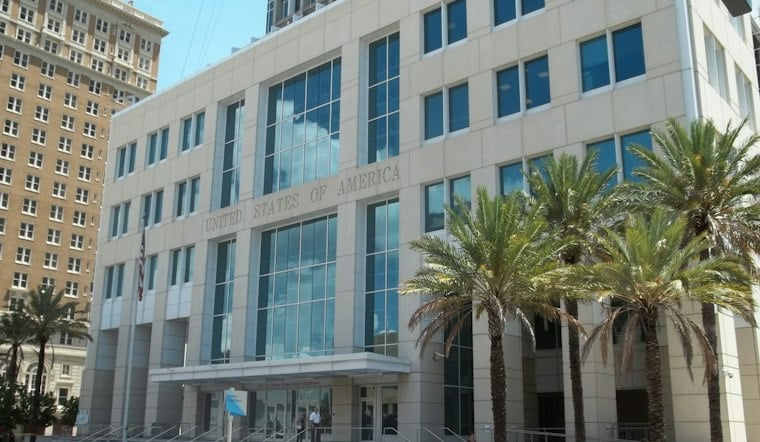
A federal correctional officer from Webster, Florida is facing criminal charges after a grand jury indicted him on allegations that he accepted a bribe and provided contraband to a federal prisoner. Weston Burney, 34, was charged with one count of receipt of a bribe by a public official and one count of providing contraband to a federal prisoner, according to a Justice Department announcement.
The indictment was announced by the U.S. Attorney's Office for the Middle District of Florida
, whose official account, based in Tampa, posted news of the charges and tagged both the Department of Justice Office of Inspector General and the Federal Bureau of Prisons in the announcement. The social media post offered only the bare outline of the case: that Burney, as a correctional officer, had received a bribe and provided contraband to a federal prisoner. Beyond that headline-level description, the office's announcement did not detail the alleged bribe amount, the type of contraband involved, the facility where Burney worked, or when the alleged conduct is said to have occurred.
An indictment is merely a formal accusation, not a finding of guilt, and no information was available regarding Burney's arrest status, any plea, or whether he remains employed by the Bureau of Prisons.
A Pattern of Similar Cases in Florida's Prison System
Burney's case is not the first time a correctional officer in Florida's federal prison system has faced this kind of allegation. In February 2025, a Bureau of Prisons correctional officer assigned to FCI Coleman Medium was arrested following a grand jury indictment on bribery and contraband-introduction charges, according to the DOJ Office of Inspector General.
In a separate Ocala case, Cornelius Alexander Thompson, 38, pleaded guilty to one count of sexual abuse of a person in federal custody and one count of receiving a bribe as a public official, as reported by WFTV. That case alleged Thompson accepted money to smuggle contraband into the prison between January 2020 and April 2024, the outlet reported.
Contraband Cases Surface Beyond Florida Too
Similar allegations have surfaced in other states this year. In South Carolina, a federal grand jury indicted correctional officer Joseph Templeton on charges of smuggling contraband and bribery at a federal prison, according to WYFF. Officials alleged Templeton accepted more than $60,000 in bribes from an inmate and the inmate's associates in exchange for smuggling in cellphones, cellphone accessories, cigarettes and THC.
In California, former correctional lieutenant Matthew L. Madsen pleaded guilty to taking bribes and smuggling contraband into Salinas Valley State Prison in exchange for roughly $100,000, per KSBW. That report said Madsen worked with others, including at least one inmate and one person outside the prison, from January 2023 through February 2025, ultimately receiving more than $95,000 through cash payments and wire transfers.
Why Contraband Keeps Showing Up in Prison Oversight Reports
Cases like these point to a persistent vulnerability in the federal prison system. The Government Accountability Office analyzed Bureau of Prisons policies and data from October 2013 through February 2025, according to a GAO report. The DOJ Office of Inspector General separately identifies contraband such as cellphones and illegal drugs as a critical threat to the safety and security of Bureau of Prisons inmates and staff.
A prior oversight review found that the Bureau of Prisons lacked a comprehensive system for tracking contraband and had not effectively implemented a 2013 staff-search policy meant to deter employees from introducing contraband, according to a report from oversight.gov.
What Burney Could Face Under Federal Law
The contraband charge against Burney falls under 18 U.S.C. § 1791, which prohibits providing or attempting to provide a prohibited object to a prison inmate in violation of a statute, rule or order, according to the U.S. Department of Justice's Justice Manual. Prohibited objects under the statute can include firearms, controlled substances, weapons, alcoholic beverages, phones and other items that threaten prison security. The Justice Manual notes that the statute authorizes up to 10 years in prison for offenses involving a firearm or destructive device and up to 20 years for offenses involving specified controlled substances.
No information was provided about Burney's attorney, any scheduled court appearances, or how the case will proceed. The charges remain allegations at this stage, and it will be up to the court to determine whether the government can prove them.


