

























































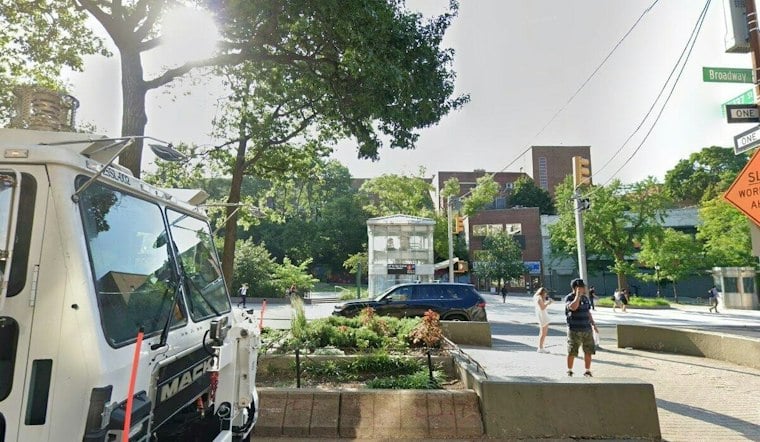
Nearly seven thousand riders a day pass through West Harlem's 137th St-City College station, and for 122 years every one of them had to use the stairs. That changed this week as the MTA unveiled two new elevators at the station, one on the northbound platform and one on the southbound side, finally making the stop fully step-free for the first time since it opened in 1904.
The milestone carried personal weight for Quemuel Arroyo, the MTA's chief accessibility officer, who uses a wheelchair. As reported by amNewYork, Arroyo said he had not seen the inside of 137th Street for 19 years because he was denied access, and he recalled growing up watching his mother struggle to carry his sister's stroller up the station steps.
MTA Chair and CEO Janno Lieber struck a similar note, saying accessibility was not a priority when the original subway system was designed but that the agency now makes it a priority every day, according to the same amNewYork report. The station, built by the Interborough Rapid Transit Company as part of the original subway stretch in 1904, serves as the home stop for CUNY's City College — decades before the Americans with Disabilities Act became law in 1990.
A Bundled Contract Years in the Making
The 137th St-City College overhaul was part of the MTA's $230.3 million ADA Package 4, a bundled design-build project that also funded new elevator installations at Northern Blvd in Queens, Bay Ridge-95th St in Brooklyn, and Parkchester in the Bronx, according to the MTA. The design-build contract was carried out by a joint venture of contractors J-Track and TC Electric, with Modern Elevator manufacturing and installing the vertical lift systems.
Completion was delayed by three months into late 2026 because of complex underground utility work beneath Broadway, which required sequential cable-pulling and splicing by Con Edison and Verizon, per MTA documents. Along with the elevators, the agency made the station's platforms completely ADA accessible, installed new fare arrays, and updated stairways and other structural elements. Lieber said remaining blue plywood barriers were expected to come down within a week following weekend ceiling repairs, per amNewYork's report.
Local Advocacy and a Two-Decade Push
U.S. Representative Adriano Espaillat and New York City Council Member Shaun Abreu helped coordinate local community advocacy and push for federal and city support for the West Harlem retrofit, according to Council Member Abreu. The push reflects years of community pressure for step-free access along this stretch of the 1 train — pressure that has also shaped nearby projects, including the 148th Street ramp that opened earlier this year.
The 137th Street project fits into a much larger legal and financial framework. Under an April 2023 federal class-action court settlement resolving lawsuits filed by Disability Rights Advocates, the MTA is legally required to make at least 95% of its non-accessible subway stations step-free by 2055. That same settlement mandates that the agency commit at least 14.69% of its total budget in each five-year capital plan toward accessibility projects, unless emergency capital needs arise.
Citywide Progress, and the Gap That Remains
As of July 2026, roughly 160 of the subway system's 472 stations are fully ADA accessible — about 34% of the network, according to the MTA. Per amNewYork, the agency says it has installed elevators at 49 stations over the past six years, has 34 more under construction, and has funded elevators at 60 additional stations through its $68 billion 2025–2029 Capital Plan. The MTA says it expects 75% of total subway ridership to pass through accessible stations by the time that plan wraps up in 2029.
The MTA funded the 137th Street project and upgrades to three other stations with federal dollars, amNewYork reports. Much of that federal support flows through the Federal Transit Administration's All Stations Accessibility Program, created under the 2021 Bipartisan Infrastructure Law to upgrade rail stations built before 1990, according to the Federal Transit Administration
. Separately, the city's 2021 Elevate Transit: Zoning for Accessibility framework offers private developers up to a 20% floor area bonus if they build subway elevators or donate station access easements, giving the MTA another tool outside its own capital budget.
Warnings Over Future Funding
Despite Wednesday's ribbon-cutting mood, Lieber warned that future station accessibility funding could be in doubt. He said the Trump administration has distributed only about 30% to 40% of available money in accessibility project grants, holding back the remainder without explanation, according to amNewYork. Lieber said projects the MTA applied for would not receive funding and that underspending was already affecting projects underway.
Compounding that uncertainty, a Republican-controlled Congress is pushing new surface transportation legislation that could lead to steep cuts in annual federal transit formula funding, per the same amNewYork report. For now, though, West Harlem commuters and City College students have what generations of riders before them did not: a station they can enter and leave without climbing a single step.





