

























































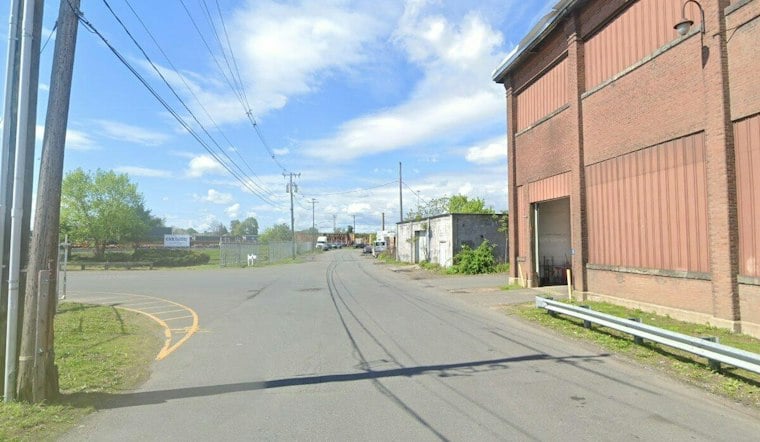
Drivers who've spent years stuck behind CSX freight trains at the Front Street rail crossing in West Springfield finally have a reason to believe relief is coming. The state has secured $30 million in federal funding to eliminate two busy at-grade crossings near the CSX intermodal terminal and replace them with a new roadway overpass connecting West Springfield and Agawam.
The funding announcement, reported by Western Mass News, moves forward a project that has been discussed in various forms for years. The plan calls for a flyover ramp connecting Second Street in West Springfield with the Vietnam Veterans Memorial Bridge, allowing traffic to bypass the Front Street railroad crossing entirely, according to MassLive. Nearly 8,000 vehicles pass through the Front Street crossing every day, per an earlier MassLive report on the project.
Why the Crossing Became a Daily Headache
The root of the problem sits more than a mile west of the crossing, where CSX trains are shuffled in and out of a rail yard. That shuffling frequently blocks the at-grade crossing, MassLive has reported, and more recent reporting from the outlet found that freight trains have blocked both the crossing and the Vietnam Veterans Memorial Bridge for more than an hour at a stretch, several times a week. Most of those blockages happen when long trains sit idle at the CSX yard while crews attach or remove freight cars, the same report noted.
Separately, WWLP has reported that rail traffic can stop vehicles at the crossing for 45 minutes to a full hour on a given day. The station also noted that the underlying problem dates back to the 1960s, underscoring just how long West Springfield and Agawam residents have waited for a fix.
Three Design Concepts, One Favorite
MassDOT presented three potential routings for the flyover ramp, labeled concepts A through C, at a public forum in June. By September, the agency had settled on a recommendation: Concept B, described as the least expensive of the three options, the same MassLive report said. All three concepts under consideration would close the existing at-grade crossings on Front Street and at the end of First Street.
The design calls for 11-foot travel lanes in each direction, along with 5-foot bike lanes and 6-foot sidewalks on both sides of the roadway. The new overpass would cross the railroad tracks with 22 feet of clearance, enough room for double-stacked freight cars to pass beneath without disrupting traffic above, per the same MassLive account.
Funding Figures and Timelines Still in Flux
Exactly how much the project will cost and when it will break ground remain open questions, with different figures surfacing across reporting over the past two years. MassLive reported in July 2024 that the effort was then described as a $20 million project, while the same outlet reported in September that MassDOT officials said the state had applied for a $38 million federal grant to eliminate the crossings — a figure that sits above the $30 million Western Mass News now reports has been secured.
Construction timing has shifted in the reporting as well. The 2024 MassLive article said construction was anticipated to start in 2027, but the outlet's September report put the likely start further out, saying construction could begin in 2029 or 2030 if design work and bidding proceed without interruption. MassDOT has said it plans to complete a 25% design, along with another round of public comments, by spring 2027.
Tied to Bigger Rail Ambitions
State and federal leaders have framed the crossing elimination as part of a larger push. According to Western Mass News, officials say the project supports MassDOT's Compass Rail program and could eventually support a future West-East Passenger Rail connection linking Albany, Springfield and Boston. The Massachusetts government's project page describes the effort as converting the crossings to a railroad-under grade separation through construction of an overpass along a new roadway alignment.
For now, the headline news is the money: $30 million toward a project that has frustrated drivers in West Springfield and Agawam for decades, with the design phase moving forward and the public set to weigh in again on the preferred routing before construction timelines firm up.





