

























































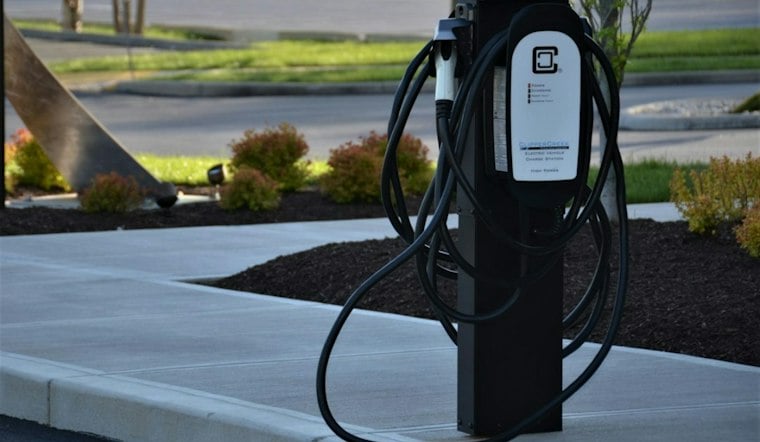
Free electric vehicle charging at Westminster's city-owned stations comes to an end Thursday, with drivers now facing a $1.50 session fee, a $0.35 per kilowatt-hour charge, and a $2 hourly idle fee that kicks in 10 minutes after a vehicle reaches full charge. The city owns three EV charging stations affected by the change: one at City Hall, one at the Downtown Parking Garage at 8855 Eaton Street, and one at 5850 Central Avenue.
The shift was first reported by The Denver Gazette, which noted that Westminster officials did not respond to an email and phone message seeking comment on why the city made the change. The city had previously promoted up to four hours of free charging across multiple public sites, according to the City of Westminster, which lists roughly 35 charging stations within city limits overall, including the Westminster Station Parking Garage at 6995 Grove Street.
Reaction on Instagram was largely negative toward the new fees and the loss of free downtown charging, per the Gazette's reporting. The Eaton Street garage is more than just a charging stop — the city runs an electric vehicle car-share service there in partnership with Colorado Carshare, housing shared rental EVs on the garage's first floor as part of a broader multi-modal parking hub downtown.
How Westminster's New Fees Stack Up Against Adams County
Westminster isn't the first Front Range government to end free charging, but its new rates land well above what drivers pay just next door. Neighboring Adams County ended 12 years of free public EV charging at stations across seven locations in August, instituting a $0.15 per kilowatt-hour rate and a $0.25 per minute idle fee after a one-hour grace period, as Hoodline previously reported. Westminster's combined $0.35/kWh rate plus its $1.50 session fee is more than double that residential-adjacent benchmark, while its $2-per-hour idle fee is lower than Adams County's $15-per-hour equivalent.
The gap looks even larger against home charging costs. Local residents on Reddit's r/WestminsterCO forum flagged that charging at home runs roughly $0.11 per kWh compared to the city's new $0.35 rate, and worried the change removes an incentive for drivers to visit downtown businesses, since the Eaton Street chargers were often used by patrons of nearby entertainment venues. State data from Electric Vehicle Colorado shows average residential electricity statewide runs about 16.79 cents per kWh, while Xcel Energy's residential rates typically fall between $0.10 and $0.15 per kWh, climbing to 21.3 cents during summer peak hours.
A Regional Pattern of Ending Free Charging
Westminster and Adams County aren't alone. The City of Boulder altered its public recreation center EV charging policy back in June 2025, moving to $1 per hour for the first two hours and $2.50 per hour after that, citing concerns that free charging was being exploited by commuters rather than facility visitors rather than gym-goers, according to the City of Boulder. Boulder had previously used grants to help subsidize free public charging before transitioning to paid rates.
Market data from ChargeHub indicates that within 15 kilometers of Westminster, there are 187 public Level 2 and Level 3 charging ports as of this year, and only 21% of them still offer free charging. Free public charging, in other words, is becoming the exception rather than the rule across the metro area.
Why Cities Say They Need the Fees
Part of the financing puzzle involves how these stations got built in the first place. Colorado's state-administered Charge Ahead Colorado grant program can cover 80% to 90% of EV charging equipment and installation costs, with standard Level 2 dual-port grants capped at $9,000 per station. Xcel Energy's 2026 incentive framework separately offers commercial and public property owners rebates up to $7,085 per port, and as much as $14,170 per port in disproportionately impacted communities, to offset the cost of electrical infrastructure upgrades.
Those subsidies cover installation, but not the ongoing electricity bills, maintenance, and staffing costs of keeping chargers running — the gap municipalities like Westminster and Adams County now say their new fees are meant to close. For drivers weighing whether to go electric at all, Colorado has also expanded its Vehicle Exchange Colorado rebate, offering income-qualified residents up to $9,000 for new EVs and $6,000 for used EVs when trading in older gas vehicles, which can be combined with a state tax credit of up to $3,250 this year.


